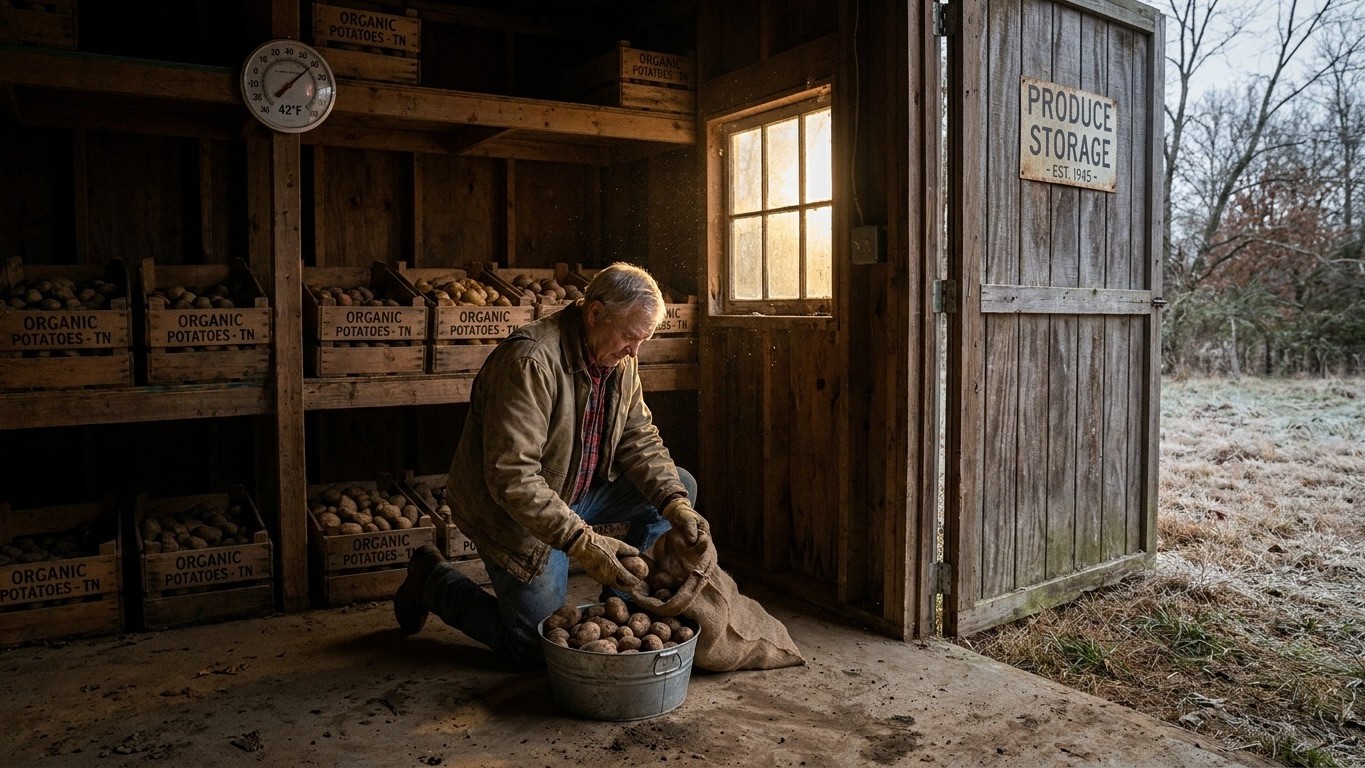

Potatoes need to be out of Tennessee ground before the first fall frost, and cured potatoes need a spot that stays near 40-45°F all winter to keep. The catch is that the mean minimum in Tennessee’s coldest month sits at 30.1°F, which means an uninsulated shed or garage won’t hold that storage range on its own. Curing and storage locations have to be chosen with that number in mind, not just picked because they’re convenient.
The short answer
Two numbers set the calendar and the risk here. NOAA NCEI’s 1991-2020 Climate Normals put Tennessee’s first fall freeze somewhere between October 28 and November 8, based on the Nashville-area station used for this data. That window is the deadline for having tubers out of the soil, since a hard freeze in the ground can bruise or blacken potatoes left in place. East Tennessee and the Cumberland Plateau run cooler and later than Nashville in spring, which pushes their whole growing season back and, in practice, often nudges harvest a bit later in the fall too.
The second number matters once the crop is out of the ground and into storage. The mean daily minimum for Tennessee’s coldest month is 30.1°F. That’s not a record low, and it’s not an average across the whole day. It’s what the thermometer tends to read on an ordinary cold night in the depth of winter, and it’s already below freezing.
That figure is the reason an unheated garage, a detached shed, or an open carport can’t be trusted to hold potatoes at 40-45°F straight through a Tennessee winter. If outdoor air is regularly bottoming out near 30°F on ordinary nights, a structure with no insulation and no heat source will track close to that outdoor temperature, especially on the coldest stretches when the actual low can drop well past the mean. A freeze inside the storage space turns starch to sugar, breaks down cell walls, and leaves potatoes soft and eventually rotten once they thaw.
The workable window, then, is this: dig before the frost dates hit in late October or early November, cure for a few weeks in a moderate spot, and store somewhere insulated enough or buffered enough (a basement corner, an interior closet, an insulated cooler) to stay above freezing even when outdoor nights sit at 30°F or lower. A garage or shed can still work, but only with added insulation or a location against an interior wall, not left as a bare, unheated box.
Curing, and where
Utah State University Extension recommends curing potatoes at 55-60°F with high humidity for 2 to 3 weeks before they go into long-term storage. In Tennessee, that window falls in October, right before the first frost dates arrive, which narrows down where curing can actually happen.
- Dig the crop before the October 28 to November 8 frost window opens for your part of the state, brushing soil off gently rather than washing the tubers.
- Choose a shaded, sheltered spot out of direct sun, such as a covered porch or an open garage bay, since full sun on a mild October afternoon can push the surface well above the 60°F ceiling.
- Spread the potatoes in a single layer and cover them loosely with burlap or a cloth to hold humidity without trapping heat or blocking airflow.
- Hold them at 55-60°F for 2 to 3 weeks, per Utah State University Extension, and check nighttime lows if the curing spot is an open porch late in the window; as the calendar gets close to the frost dates, night air can dip below that range even while days stay mild.
- If the outdoor spot cools too far below 55°F on a given night, move the batch temporarily to an interior space, a basement, hallway, or spare room, then return it once conditions warm back up.
- After 2 to 3 weeks of curing, sort out any damaged or soft tubers and move the rest into storage.
A basement is often the more reliable curing location in Tennessee, since it holds a steadier temperature through October than a porch or garage that swings with the outdoor air. A garage works fine on a mild, cloudy stretch, but it’s the least predictable of the three once nights start trending toward the frost dates.
Storing through this winter
Utah State University Extension recommends storing cured potatoes in the dark at 40-45°F. The University of Maine Cooperative Extension gives a tighter figure, 38°F at 95 percent humidity, for longer holding. Both ranges sit above freezing, and both assume the storage space can actually be held steady, which is where Tennessee’s winter climate becomes the deciding factor.
With the coldest month’s mean minimum at 30.1°F, an unheated outbuilding is working against the storage target from the start. On an average cold night, outdoor air is already below freezing before you even account for a harder cold snap. A garage or shed with no insulation will drift close to that outdoor number, which means the crop could sit right at or below freezing for stretches of the coldest month, not just on rare extreme nights.
A basement generally offers the better odds here, since below-grade space stays buffered from outdoor swings and tends to run warmer and steadier than an aboveground structure in winter. A cool, dark basement corner away from a furnace or water heater can often land close to the 40-45°F range on its own. If the only available basement space runs warmer than that near a heat source, moving storage bins to the coolest, most distant corner usually solves it.
For a garage or shed used anyway, insulation makes the difference: a wooden storage box lined with straw or old blankets, or a storage container set inside a second insulated box, buffers the crop against the outdoor low even when the space around it isn’t heated. The University of Maine’s 95 percent humidity figure also matters through a Tennessee winter, since heated interior spaces run dry; potatoes stored near a furnace vent or in a heated hallway closet can shrivel even if the temperature itself stays in range. Covering bins with a damp cloth, or adding a shallow pan of water nearby, helps hold humidity without letting the tubers sit wet.
Checking stored potatoes every few weeks catches rot before it spreads. One soft or moldy tuber left in a bin can take down its neighbors, so a quick sort through the pile periodically is worth the five minutes it takes.
What goes wrong here
- Tubers left in the ground past the frost window. Once the first freeze arrives between October 28 and November 8, tubers still in the soil risk cold damage. Watch the forecast in late October and dig ahead of any hard freeze warning rather than waiting for a fixed calendar date.
- Curing in full sun on a warm October afternoon. Direct sun can push a porch or garage floor well past the 55-60°F range Utah State University Extension recommends, damaging skin set before it has a chance to form. Curing spots need shade, not just shelter from rain.
- Curing outdoors too late in the window. As the frost dates approach, night temperatures on an open porch can drop below the curing range even while the crop still needs another week or two. Move the batch indoors on cold nights rather than leaving it exposed.
- Storing in an unheated garage or shed straight through the coldest month. With a mean minimum of 30.1°F, ordinary winter nights already sit near or below freezing, and an insulated structure isn’t automatically warm enough. Add insulation to the storage container itself, or relocate the crop to a basement.
- Storing too close to a furnace or water heater. A basement corner that runs warm defeats the purpose of storing indoors at all, and potatoes held above 45°F for weeks will start to sprout. Locate the coolest, darkest corner of the space instead.
- Dry air in a heated home shriveling stored potatoes. The University of Maine’s 95 percent humidity figure is easy to miss indoors during a Tennessee winter, when furnaces dry out interior air. A damp cloth over the storage bin or a nearby pan of water helps hold moisture without soaking the tubers.
Common questions
When should I harvest potatoes in Tennessee?
Aim to have the crop out of the ground before the first fall frost, which lands between October 28 and November 8 according to NOAA NCEI’s 1991-2020 Climate Normals. Growers in East Tennessee or on the Cumberland Plateau, where the season runs cooler and later, should watch local frost forecasts rather than relying on the Nashville-based window alone.
Can I store potatoes in an unheated garage all winter in Tennessee?
It’s risky without added insulation. The state’s coldest month has a mean minimum of 30.1°F, meaning an uninsulated garage or shed can drift to or below freezing on an ordinary winter night, let alone a harder cold snap.
How long should potatoes cure before storage?
Utah State University Extension recommends 2 to 3 weeks at 55-60°F with high humidity, using a shaded spot rather than direct sun.
What temperature and humidity is best for potato storage?
Utah State University Extension recommends 40-45°F in the dark. The University of Maine Cooperative Extension recommends 38°F at 95 percent humidity for longer-term holding. Either target requires a storage space insulated or buffered enough to stay above freezing through Tennessee’s coldest month.