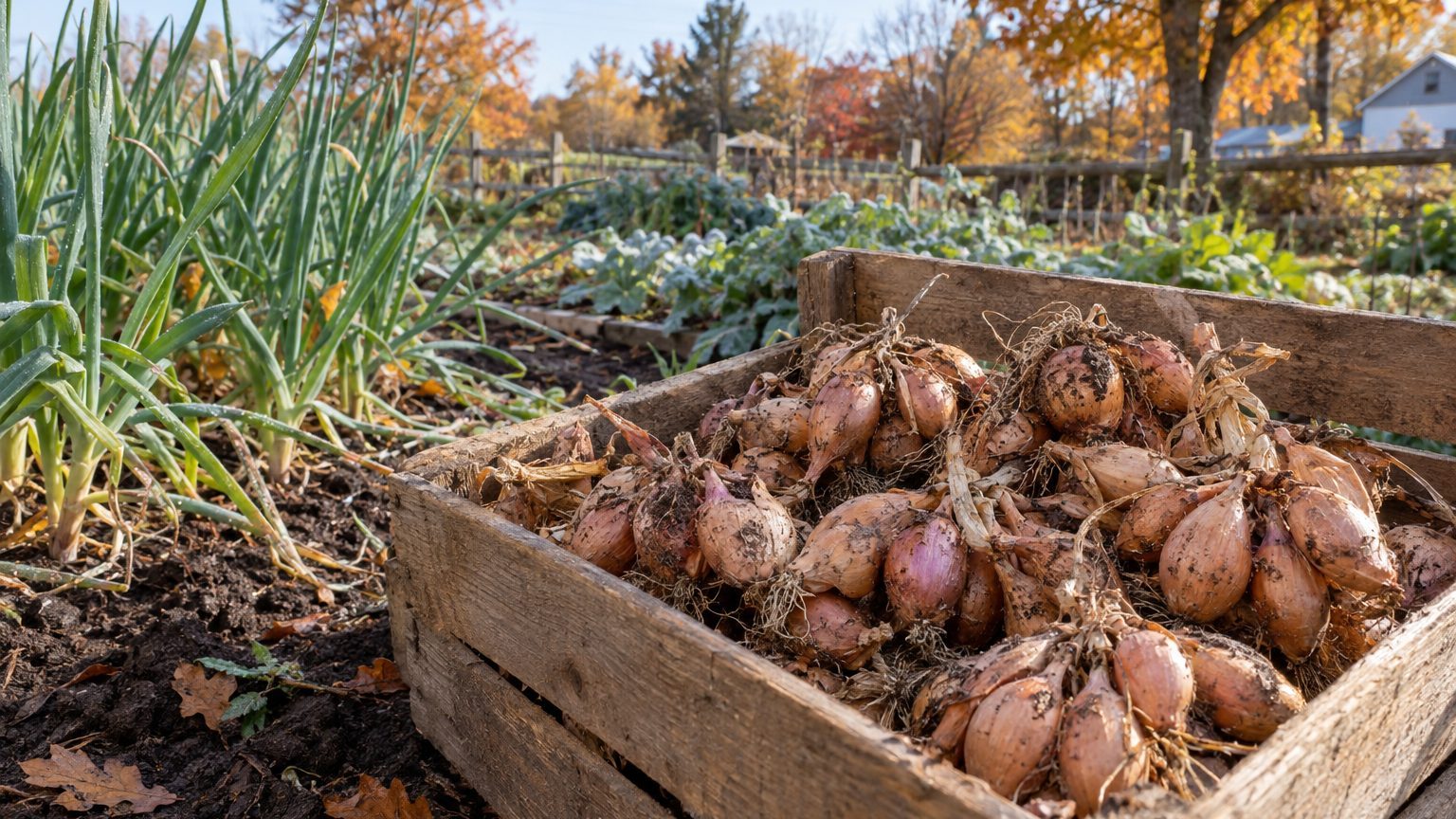

Washington’s best shallots are the multiplier types grown from bulbs, which split into a cluster of 3 to 8 bulbs at harvest. Plant them in fall west of the Cascades and in spring east of them. Seed-grown shallots, started indoors and transplanted, suit gardeners with short seasons or those who want a cheap, disease-free start.
The short answer for Washington
Pick the type first, then the variety. Which side of the Cascades you garden on settles most of the decision. At the Seattle reference station, the last spring freeze falls between February 27 and March 18, and the first fall freeze between November 13 and November 30. Those dates mark the 30 to 70 percent probability band for a 32°F freeze. The coldest month there has a mean daily minimum of 37.1°F, which is mild enough that fall-planted shallot bulbs sit through winter without freeze damage.
Which shallot type suits western Washington?
Fall-planted multiplier bulbs fit the maritime west best. They root in the cool, damp months, put up green shoots in late winter, and bulb up as days lengthen in June. Washington’s northern latitude favors long-day types, which form bulbs as daylight stretches toward summer. Look for shallots sold as storage types, because a bulb that keeps into winter is worth more than a pretty one that sprouts in November.
Which shallot type suits eastern Washington?
East of the Cascades the land is high desert with a far shorter season, so the slow route is a poor bet. Spring-planted sets or seed-grown transplants get the crop in the ground as soon as the soil can be worked. Fall planting works only in the milder eastern spots, and then with a thick straw mulch.
| Type | Best fit | Planting time | Trade-off |
|---|---|---|---|
| Fall-planted multiplier bulbs | Western Washington | Fall, for harvest the next summer | Wet winter soil can rot bulbs |
| Spring-planted multiplier bulbs | Eastern Washington, cold western sites | As soon as soil is workable | Smaller bulbs than fall plantings |
| Seed-grown transplants | Short seasons, disease-wary gardeners | Start indoors, set out in spring | More handling, single bulbs |
Exact planting dates by region are laid out in When to Plant Shallots in Washington, and the wider growing picture is in Growing Shallots in Washington.
What will not work here

A mild frost date does not mean an early planting date. In the Seattle area the last freeze can come as early as February 27, but spring soil stays cold and wet well past it, and low light holds growth back. Sets pushed into saturated ground in early March often sit idle or rot. Waiting for soil that crumbles in your hand beats following the frost date.
Why does close spacing fail in the maritime west?
Long, damp springs and falls keep foliage wet for days. Shallots crowded into tight rows hold that moisture, and fungal problems such as downy mildew and botrytis move easily from leaf to leaf. Give each bulb room in the row, and plant on a raised bed or ridge in heavy clay so winter water drains away from the bulb.
What fails east of the Cascades?
The slowest, longest-season shallots lose out where the growing season is short, because they run out of warm weeks before the tops can finish and cure. A hot, dry summer also defeats the gardener who waters once a week. Shallots have shallow roots, so on sandy or fast-draining soil a weekly soaking leaves the top few inches dry for days. Smaller, more frequent watering plus mulch does better until the tops begin to yellow, then taper off.
What about fall planting in the coldest areas?
Washington’s hardiness range runs from 4a to 9a on the USDA system, which is built on the average annual extreme minimum temperature. In the colder zones, an unmulched fall planting can be heaved out by freezing and thawing or winter-killed. The same bulb that sails through a Puget Sound winter needs either mulch or a spring planting in the high country and the northeast.
Planting too early in fall causes a different mistake on the west side. Bulbs that make a lot of top growth before winter are more likely to bolt in spring, sending up a flower stalk instead of fattening the bulb.
What changes across Washington
Washington is not one garden. The USDA Plant Hardiness Zone Map (2023, built on 1991-2020 normals) places the state anywhere from zone 4a to 9a. That spread covers mountain valleys with brutal winters and mild Puget Sound shores. No single recommendation holds across it, and the reference-city numbers above describe western Washington only.
Reading the map for your own place takes a minute. Look up your ZIP code on the USDA Plant Hardiness Zone Map and read the zone it gives for your spot rather than guessing from a neighbor’s garden. Then compare it with the rough guide below.
- Mild western zones: fall planting, mulch lightly, watch drainage.
- Middle zones in the east and foothills: fall planting works with a heavy mulch, spring is the safer choice.
- Cold northern and high-elevation zones: spring planting, or seed-grown transplants started indoors.
Elevation matters as much as latitude. A garden a few hundred feet up a slope can thaw later than one in the valley below, and cold air pooling in low spots keeps spring frosts coming late. If you are north or at altitude, shift every date later and favor the faster routes: spring sets, transplants and early-maturing types. If you are on the mild coast, move the other way and put your effort into drainage and airflow instead of cold protection.
Where to check this for your own county
The best local source is Washington State University Extension. Washington’s counties each have an office or a Master Gardener program, and those staff know which varieties have actually done well in nearby soil and weather. Look for two things there: a planting calendar written for your county or region, and any list of onion-family varieties trialled locally.
Search the site for onion, garlic or allium guidance, and check whether your county publishes its own frost dates and fall planting window. If a county office names a specific shallot as reliable in your valley, take that over any statewide pick. A county recommendation beats a state one, because a state-level answer must stretch from rainy coastal lowlands to dry eastern basins. This article is the state-level one.
Checking this against your own garden
Your own observations outrank every date here. Three things are worth watching.
Soil by feel. Squeeze a handful of soil from below the surface. If it forms a sodden ball that stays muddy, it is too cold and wet for sets. If it crumbles and feels cool rather than icy, it is ready. How early that happens tells you how well your bed drains and warms.
Green shoots. For fall-planted bulbs, note the week the first green tips break the soil in late winter. An early flush points to a sheltered, warm microclimate, and a late one means cold soil or shade.
Tops flopping and yellowing. In summer, the tops fall over and turn yellow when bulbs finish. If that comes earlier than expected, or if flower stalks appear first, your spot runs warm or the bulbs were stressed. Note the date and adjust next year’s planting.
Common questions
Can I grow shallots in Washington without a greenhouse?
Yes. Bulbs and sets go straight into the ground, and the only reason to start seed indoors is a short season or a wish to cut costs.
Is fall or spring planting better in Washington?
West of the Cascades, fall usually gives larger bulbs and an earlier harvest. East of them, and in the colder zones, spring is the safer pick.
Do shallots survive Washington winters?
Where the coldest month averages a minimum of 37.1°F, as at the Seattle reference station, bulbs overwinter without trouble. In zone 4a country, add mulch or wait for spring.
Which shallot type stores best?
Long-day, storage-type multiplier shallots. Cure them in a dry, airy spot until the necks are tight, and they keep for months.