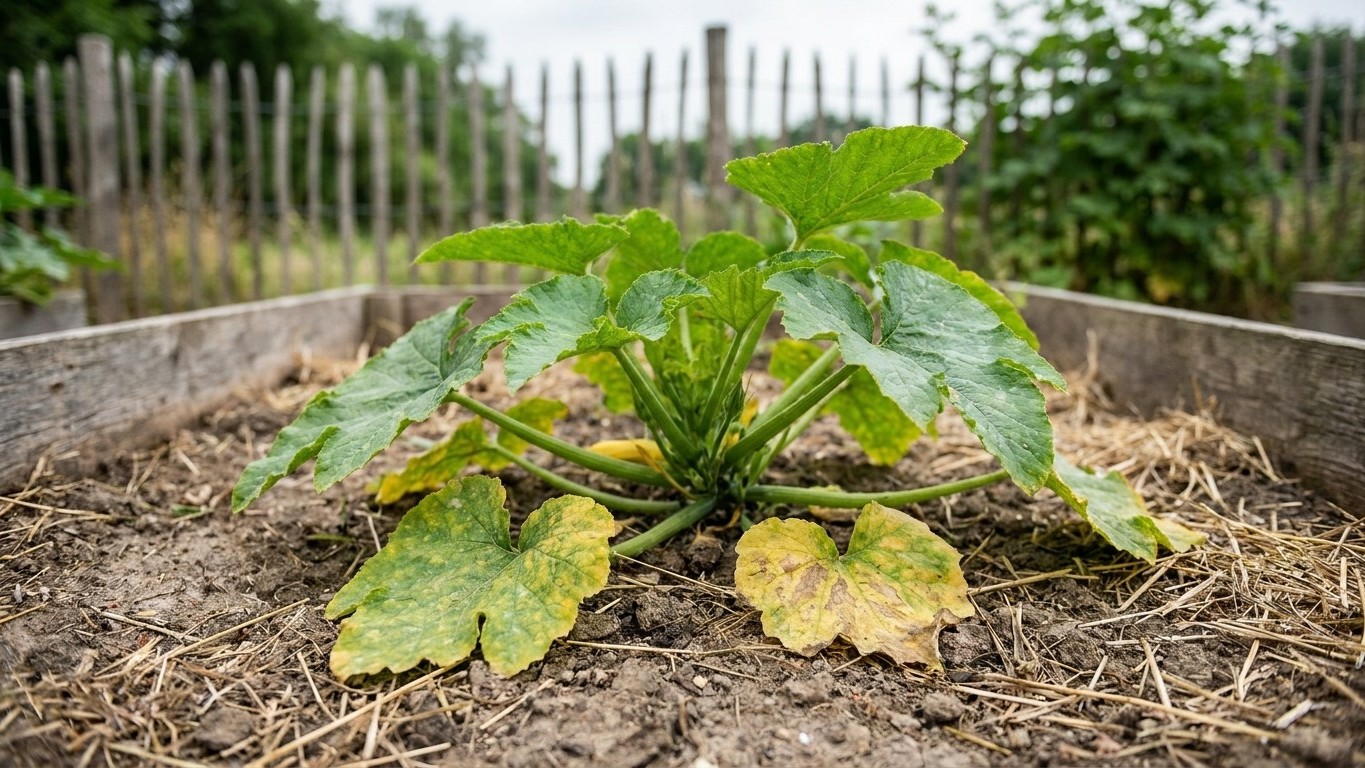

Five pests documented for West Virginia gardens actually feed on summer squash: aphids and whiteflies, cucumber beetles, flea beetles, Japanese beetle, and slugs. Cucumber beetles show up first, right as seedlings emerge. Aphids and whiteflies build through the hottest stretch. Slugs track the rain.
Which pests attack summer squash in West Virginia

WVU Extension documents eleven garden pests for this territory: Aphids and whiteflies, Asparagus beetles, Cabbage worms, Colorado potato beetle, Corn earworm, Cucumber beetles, Flea beetles, Harlequin bug, Japanese beetle, Slugs, and Tobacco hornworm. That’s the full list for the state, and it’s not a long one. Nobody padding it with extras is doing the reader a favor.
Not all eleven belong on a squash plant. Sorting them by actual host range matters more than reciting the whole list, because a gardener who spots one of the wrong bugs on a squash leaf and panics over the wrong threat wastes a season chasing the wrong problem.
Asparagus beetles stay on asparagus. They don’t cross over to cucurbits, so a beetle on a squash leaf that looks similar is something else. Cabbage worms and harlequin bug are both brassica specialists, cabbage, broccoli, kale, that kind of plant, and they have no reason to be on squash. Colorado potato beetle wants nightshades, potatoes and eggplant mostly, and largely ignores cucurbit foliage. Corn earworm targets corn ears and tomato fruit; it isn’t a squash-feeder in this territory’s documented pattern. Tobacco hornworm is a solanaceous-crop specialist too, tomato, tobacco, pepper, and it won’t be found stripping a squash vine.
That leaves five that do feed on summer squash here. Cucumber beetles, striped and spotted, are the one to watch hardest: they chew seedling leaves and stems, and they carry bacterial wilt, a disease that can take down a plant that otherwise looks fine. Flea beetles riddle young leaves with small shot-holes, mostly a seedling-stage problem. Aphids and whiteflies cluster on the undersides of leaves and multiply fast in hot weather. Japanese beetle has a broad host list and will skeletonize squash foliage along with dozens of other garden plants. Slugs go after seedlings and fruit that sits on damp soil, more a moisture problem than a heat one.
Five pests, five different feeding habits, five different windows in the season. Knowing which one you’re actually dealing with saves a trip to the garden center for the wrong fix.
When each one shows up, and what it does first
Timing in West Virginia starts with the frost window, not the calendar month. NOAA’s 1991-2020 normals put the last spring frost between April 9 and April 23 at the Charleston reference station, and squash typically goes into the ground once that risk has passed. Everything downstream of planting follows from there, and higher elevations across the state will run behind that valley timing.
Cucumber beetles are usually the first sign of trouble. They find seedlings almost as soon as the cotyledons open, chewing small pits into the first true leaves and sometimes girdling a stem at the soil line. A plant that wilts suddenly and doesn’t recover, even with adequate water, is the pattern to watch for, since that’s the bacterial wilt the beetles carry.
Flea beetles arrive around the same early window. Their damage looks different, though: a scatter of tiny round holes across a leaf, like it’s been hit with fine buckshot, rather than the ragged chewing of cucumber beetles. Seedlings with several sets of true leaves usually outgrow flea beetle pressure faster than they outgrow a beetle carrying disease.
Aphids and whiteflies build later, as the season’s heat load kicks in. The reference station averages 16.0 days a year at or above 90°F, and that heat is what drives both plant stress and aphid reproduction. Curled new growth, a sticky film on leaves, or a cloud of tiny white insects lifting off when a leaf is disturbed all point here, and it tends to be a midsummer problem rather than an early one.
Slugs move with the rain more than the thermometer. June averages 4.72 inches and July 5.38 inches at the reference station, the wettest stretch of the growing season, and that’s when slugs do the most damage to seedlings and to fruit resting on wet soil. August, drier at 3.75 inches, usually brings a letup unless the garden is getting supplemental water on a regular schedule.
Japanese beetle shows up mid-to-late summer as adults emerge and start feeding on foliage across dozens of plant species at once, squash included, leaving that lace-like skeletonized look between the leaf veins.
Telling the damage apart from everything else
A squash plant with problems doesn’t always have an insect on it. Heat stress, uneven watering, and a couple of common cucurbit diseases all produce symptoms that get blamed on bugs when the actual cause is something else entirely. The detail that decides it is usually where on the plant the damage sits, not how bad it looks.
| Symptom | Possible cause | What tells it apart |
|---|---|---|
| Sudden wilting of one vine, rest of plant fine | Bacterial wilt (from cucumber beetle feeding) or a cut stem | Cut the stem near the wilt; a milky, stringy ooze points to bacterial wilt rather than mechanical damage |
| Small round holes across many leaves | Flea beetles or hail/mechanical damage | Flea beetle holes are concentrated on younger leaves; storm damage hits all leaves evenly regardless of age |
| Leaves yellowing between the veins | Aphid/whitefly feeding, or a nutrient deficiency | Check leaf undersides for insects or sticky residue first; a deficiency shows the same pattern on every leaf at once, not scattered |
| Lace-like skeletonized leaves | Japanese beetle feeding, or drought stress curling leaf edges | Skeletonizing leaves the veins intact and visible; drought stress crisps whole leaf margins instead |
| Ragged holes in fruit or seedlings, slime trail present | Slugs, distinct from any insect chewing | Slime trails are the giveaway; insect chewing never leaves that residue |
None of that replaces a look from someone trained to do it. A county extension agent can confirm bacterial wilt or rule it out in a way a homeowner guessing from a photo can’t, and that call matters more than any home remedy tried in the meantime.
What actually works here, and what is a waste of time
The short growing season this state runs on rewards timing over any product on a shelf. Row covers put down at planting, before cucumber beetles find the seedlings, do more than almost anything applied after the fact — they physically block the beetle from ever reaching the plant during the two or three weeks it’s most vulnerable. Covers come off once flowering starts, since squash needs pollinators to set fruit.
Handpicking works for Japanese beetles on a small planting, especially early in an infestation before numbers build. Shallow containers of soapy water set at the base of plants intercept slugs overnight without needing anything sprayed at all. Straw or board traps laid flat between rows give slugs a daytime hiding spot that can be checked and cleared each morning.
What tends to waste time: spraying for aphids or whiteflies without checking leaf undersides first, since a light population usually recovers on its own once weather cools or beneficial insects catch up to it. Treating for cucumber beetle after wilt has already appeared is also too late, since the bacteria is already inside the plant by that point; the window that mattered was at planting.
- Skip any treatment aimed at a pest not actually confirmed on the plant
- Skip late-season sprays for beetle damage that’s already cosmetic
- Skip watering schedules that ignore how wet June and July already run here
Beyond timing and physical barriers, any chemical option depends on what’s registered for use in this state on this crop, and that’s a question for the extension service, not a garden blog.
Where to check this for your own county
WVU Extension is the service that documents these pests for the state, and its county offices are where a gardener confirms what’s actually showing up on a specific plant, not just what’s been recorded statewide. Find the state office and county contacts at extension.wvu.edu.
What’s documented at the state level doesn’t map evenly across the state. A garden in the Eastern Panhandle sits at a different elevation and frost pattern than one in the Kanawha Valley, and the state’s hardiness zone range runs from 5a to 7a under the USDA system, a spread wide enough that a pest pressing hard in one county might be a minor issue two counties over. The reference station behind the frost and heat figures cited here sits in a river valley; higher ground across the state typically sees frost earlier in fall and cooler summer stretches overall.
A photo of the actual damage, taken to a county office or submitted through the extension’s diagnostic system, settles more than any general list can. That’s the next step once something shows up on a squash leaf that doesn’t match a known pattern: not another search, but a call to the office that covers the actual county the garden sits in.