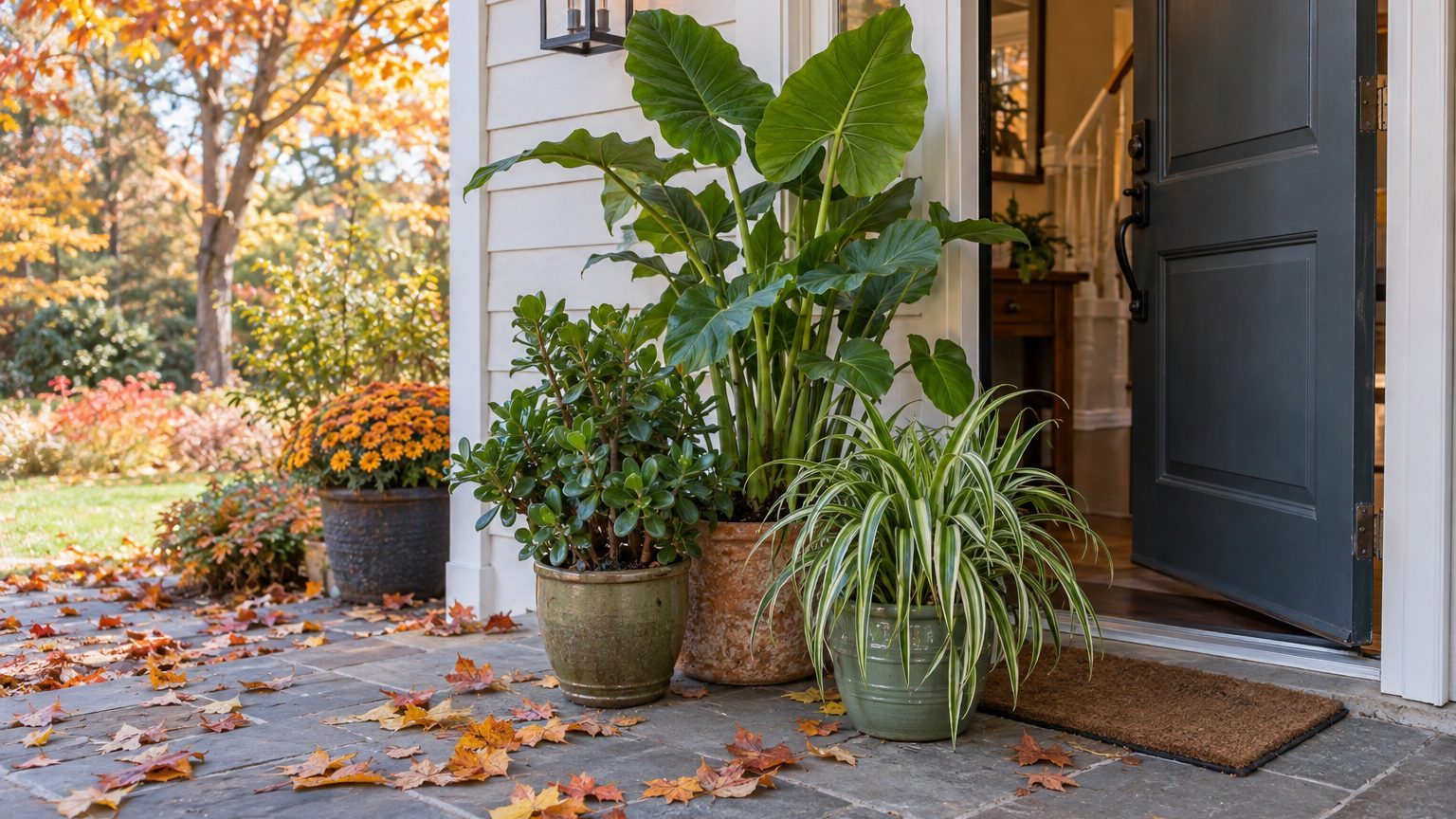

A frost warning arrives too late for a tropical houseplant. Bring your plants in when the nights turn steadily cool, in the 50s °F, and you will beat the cold rather than race it. Start watching the overnight low in your forecast now, and begin moving pots toward shade as soon as those lows settle into the 50s.
Bring them in when the nights cool, before frost

The signal is the night, not the day. A warm afternoon tells you nothing, because it is the overnight low that stresses a plant grown for indoor rooms. The extension services do not agree on a single number, so here is what each one says.
| Source | The signal |
|---|---|
| Iowa State University Extension and Outreach | Move plants when nighttime temperatures dip consistently into the 50s °F, and the same page puts the start of that dip at around 50°F |
| University of Illinois Extension | When temperatures drop below 55°F, it’s time to bring plants indoors |
| Purdue University Indiana Yard and Garden | Bring plants inside before the outdoor temperature drops to 55 F |
| Penn State Extension | Tropical plants must be brought inside before the first frost |
Reading the four signals together
Do not pick one of these as the rule. They describe the same window from different sides. Illinois and Purdue put the line at 55°F. Iowa State describes a pattern, nights that keep dipping into the 50s, and its page also mentions around 50°F as where the dip begins. Penn State gives the outer limit, the first frost, which is the point past which tropical plants are already in danger.
The practical reading is simple. Treat the first run of 50s nights as your cue to start the transition, and treat frost as a deadline you should never reach. Iowa State’s page also advises watching the weather forecast and bringing plants in well before nighttime temperatures get too cold. A forecast that already says frost is a forecast that has run out of margin.
Why you need a window, not a day
Moving a plant is not a single event. Pests need checking, and the light shift described below takes about a week by Illinois Extension’s account. If you wait for the night you are afraid of, you have no room for any of it. Start early and the work spreads out comfortably.
Your region sets how this plays out. A gardener in a cold northern state will see 50s nights arrive much sooner than one in the Gulf states, and the same plant sits outside for different lengths of time. This page is written for the United States and Canada, and the extension sources above are American, quoted in Fahrenheit as they give them. If you garden in Canada, check guidance from a Canadian provincial or university source, since the rule may differ for your climate.
Check for pests before they come inside
Everything that lived on your plants all summer comes in with them.
Treat before the move
The University of Maryland Extension puts it directly: to prevent an indoor infestation, treat your plants before you bring them in with a labeled insecticidal soap or horticultural oil. Do it outside, before the plant crosses the threshold. Read the label on whichever product you buy and follow it for the plant in question, since labels differ on which plants tolerate which treatment. Check the leaf undersides, the stem joints and the soil surface at the same time.
Keep them apart once inside
Treatment lowers the risk but does not erase it. Iowa State University Extension and Outreach advises keeping plants isolated from your other houseplants for 3 to 4 weeks once they are inside. That is long enough for a hidden problem to show itself before it reaches the plants that stayed in all summer.
Look them over regularly during that stretch. Do not merge the returning plants into your main collection until the isolation period is over.
Adjust to less light
Light is the quiet shock. A plant that spent the summer outdoors has been living in a very different world from your living room, even when it sat in shade the whole time.
How much less light there is
The University of Missouri IPM program notes that the light indoors pales in comparison to the amount of light plants encounter outdoors for the summer. Iowa State University Extension and Outreach says the same from another angle: even the brightest locations indoors are a fraction of the light intensity found in shade or part-shade locations outside. So a plant on a sunny windowsill is still getting far less than a plant under a tree on the patio.
A sudden move makes the change abrupt, which is why the sources step the light down.
Step the light down
Clemson Cooperative Extension recommends gradually reducing light levels by moving plants from sun to light shade to heavy shade and finally indoors. The University of Illinois Extension puts a timeline on it, saying to do it over a period of about a week by moving plants to increasingly shadier areas. Start that stepping-down as soon as the nights begin to cool, because it needs the same lead time as the pest check.
In practice, that means shifting pots a little farther from the open sun each day or two, then under a porch roof or dense tree, then into the house. Place them in your brightest indoor spot first. You can reshuffle later, but the first location matters most.
Stop feeding
Iowa State University Extension and Outreach says to stop fertilizing plants in the fall and winter months, as they are not actively growing this time of year. Put the fertilizer away when the plants come in.
Where to go from here
Find your own first-frost date on our page of first and last frost dates by state, then work backward. Frost is the outer limit, and the cool-night signal above arrives ahead of it. Your local county extension office can tell you how those dates behave near you.
Once the plants are in, the air changes too. Heated rooms are dry, and a running furnace will make them drier. Our page on the furnace humidifier explains how one affects the air your plants share with you.
Common questions
Can I wait until the forecast says frost?
No. Penn State Extension says tropical plants must be brought inside before the first frost, and Iowa State advises acting well before nights get too cold. A frost forecast leaves no time for pest treatment or the gradual move out of the sun.
My plant dropped leaves after I brought it in. Is it dying?
Iowa State says even the brightest indoor locations are a fraction of the light found outdoors, so a plant that has just come in is adjusting to far less light. Keep it in your brightest spot and hold off on fertilizer, as Iowa State advises for fall and winter. If it keeps declining, ask your county extension office.
Do I still need to treat plants that look clean?
Yes. Maryland’s advice is to treat before you bring plants in to prevent an indoor infestation, which means acting before you see a problem. Many pests are small or hide on leaf undersides and in the soil, so a clean look at a glance proves little.
I live in Canada. Do the same temperatures apply?
Not necessarily. The thresholds above come from US extension services. Check a Canadian provincial or university source for your region, and use your own frost date as the outer limit.
Rules and recommendations can change, so confirm current guidance with your county extension office or the official source before acting.