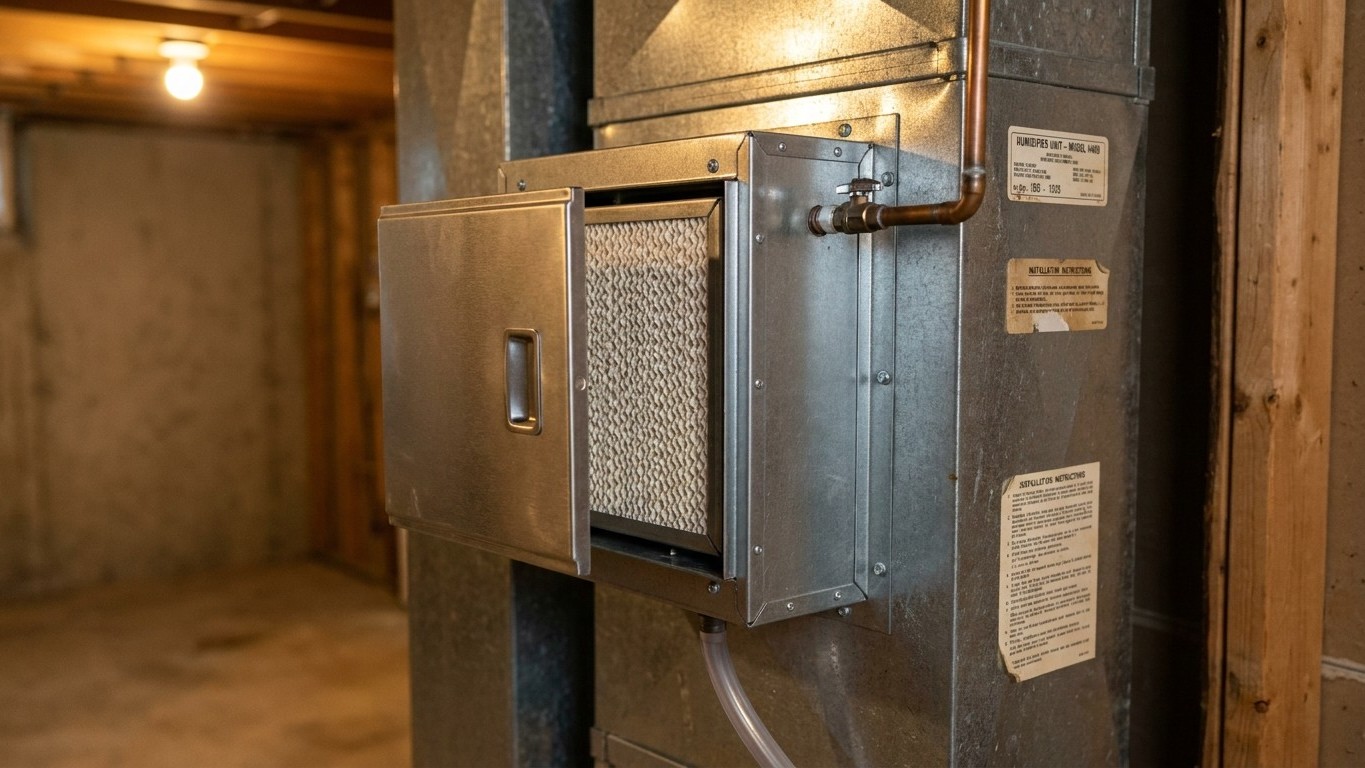

Furnace humidifier maintenance comes down to two seasonal passes and one habit of watching for damage in between. Open the unit and prep it before the heating season starts, shut off its water supply when the season ends, and keep an eye on your windows and cold corners the rest of the year. Skip either pass and the unit either does nothing or does too much.
A small appliance most owners never look at

Look beside the furnace and you’ll likely find it: a flat metal box bolted directly to the supply or return ductwork, with a small copper or plastic water line running in and a drain line running out. It’s easy to miss because it doesn’t look like an appliance at all. No display, no buttons most of the time, just a box riveted into the metal. Plenty of homeowners have lived with one for a decade without ever opening the front panel.
The mechanism inside is almost embarrassingly simple. Water is fed onto a porous pad, or in some models onto a slowly rotating drum wrapped in absorbent material, and the furnace’s own blower pushes warm air across that wet surface on its way into the house. The air picks up moisture as it passes, the way a towel dries faster in front of a fan. There’s no separate motor doing the work of humidifying and no independent fan pulling air through the unit. It rides entirely on the furnace’s airflow.
That dependency is the detail most people miss, and it explains half the service calls that start with “my humidifier isn’t doing anything.” If the furnace blower isn’t moving air, the pad just sits there wet or dry, and nothing reaches the living space. The humidistat on the wall can call for more moisture all it wants; without air moving across that pad, the call goes nowhere. A furnace humidifier isn’t really a separate climate device sitting off in a corner of the basement. It’s a passive attachment that borrows the furnace’s air the same way a dryer sheet borrows the tumbling of a clothes dryer.
Water enters through a small supply line, usually tapped off a nearby cold line, and it’s regulated either by a simple float, a solenoid valve, or a slow drip depending on the model and age of the installation. Whatever doesn’t evaporate, or whatever flushes through in a drum-style unit, runs down the drain line rather than sitting and stagnating in the box. That drain is doing more work than most owners realize, and a lot of the failures described later in this article start right there.
The pass it needs, twice a year
Furnace humidifier maintenance isn’t complicated, but it happens on a calendar the appliance doesn’t announce on its own. There are two moments that matter each year, and missing the second one is far more common than missing the first.
Start of the heating season
- Open the housing and inspect the pad or drum for scale, mineral buildup, or mold, and replace or clean it as needed before cold weather sets in.
- Check the water line and the solenoid or valve for leaks, kinks, or mineral crust that could keep it from opening properly.
- Clear the drain line of sediment so water isn’t sitting and stagnating inside the unit.
- Set the humidistat control to an active setting so the unit will call for moisture once the furnace starts running regularly.
End of the heating season
This is the step almost everyone skips. Shut off the water supply valve feeding the humidifier, and turn the control to off, not just down. A humidifier left live through spring and summer keeps adding moisture to a house that the air conditioner is actively working to dry out, which means the AC runs longer and works against a system that’s still, quietly, pumping water vapor into the ductwork. It’s a small contradiction that plays out in a lot of basements every year: one appliance drying the air, another one wetting it, both running on the same electric bill.
It’s worth being clear about what the humidifier pad is not. It is a separate part from your furnace’s air filter, and it doesn’t get touched by a filter change. The U.S. Department of Energy’s ENERGY STAR program advises homeowners to “Inspect, clean, or change air filters once a month in your central air conditioner, furnace, and/or heat pump.” That’s a monthly task tied to airflow and dust, and it has nothing to do with the humidifier pad, which is serviced on the seasonal schedule above, not monthly. Confusing the two is common, and it’s why some humidifiers run for years with a pad nobody has looked at since installation.
When it is doing harm
A furnace humidifier that’s working too well is more common, and more damaging, than one that’s failed outright. Warm indoor air can carry more moisture than cold air, so the trouble shows up right where warm indoor air meets a cold surface. That’s your window glass first, and it’s the frame and sash around it second. When the moisture load is too high for the outdoor temperature, that water condenses right there, on the coldest surface it can find.
Windows are the visible warning. What worries a building inspector more is the same condensation happening inside a wall cavity where nobody’s looking, against a cold stud or behind insulation, where it doesn’t dry out the way a windowsill does and where it can sit for weeks feeding mold instead of evaporating.
| Sign | What it usually means |
|---|---|
| Persistent condensation on windows, especially in the morning | Indoor moisture is higher than the glass temperature can handle |
| Damp patches at cold corners or exterior walls | Moisture condensing on the coldest points in the house, sometimes inside the wall |
| A musty smell, particularly near closets or exterior walls | Early sign of mold growth from sustained dampness |
| Frost forming on the inside of glass | Same condensation problem, worse, happening in colder weather |
This brief won’t hand you a target humidity number, and there’s a good reason for that: the right level shifts with how cold it is outside. What condenses on a window at 10 degrees outside won’t necessarily condense at 35 degrees, and a setting that felt fine last week can start fogging glass the moment a cold snap moves in. Rather than chasing a number, watch the signs above. If windows are sweating, corners feel damp, or that musty smell shows up, turn the humidistat down and see whether the signs clear within a day or two. If they don’t, or if you find dampness anywhere besides the glass, that’s worth a closer look at the wall itself, not just the humidifier setting.
When it does nothing at all
The opposite complaint is just as common: a humidifier that runs all winter and never seems to change anything, with dry skin, static shocks, and cracking woodwork the only feedback anyone gets. The causes are almost always mechanical, and almost always something that got missed at the start of the season.
- The water valve is still off from last spring. If the end-of-season shutoff happened but nobody reopened it in the fall, the pad simply stays dry all winter no matter what the control says.
- A scaled-up pad. Mineral deposits from hard water can coat a pad until water barely passes through it, even though the valve is open and water is reaching the housing.
- A blocked drain. If water can’t leave the unit, some designs will stop feeding new water in to avoid overflow, which quietly shuts the whole system down.
- A solenoid that no longer opens. These valves cycle constantly through a heating season, and after enough winters, they can stick closed and never let water in at all.
- A humidistat calling when the furnace isn’t running. This is the one that trips people up.
That last cause isn’t really a fault at all. On most residential setups, the humidifier only functions while the furnace blower is moving air across the pad, so during a mild winter with little heating demand, the furnace simply doesn’t run long enough for meaningful humidifying to happen, regardless of how the humidistat is set. A stretch of unusually warm weather in January can make a perfectly healthy humidifier look broken, when the real explanation is that the furnace itself has had little reason to fire.
Common questions
Does the humidifier need power year-round?
No. Turning the control to off at the end of the heating season, along with shutting the water supply valve, is part of the standard seasonal routine and prevents the unit from adding moisture while the air conditioner is trying to remove it.
Can I run the humidifier without the furnace blower on?
On most installations, no. The unit relies on the furnace’s own airflow to carry moisture off the pad and into the ducts, so it typically only humidifies while the furnace is actively running.
Is the humidifier pad the same as my furnace filter?
No, they’re separate parts with separate schedules. The air filter is checked monthly per ENERGY STAR guidance, while the humidifier pad is serviced at the start and end of each heating season.
What should I do if I see condensation on my windows?
Turn the humidistat down and watch whether the condensation clears over the next day or so. If it persists, or if you notice dampness anywhere besides the glass, that’s worth investigating further rather than just adjusting the setting again.