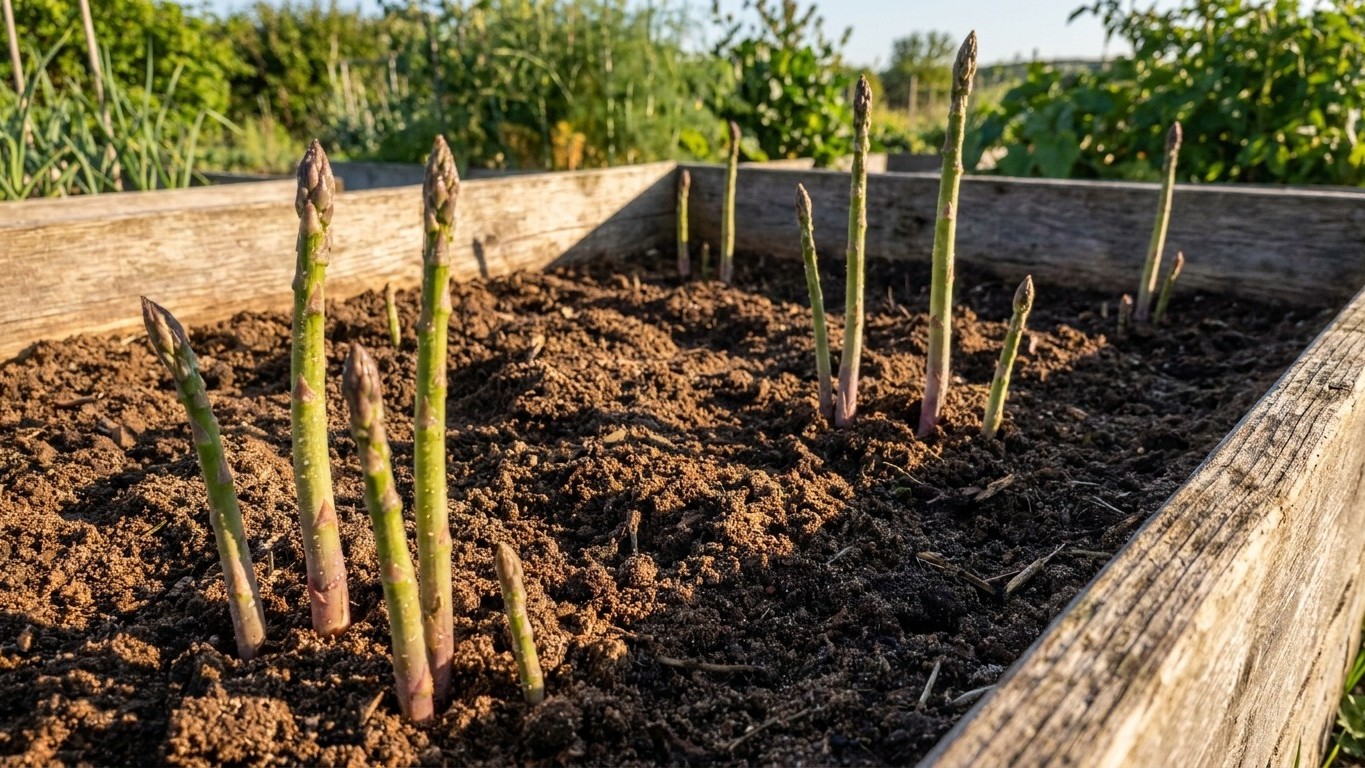

Wisconsin’s official soil, the Antigo series, is well drained loam over silt, and that single trait is the only soil requirement an asparagus bed actually has. A bed planted this spring could still be producing spears in fifteen years, provided the ground it sits in lets water pass through rather than pool around the crowns. The catch is that “Wisconsin soil” is a state average, not a promise about the dirt behind any one house.
The short answer
The Antigo series was named Wisconsin’s state soil by state law, and USDA’s own mapping data describes what it typically looks like at the surface: about 20 percent sand, 10 percent clay, and 70 percent silt, a texture that lands squarely in loam-to-silt territory. Organic matter sits around 3.0 percent, surface pH runs about 5.5 (mildly acid), and the drainage class is listed plainly as well drained. For a crop that asks for almost nothing except drainage, that’s a reasonable match. An asparagus crown doesn’t care much about fertility swings or a slightly sour pH; it cares whether its roots sit in a puddle every time it rains.
That’s the part worth sitting with. Asparagus crowns go into the ground once and, if the bed performs, aren’t dug up again for ten to fifteen years. Most soils will support the plant, as long as they’re well drained, which is a low bar for a lot of crops but a real filter for asparagus, because a badly drained bed doesn’t just underperform for a season, it stunts a planting that’s supposed to outlast a car, a roof, maybe even a kid’s time in high school.
Here’s the part the state soil can’t answer: what’s actually under a particular yard. Antigo silt loam shows up across a good stretch of central and north-central Wisconsin, but plenty of the state sits on something else entirely: heavier clay pans in old lakebed country, sandy outwash near the river valleys, or whatever mix of subsoil and fill got pushed around when a subdivision went in. None of that shows up in a state-level soil designation. A gardener whose yard turns to standing water after a hard rain is not sitting on anything like the Antigo profile, no matter what the county might be known for.
The fix, when drainage is the problem, isn’t complicated: build up instead of digging down. A raised bed or a mounded row lifts the crowns above the water table that would otherwise sit at their roots, and it sidesteps the guesswork entirely. A simple test costs nothing and takes an hour: dig a hole about a foot deep, fill it with water, and see how long it takes to drain. If it’s gone within a few hours, the ground is doing its job. If water is still standing the next morning, that’s the signal to raise the bed rather than fight the native soil for fifteen years.
Will the summer here water it for you?
Rain alone rarely covers what a young asparagus bed needs, and the gap matters most in the first two years, before the root system is established enough to coast through a dry stretch.
- What the bed asks for early on: newly planted crowns want 1 to 2 inches of water every other week for their first two growing seasons, while the root crown is still building the reserves that will carry the plant through a decade or more of harvests.
- What changes after year two: once established, the watering schedule relaxes to 1 to 2 inches roughly every three weeks, since a mature root system reaches deeper and tolerates longer gaps between soakings.
- What the sky actually delivers: the reference station’s 1991-2020 normals put summer rainfall at about 11.4 inches total across June, July and August, broken down as 4.38 inches in June, 3.4 inches in July, and 3.65 inches in August. July, the driest of the three, still edges past 3 inches on average.
- Where the numbers land: spread evenly, roughly 3.4 to 4.4 inches a month works out to something like 1.7 to 2.2 inches every two weeks, which sits right at the edge of what a young bed needs. The problem is rain doesn’t arrive evenly. A single thunderstorm can dump an inch in an afternoon and run straight off a slope, then two dry weeks follow with nothing to show for that monthly average.
- What that means on well-drained loam-silt ground: a soil like Antigo drains cleanly, which is exactly what asparagus wants, but the same trait means water doesn’t linger in the root zone waiting to be used. On this kind of ground, a dry ten-day stretch in July can leave a two-year-old bed short, even in a month where the seasonal average looks fine on paper.
None of this is a forecast for one particular backyard. Averages describe the reference station over three decades, not a lawn behind a specific garage. The only way to know if a bed is actually getting enough is a cheap rain gauge staked next to it, checked weekly through July and August, with a hose making up whatever the sky didn’t.
When to put the crowns in
Asparagus crowns go into 8-inch furrows in early spring, timed around the last frost rather than a fixed date, since a hard freeze on newly planted crowns can set the bed back before it’s even started. The 1991-2020 normals put the state’s last spring freeze (32°F) somewhere around April 16 to April 29, depending on where in the state a garden sits. That’s a mean window, not a guarantee, and Lake Michigan complicates the picture further: the lakeshore runs later into fall before its first freeze than inland spots do, which shifts the safe planting window at the other end of the season too. Treat the April dates as the general shape of spring here, not a calendar entry to plant around blindly.
Once the crowns are in the furrow, the trench doesn’t get filled all at once. Soil goes back in gradually, about 2 inches every other month across the year, rather than burying the crowns immediately under a full 8 inches of dirt. That staged backfilling gives the emerging spears room to push through loose soil rather than fighting compacted ground from day one.
Patience is the real cost of this crop. There’s no harvest in year one or year two, full stop, no matter how vigorous the fern growth looks above ground. Year three brings the first cutting, and even then it’s limited: about four weeks of harvest that first cutting year, stretching to six weeks the year after, and eight weeks once the bed is fully mature. The rule for when to stop cutting each season isn’t a date on a calendar either; it’s a visual cue, when most of the spears coming up are thinner than a pencil, that’s the signal the plant needs its energy back to build next year’s crop.
Starting from seed is the other route, though it adds a full year to that already slow climb toward harvest, since seedlings need a season in a nursery bed before they’re transplanted out as young crowns. Published guidance on the seed method’s specific timing isn’t detailed here; the early-spring window described above applies to crown planting, which is the far more common approach for a home garden.
On variety, the available information is narrower than most gardeners expect. Four names come up in extension guidance, distinguished only by their sex, not by flavor, yield, or any stated reason to prefer one over another:
- Jersey Giant (all-male)
- Jersey Knight (all-male)
- UC 157 F1 (male and female)
- Purple Passion (male and female)
All-male varieties tend to get recommended because they don’t spend energy producing seed, but that’s a general horticultural point, not something tied to a specific yield figure in the source above. No nursery or brand is named here, and none should be trusted as an endorsement if it claims to be based on this kind of extension guidance.
Common questions
Does a state’s official soil tell you what’s in your own yard?
No. It describes the soil chosen to represent the state, mapped from surface samples of its major components. Actual yards vary enormously depending on local geology, drainage patterns, and whatever grading happened when a house was built. A soil test or a simple drainage check is the only way to know what’s actually there.
What happens if asparagus is planted in poorly drained soil anyway?
The crowns can rot or the plant simply struggles for years without ever producing well, and because a bed is meant to last a decade or more, that’s a slow failure rather than a quick one. Raising the bed with a mound or a framed raised bed sidesteps the issue without needing to change the native soil underneath.
Is the soil pH here a problem for asparagus?
The Antigo series runs mildly acid at the surface, around 5.5, but the asparagus guidance cited here is silent on any preferred pH range. There’s no published figure to compare it against, so pH isn’t something this source can confirm or rule out as an issue.
Can a gardener rely on rainfall alone once the bed matures?
Established beds need less supplemental water, roughly 1 to 2 inches every three weeks rather than every two, and summer rainfall normals come reasonably close to that on a monthly average. But averages hide dry stretches, and a well-drained soil won’t hold moisture in reserve the way a heavier soil might, so a rain gauge is still the more reliable answer than assuming the sky will handle it.