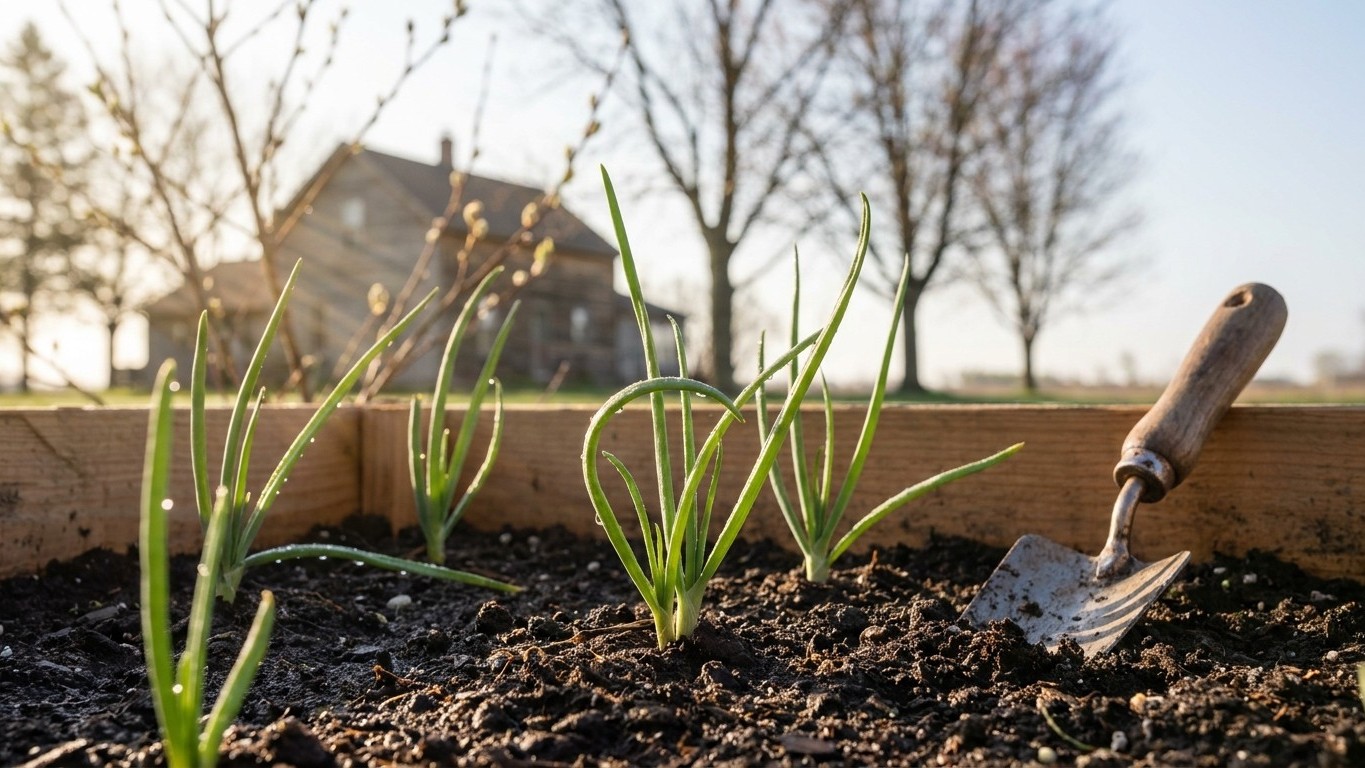

Wisconsin gardeners plant onions in late winter to early spring, not in fall. At 42.95 degrees north, the reference point for this state’s climate data, the longest day of the year brings 15 hours and 10 minutes of daylight, which is what actually tells an onion when to stop growing leaves and start forming a bulb. That number, not the calendar, decides both which varieties will work here and when to get them in the ground.
The short answer for Wisconsin

Onions respond to day length before anything else. A bulb doesn’t form because the plant is “mature enough” or because the weather warmed up. It forms when the hours of daylight cross a threshold specific to that variety’s type. At 42.95 degrees north, near the weather station that anchors these climate figures, the longest day of the year delivers 15 hours and 10 minutes of light. That’s well past the roughly 12-hour trigger for short-day onions, past the 12-to-14-hour range for intermediate types, and squarely inside the 14-to-16-hour window that long-day onions need.
What that means for timing: Wisconsin’s job is to grow the biggest possible plant before that long June daylight arrives, because whatever size the onion has reached when bulbing kicks in is roughly the size it will stay. That’s the opposite of the fall-planting approach used in mild-winter states, where onions go into the ground in October or November and spend the cool season quietly building roots and leaves ahead of a bulbing trigger that arrives earlier in the year at their lower latitude.
Wisconsin winters make fall planting a non-starter. The ground freezes hard, and small transplants or sets left outdoors from autumn wouldn’t survive to spring. So the season shifts entirely: seeds started indoors in late winter, roughly six to eight weeks before the last expected frost, then transplants moved outside in early spring as soon as the soil can be worked. Sets and nursery transplants follow the same early-spring window. Either way, the goal is the same one that drives every long-day growing region: pack in as many weeks of leaf growth as possible before mid-June daylight tells the plant to switch modes.
This is also why variety choice and planting date aren’t separate decisions here. A long-day onion started too late in spring hits that 15-hour-10-minute trigger with a small root system and few leaves, and it bulbs anyway, just smaller. There’s no waiting it out.
What will not work here
Short-day onions are the clearest mismatch for this latitude, and it isn’t a matter of them struggling. These varieties are bred to start bulbing at around 12 hours of daylight, a threshold Wisconsin blows past well before the plants have had a real growing season. The result is a full-size adult plant’s worth of energy poured into a bulb the size of a golf ball, sometimes smaller, because the plant simply ran out of leaf-growing time before it had built any size.
- Candy (intermediate-day, published range 33-40N): bulbs too early at this latitude for full size.
- Gabriella (short-day, 20-35N): triggers into bulbing while still a seedling by Wisconsin standards.
- Madalyn (short-day, 20-35N): same short-day mismatch, undersized bulbs guaranteed.
- Red Rock (short-day, 30-36N): bulbs at 12 hours, long before a Wisconsin plant reaches size.
- Red Sensation (short-day, 25-35N): built for latitudes 8 to 18 degrees south of here.
- Texas Grano 1015Y (short-day, 25-35N): a Gulf Coast onion, not a Great Lakes one.
- Vidora (short-day, 25-35N): same day-length ceiling, same outcome.
- White Castle (short-day, 30-38N): even at the top of its range, still too far south.
Plant any of these here and the pattern is predictable: leaves through most of the season, a bulbing signal that arrives on schedule regardless of plant size, then a tiny onion that stores poorly and often starts to soften before fall.
The timing version of this mistake is just as common and less obvious. Gardeners who get a late start, whether from a delayed seed order or a wet spring that pushed back transplanting, sometimes assume the harvest simply arrives later too. It doesn’t. Bulbing still starts the moment day length crosses the threshold, on the same June calendar date whether the onion was planted on schedule or three weeks behind. A late-planted long-day onion doesn’t get a later harvest. It gets a smaller one, because it had less time to build leaf mass before the trigger fired. Late planting shrinks the crop; it never delays it.
What changes across Wisconsin
The 42.95-degree figure belongs to one reference point near the middle of the state, close to Madison, and Wisconsin is not a single latitude. The state runs from roughly the Illinois border in the south, near 42.5 degrees north, up to the shore of Lake Superior in the north, past 46.5 degrees. That’s close to four degrees of spread, enough to shift both frost timing and the exact daylight hours a plant experiences.
| Location | Approximate latitude | What it changes |
|---|---|---|
| Southern border (near Illinois) | ~42.5N | Day length slightly under 15h10; soil warms and frost clears a bit earlier, so transplants can go out sooner |
| Reference city (Madison area) | 42.95N | 15h10 on the longest day; baseline for this page’s advice |
| Northern Wisconsin (near Lake Superior) | ~46.5N | Day length noticeably above 15h10; frost lingers later into spring, shortening the pre-bulbing growing window even though summer daylight is longer |
The practical effect is a two-to-three-week gap between southern and northern gardeners on when it’s safe to move transplants outdoors, even though both ends of the state need the same long-day varieties. A reader gardening near Superior or Ashland is working with a shorter frost-free stretch than one near Beloit or Kenosha, so the leaf-building window before that mid-June bulbing trigger is tighter. That’s a real constraint, not just a colder feel to the air. Two of the long-day varieties documented for this latitude, Powell (published range 43-47N) and Redwing (43-65N), sit right at this edge: they may bulb reliably in the state’s northern reaches but are worth treating as an experiment rather than a certainty for a garden near the southern border.
Sweet now, or onions that last
Wisconsin’s day length rules out short-day onions almost entirely, which also rules out most of the sweetest, mildest varieties on the market, since those tend to be short-day types built for southern growing conditions. That’s not a loss so much as a trade dictated by chemistry. The compounds that give an onion its bite are volatile sulfur compounds, and those same compounds are what protect the bulb from rot in storage. University of Missouri Extension puts it plainly: sweet varieties, as a rule, do not store as well as more pungent ones.
That pairs directly with the day-length picture. Short-day and many intermediate-day onions, grown fast under lower light thresholds, tend to run sweeter and milder, and they’re meant to be eaten within weeks of harvest. Long-day onions, grown slowly over a longer stretch of daylight the way Wisconsin’s season forces them to be, tend to build more of those sulfur compounds. Sharper in the kitchen, but they’re also the onions still firm in a root cellar or a cool basement in March.
A Wisconsin garden, by geography alone, leans toward the second kind. A handful of long-day varieties documented for this latitude, including Ailsa Craig, Blush, and Walla Walla Sweet, are bred to be milder despite being long-day types, but even these won’t rival a true short-day sweet onion at the table, and they generally still keep better. The honest expectation for a Wisconsin pantry is fewer super-sweet slicing onions in August and a steady supply of sharper, longer-lasting onions running well into late winter.
Checking this against your own garden
Every figure in this article traces back to one reference point near 42.95 degrees north. A garden four degrees north or south of that experiences a meaningfully different daylight curve and a different frost calendar, so the advice above is a starting point, not a guarantee for every yard in the state.
- Look up your own latitude if you’re gardening well north of Madison or south toward the Illinois line; a few degrees shifts both day length and frost timing.
- Confirm your local average last-spring-frost and first-fall-frost dates rather than relying on a statewide estimate.
- Call your county extension office, which tracks soil temperature and frost trends specific to your area and can flag a shorter or longer season than the state average.
- Check the day-length requirement printed on any seed packet or transplant tag against the 15-hour-10-minute figure for this latitude before buying.
- Note how close your garden sits to Lake Superior or Lake Michigan, since large water bodies can delay both spring warm-up and fall frost along the immediate shoreline.