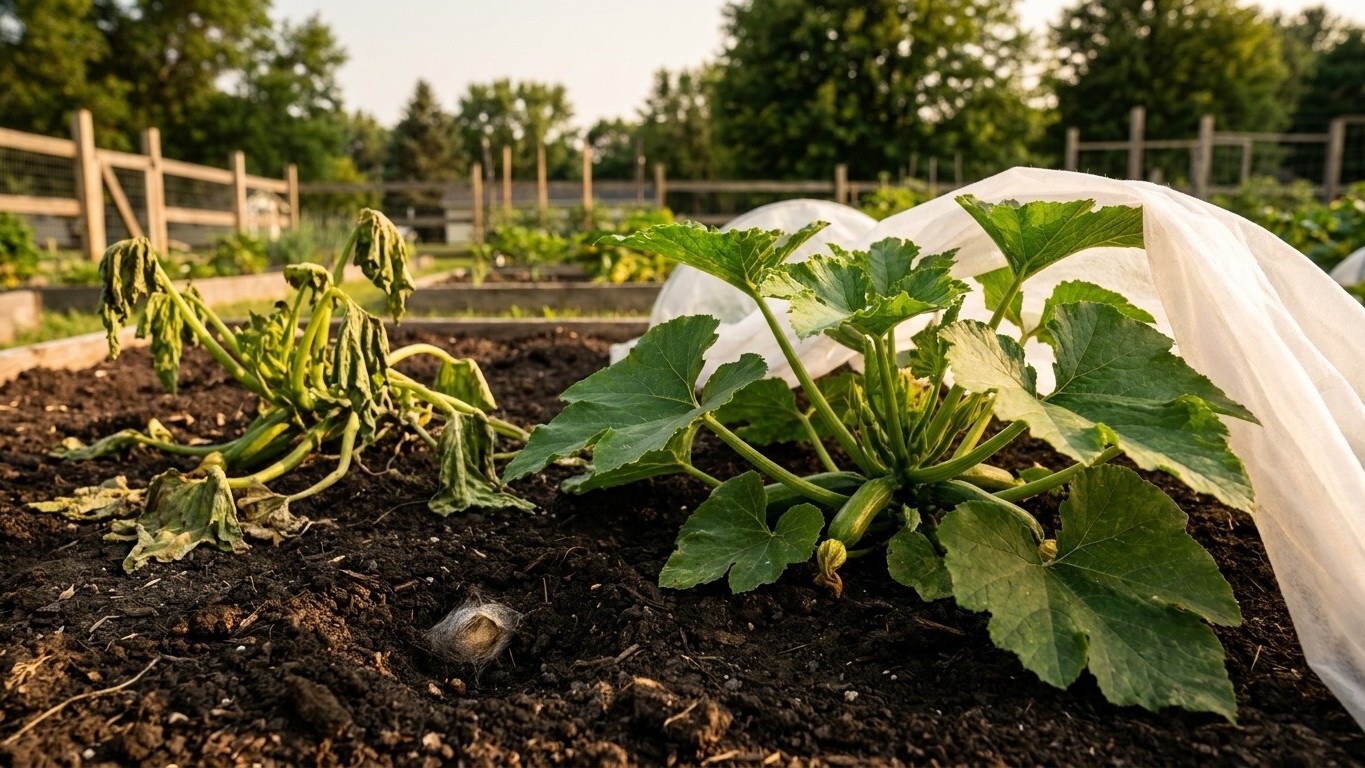

Squash vine borer moths start flying in Wisconsin from late June through mid-July, with most egg-laying happening in the first three weeks of that window. One generation per year is the rule here, unlike southern states where the pest cycles through twice. That single-generation pattern is actually good news for Wisconsin gardeners: get ahead of that late-June emergence with row covers or stem protection, and you can skip the damage entirely instead of fighting a moth that keeps coming back all summer.
The tricky part is that squash vine borer damage looks sudden even though it isn’t. A zucchini plant can look perfectly healthy on Monday and be a collapsed, wilted mess by Thursday. By the time you see that wilt, the larva has already been tunneling inside the stem for one to two weeks. Understanding the timing is what separates gardeners who lose half their squash patch from those who barely notice the pest exists.
The Life Cycle, Mapped to Wisconsin’s Growing Season

Squash vine borer (Melittia cucurbitae) overwinters as a mature larva or pupa in a tough silken cocoon, buried one to two inches deep in the soil right where an infested plant grew the previous year. That’s a detail worth sitting with: the pest doesn’t migrate in from somewhere else each spring. It’s already in your garden bed, waiting.
Adults emerge as soil temperatures warm through late spring, and in Wisconsin that typically means the last week of June into the first half of July, though a cool spring can push things later. The moth itself surprises a lot of gardeners who expect something drab. It’s day-flying, with a red-orange abdomen ringed in black and clear-ish wings that make it look more like a wasp than a moth. That mimicry is deliberate camouflage against predators, and it also means gardeners scanning for pests often overlook it entirely because it doesn’t fit the mental image of “moth.”
Females lay eggs individually at the base of squash stems, near the soil line, over a two-to-three week stretch. Each egg hatches in seven to ten days, and the newly emerged larva bores straight into the stem within hours. From that point, it feeds inside the vine for four to six weeks, hollowing out the stem tissue and disrupting the plant’s ability to move water and nutrients. That’s why a heavily infested plant wilts even when the soil is plenty moist. The pipes are broken, not the water supply.
University extension programs in the Upper Midwest track squash vine borer flight using pheromone traps and degree-day accumulation models, since soil temperature (not the calendar date) actually drives emergence. In a typical Wisconsin season, first significant moth catches show up once accumulated growing degree days (base 50°F) reach roughly 900 to 1,000, a threshold that usually lands in late June statewide, though northern counties can trail a week or two behind southern Wisconsin.
Catching It Before the Plant Collapses
The most reliable early sign isn’t the wilting itself. It’s frass, a sawdust-like, yellow-orange material that accumulates at the base of the stem, near a small entry hole. Gardeners who check the crown of their squash plants weekly starting in late June often spot this frass days before any wilting shows up top-side. Once you see it, the larva is already inside, but early detection still matters because it tells you which specific plant to treat or sacrifice before the whole bed is compromised.
A second signal: individual vines wilting while the rest of the plant looks fine, especially on sprawling varieties with multiple runners. That partial wilt pattern is a strong tell for squash vine borer, as opposed to squash bug damage or bacterial wilt, which tend to affect the whole plant more uniformly. Splitting a suspicious stem lengthwise with a clean knife will confirm it. Cream-colored, wrinkled larvae up to an inch long inside the pith are the borer; anything else points to a different problem.
What Actually Stops It: Timing-Based Prevention
Because Wisconsin only deals with one generation, prevention windows are shorter and more effective than in warmer regions. Floating row covers placed over young squash plants at transplant or seeding, then sealed at the edges with soil or garden staples, block egg-laying entirely during the critical late-June-through-mid-July window. The covers need to come off once female flowers open, since squash relies on insect pollination, or you’ll need to hand-pollinate with a small brush each morning while the covers stay on longer.
Staggered planting is a second lever specific to a one-generation pest. Direct-seeding a second round of summer squash in early July, timed to germinate after peak moth flight has passed, often produces a healthy late crop even if the first planting takes a hit. This works because the adult moths’ egg-laying window is compressed enough that a three-to-four week planting gap can dodge it almost entirely.
Aluminum foil or a strip of nylon stocking wrapped around the base of each stem, from soil level up about four inches, physically blocks females from reaching the spot where they’d normally lay eggs. It’s low-cost, and gardeners managing a dozen plants or fewer find it manageable to apply during the first two weeks of transplanting.
Burying Vine Nodes as Insurance
Vining squash varieties, including pumpkins and Hubbard types, root readily at leaf nodes along the stem when those nodes touch soil. Mounding a small pile of soil over two or three nodes along each main vine, done in early July before borer damage appears, gives the plant a backup root system. If the main crown stem does get bored through and collapses, the plant can often survive on those secondary roots instead of dying outright. This trick doesn’t stop the borer, but it changes the outcome from total plant loss to a manageable setback.
Treating an Active Infestation
Once frass and wilting confirm a larva is inside, gardeners have two realistic options, and neither is a spray-and-forget fix. The first is surgical: slit the stem lengthwise near the entry hole with a sharp, clean blade, extract the larva by hand, then mound moist soil over the wound to encourage the stem to root and heal. This works best when caught early, while the plant still has enough intact tissue to recover.
The second option is injecting the stem with a solution of Bacillus thuringiensis subspecies kurstaki (Bt), using a syringe, at the first sign of frass, before major tunneling damage sets in. Bt is a naturally occurring soil bacterium that’s toxic to caterpillar-stage insects but harmless to bees, pets, and people, which is why it shows up repeatedly across organic pest management programs. It only works as a preventive or very-early intervention though, since it needs to be ingested by the larva to have any effect, and a larva that’s already tunneled deep into older, tougher stem tissue may not encounter enough of the treated material.
Beneficial nematodes applied to the soil around the base of plants in early summer target overwintering larvae and pupae before they ever become egg-laying adults. This is a longer-term strategy rather than a rescue for plants already infested, but for anyone who’s dealt with repeat infestations in the same garden bed year after year, breaking that overwintering cycle is where the real leverage is.
Choosing Varieties That Dodge the Problem
Not all squash are equally vulnerable, and this is where variety selection does more work than any spray or trap. Hubbard squash, zucchini, yellow summer squash, and most pumpkins have hollow, relatively soft stems that larvae tunnel through easily. Butternut squash and other members of Cucurbita moschata have solid, more fibrous stems that squash vine borer larvae struggle to establish in, which is why butternut consistently shows far less damage in mixed plantings even when growing right next to a heavily infested zucchini.
Gardeners who’ve lost squash to this pest repeatedly sometimes shift their main crop toward butternut and similar moschata types, reserving zucchini and summer squash for the staggered, later-planted rounds that dodge peak moth activity. It’s not a total solution, since butternut isn’t immune, just less hospitable, but combined with row covers and a July replanting, it closes most of the gaps a single-strategy approach leaves open.
Crop rotation matters more here than with a lot of garden pests, precisely because the borer overwinters right in the soil where infested plants grew. Moving squash to a different bed each year, even a modest 15 to 20 feet away, forces newly emerged adults to actually search for host plants instead of finding one waiting a few inches from where they hatched.
Related guides
- Squash vine borer in Michigan: When It Shows Up and What Stops It
- Squash vine borer in Minnesota: When It Shows Up and What Stops It
- Squash vine borer in Alabama: When It Shows Up and What Stops It
- Squash vine borer in Arkansas: When It Shows Up and What Stops It
- Squash vine borer in New Hampshire: When It Shows Up and What Stops It