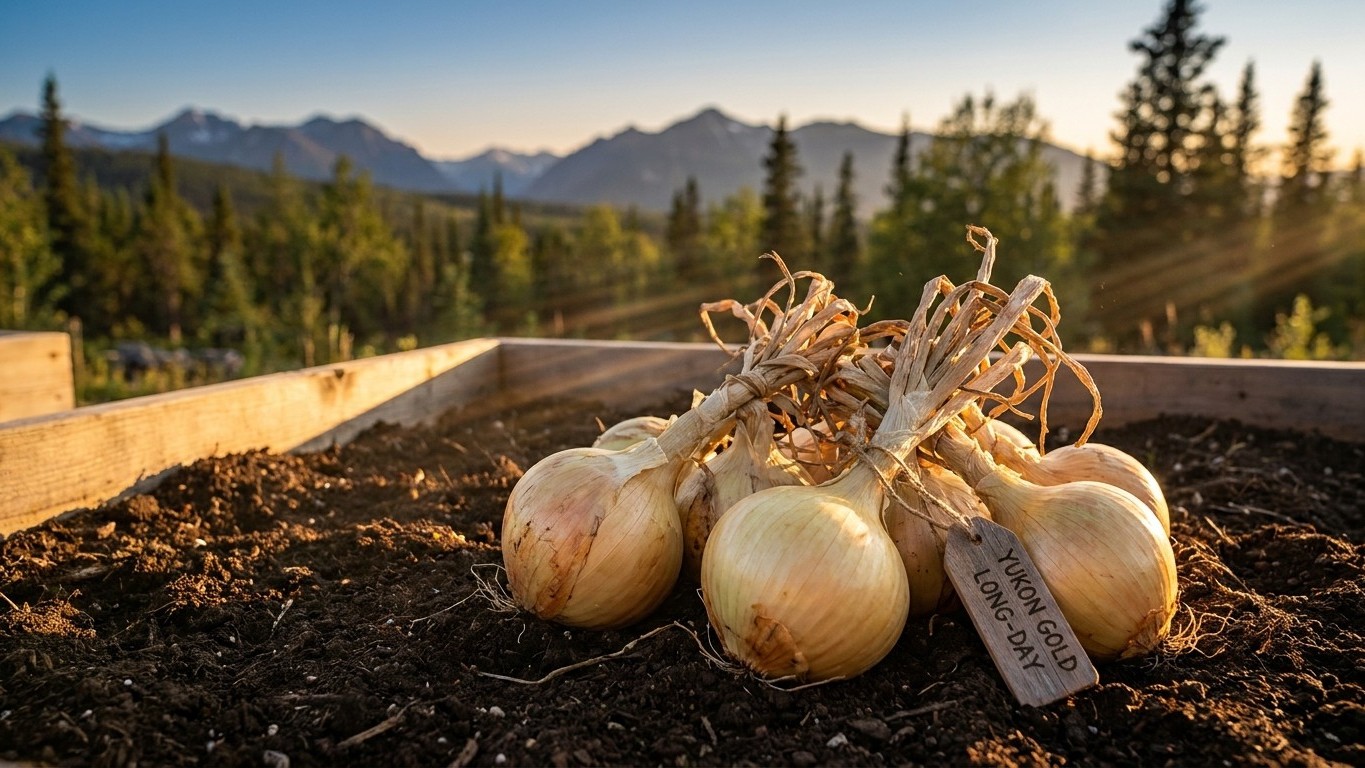

Onions bulb according to day length, not the calendar or the thermometer, and that single mechanism decides which varieties belong in a Yukon garden. At 60.71 degrees north, Whitehorse sees roughly 18 hours and 45 minutes of daylight on the summer solstice, among the longest growing-season days anywhere onions are planted in North America. That much light rules out almost every variety sold in mainstream seed catalogs. Here’s what the day-length math actually allows, and what it eliminates outright.
The short answer for Yukon

Whitehorse sits at 60.71°N, and on the longest day of the year the sun stays up for about 18 hours and 45 minutes there, according to a calculation based on Environment and Climate Change Canada’s climate-station data for that city. Onions respond to that daylight window, not to soil warmth, to decide when to stop growing leaves and start swelling a bulb. Short-day types trigger bulbing around 12 hours of daylight, a threshold Clemson Cooperative Extension’s Home & Garden Information Center identifies as the standard cutoff for that group. Intermediate-day varieties wait for roughly 12 to 14 hours. Long-day varieties hold off until 14 to 16 hours, sometimes more, which is exactly the kind of daylight only far-northern summers produce.
Yukon’s summer light comfortably clears even the top of that long-day range, which means the only varieties worth planting here are the long-day types bred specifically for latitudes this far north. Of the 31 varieties this site has documented, only one has a published range that fully covers 60.71°N: Redwing, rated for 43 to 65 degrees north. That range comfortably brackets Whitehorse with room to spare on both ends, making it the safest, best-documented choice for a Yukon plot.
One other variety sits close enough to matter. Ailsa Craig is rated for 38 to 60 degrees north, and Whitehorse’s 60.71°N falls just past that upper edge, inside what amounts to a blurred zone rather than a hard wall. Catalog ranges are drawn from field trials, not fixed physiological cutoffs, so a variety rated to 60°N does not simply stop working at 60.1°N. Treat Ailsa Craig as a variety that may bulb in Whitehorse, worth a trial row rather than the whole bed, and know that it’s operating right at the limit of what’s been documented. Redwing remains the variety with margin on its side.
What will not work here
Every other variety in this territory’s catalog data, 29 of the 31 documented on this site, has a published range that ends well south of Whitehorse. Plant any of them in Yukon and the outcome isn’t a smaller harvest late in the season. It’s a plant that reads the daylight far earlier than its genetics expect, forces itself into bulb formation before it has grown enough leaf mass to feed a decent onion, and hands you a crop of undersized bulbs no amount of fertilizer will fix. This is a variety mistake, not a feeding mistake, and no amount of compost changes what the daylight clock is telling the plant to do.
Short-day and intermediate-day types are the clearest case. Bred for southern and mid-latitude summers where daylight barely brushes 12 to 14 hours, they hit their bulbing trigger almost as soon as they’re planted in a place where the solstice delivers nearly 19 hours of light. Long-day varieties whose upper range still falls short of Whitehorse face the same problem in a milder form: they’re calibrated for daylight shorter than what Yukon actually produces, so they bulb earlier than intended here too, and their catalog data was never generated for a growing season this far north to begin with.
Varieties documented outside Yukon’s range
- Barolo (long-day, 38-55N), bred for daylight well short of Whitehorse’s summer peak, bulbs before the plant sizes up.
- Blush (long-day, 38-55N), same mismatch; catalog range never reaches this far north.
- Bridger (long-day, 35-50N), triggers bulbing early under Yukon’s extended daylight.
- Cabernet (intermediate-day, 35-45N), bulbs while still a small plant.
- Calibra (intermediate-day, 35-45N), same early-bulbing problem.
- Candy (intermediate-day, 33-40N), daylight threshold cleared far too soon here.
- Elsye (intermediate-day, 32-45N), undersized bulbs from premature triggering.
- Expression (intermediate-day, 32-45N), bred for a much shorter summer day.
- Frontier (long-day, 40-50N), range tops out well below Whitehorse.
- Gabriella (short-day, 20-35N), a warm-climate variety with no chance of a full bulb this far north.
- Madalyn (short-day, 20-35N), bulbs almost immediately, staying tiny.
- Monastrell (intermediate-day, 35-46N), same early-trigger issue as other intermediates.
- New York Early (long-day, 38-50N), daylight range doesn’t extend this far north.
- Patterson (long-day, 38-55N), undocumented and mismatched for Yukon summers.
- Powell (long-day, 43-47N), a narrow range that stops well south of 60.71°N.
- Red Carpet (long-day, 40-45N), bulbing trigger arrives too early here.
- Red Long of Florence (intermediate-day, 38-50N), small bulbs from premature triggering.
- Red Long of Tropea (intermediate-day, 35-48N), same mismatch as other intermediates.
- Red Rock (short-day, 30-36N), a southern variety entirely unsuited to this daylight.
- Red Sensation (short-day, 25-35N), bulbs far too fast under near-19-hour days.
- Rossa di Milano (long-day, 38-50N), range ends well before reaching Yukon.
- Safrane (long-day, 42-50N), daylight threshold too low for this location.
- Scout (intermediate-day, 32-46N), same early-bulbing pattern.
- Sierra Blanca (intermediate-day, 32-45N), undersized bulbs guaranteed here.
- Talon (long-day, 42-50N), range doesn’t extend into Yukon’s latitude.
- Texas Grano 1015Y (short-day, 25-35N), a warm-region variety with no fit here.
- Vidora (short-day, 25-35N), bulbs almost immediately at this daylight.
- Walla Walla Sweet (long-day, 35-55N), the closest long-day option here, but still five degrees short of Whitehorse.
- White Castle (short-day, 30-38N), a southern short-day type entirely out of place this far north.
What changes across Yukon
Whitehorse anchors the figures above, but it sits toward the southern edge of the territory, not its center. Yukon stretches from roughly the British Columbia border near 60°N up past the Arctic Circle toward the Beaufort Sea, meaning most of the territory lies north of the reference city used here, not south of it. That matters because daylight only gets longer as you move north through the summer months, pushing the advice above even further in one direction.
| Region | Approx. latitude | Summer daylight | What it changes |
|---|---|---|---|
| Southern Yukon (Whitehorse) | 60.71°N | 18h 45m on the solstice | Reference figures for this page; Redwing fits, Ailsa Craig sits at the edge of its range |
| Central Yukon (Dawson City area) | roughly 64°N | noticeably longer than Whitehorse | Ailsa Craig’s published range (max 60°N) is exceeded; Redwing remains the safer choice |
| Far north Yukon (near/above the Arctic Circle) | above roughly 66.5°N | near-continuous daylight at solstice | Even Redwing approaches the top of its documented range (65°N); the short frost-free window becomes the bigger constraint than daylight itself |
A gardener near Dawson City is working with more daylight than Whitehorse sees, which pushes even Redwing toward the upper edge of its documented range and leaves little margin for Ailsa Craig at all. Further north still, where summer light barely dips below the horizon, the growing season itself gets so short that frost dates, not day length, become the harder limit on what an onion can accomplish before fall arrives. A gardener anywhere near the southern edge of the territory, closer to the British Columbia line, is closer to the numbers used throughout this page and can rely on them with less adjustment.
Checking this against your own garden
Everything above is built on Whitehorse’s coordinates and one calculated daylight figure. That’s a solid starting point for most of Yukon’s populated areas, but it isn’t a substitute for confirming your own numbers, especially if your garden sits well north or south of the city.
- Look up your own latitude if you’re gardening well away from Whitehorse; a few degrees of difference shifts both daylight hours and which variety range applies to you.
- Confirm your last spring frost date and first fall frost date locally rather than assuming Whitehorse’s dates apply, since Yukon’s short growing season leaves little room for error.
- Contact Yukon’s territorial agriculture branch or a local extension-style service for region-specific planting windows and any variety trial results for your area.
- Check whether a local garden center or greenhouse has grown Redwing or Ailsa Craig in your specific area before, since real local results beat catalog ranges every time.
- Track your own solstice daylight hours if you’re at a noticeably different latitude than Whitehorse; the 18h45 figure here belongs to that one city, not the whole territory.