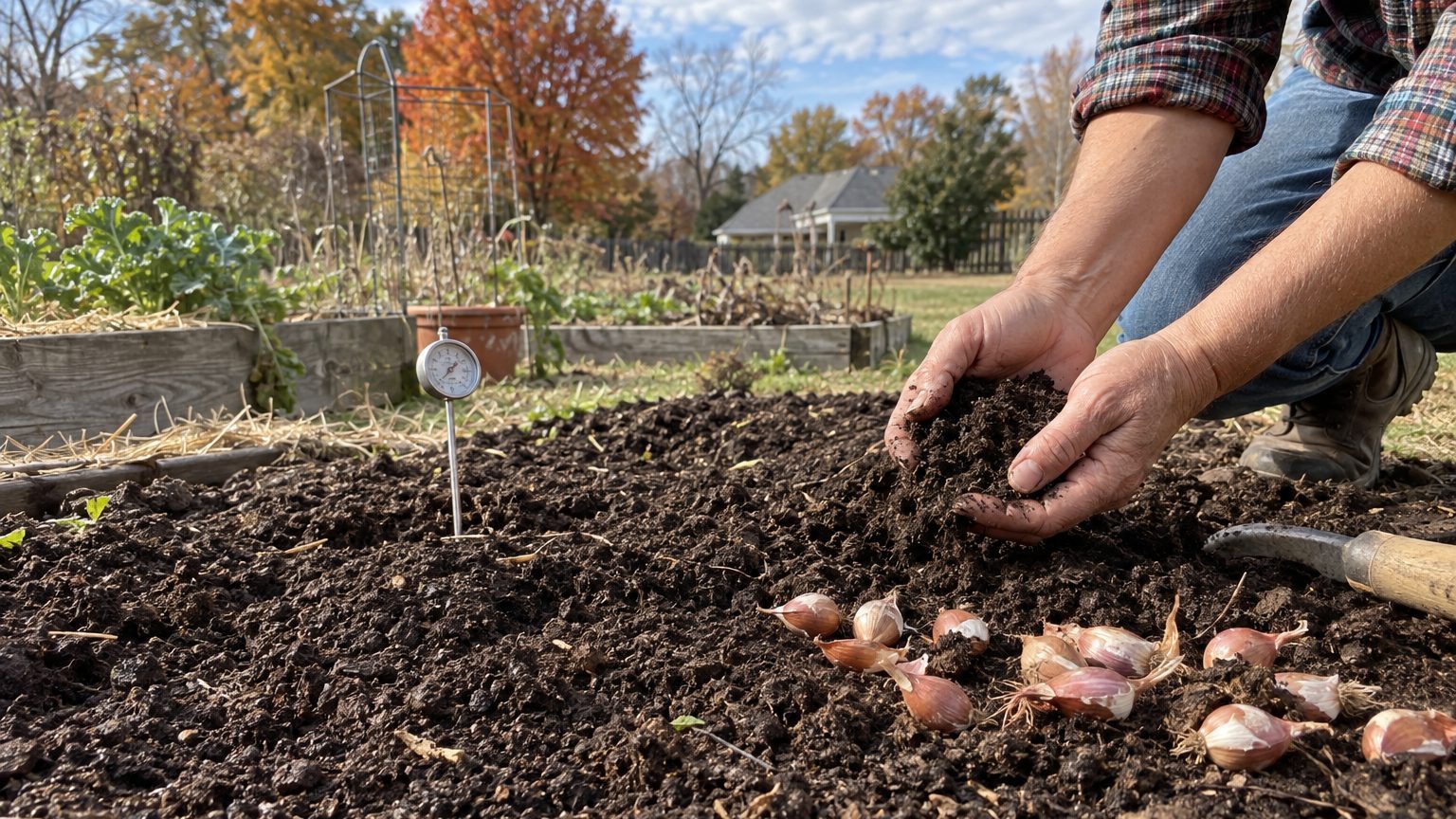

Plan on spring planting. At the Whitehorse reference station, the average last spring frost is June 5, and shallot sets go in once the soil has thawed and warmed after that, not on the frost date itself. The frost-free window is short, about 81 days between the average frosts, so a quick start matters. Autumn planting is a gamble this far north.
When the soil is warm enough in Yukon
The date most gardeners ask about is June 5. That is the average last spring frost at the WHITEHORSE A station (climate ID 2101300), from Environment and Climate Change Canada’s Canadian Climate Normals for 1981-2010. It is a mean, which means that in one year out of two the last frost falls later. Treat it as the middle of a window rather than a safe date, and keep a row cover within reach until mid-June.
Frost is only a proxy, though. Shallots respond to warm soil, and soil warms after frost risk ends, with a lag. In a territory where the ground thaws from the top down, that lag can be longer than you expect. A bed can be frost-free and still be cold and sodden a few inches down, and a set pushed into it sits there, going nowhere or starting to rot.
So test the soil itself. It should be thawed through the depth of the bed, crumble in your hand rather than smear, and drain without standing water. A cheap soil thermometer settles the argument better than a calendar. Also keep in mind that one station is not the territory. The Whitehorse figure comes from an airport on the valley floor, and northern or upland districts run weeks behind it. Gardeners in Dawson, the Klondike valley or higher ground should expect their own date to land later and watch their own beds.
Canadian normals cover 1981-2010, while the US figures cover 1991-2020. The two sets are not on the same footing, so compare them loosely. Neighbors in Alaska can read Growing Shallots in Alaska for the northern approach on the American side of the border.
Types, not varieties
Shallots come in a few broad types. There are multiplier shallots grown from small bulbs or sets, each planted bulb dividing into a cluster. There are seed-grown shallots, which are started from seed and treated closer to onions. And there are transplants, which are seedlings started indoors and set out once the soil is ready. Each type reaches the soil on a different schedule, and the short window here makes that difference matter. Section four explains where to get that answer.
What carries over from garlic
Autumn planting, curing, storage and allium rotation work much the same for shallots as for garlic. What differs for shallots is mostly scale and timing. The bulbs are smaller, they are lifted earlier than garlic in many climates, and a shallot clump has more neck tissue crowded together, which dries more slowly in a damp spell.
Curing touches food safety, so inspect rather than assume. Look at every bulb’s neck and base before it goes into storage. A soft neck or a moldy base ends the question: that bulb does not go into storage, however firm the rest of it feels. A bulb that looks sound is not therefore sound.
For the general method, start with Growing Shallots: One Bulb In, a Handful Out.
How long the season lasts here
Count from June 5, the average last spring frost, to August 25, the average first fall frost. Both come from the same Whitehorse A station and the same 1981-2010 normals. The gap is 81 days, a little under 12 weeks. Both dates are means, so in a given year the real window can be a couple of weeks shorter or longer, and in a cold year it can shrink hard at either end.
The subtraction is the easy part. The useful part is what 81 days permits. A long window, say one that stretches into the autumn, can hold a second sowing. This one does not. For bulb production, the first sowing is the only sowing, and anything planted after the soil has finally warmed has very little room to finish.
That changes the transplant question. Starting shallots indoors buys a few weeks, which in a short season is a large share of the whole window. The price is root disturbance. Shallot seedlings are fine-rooted, and a rough transplant sets them back, which can erase the weeks you gained. If you go this route, harden seedlings off gradually, handle them by the leaves instead of the roots, and check the root ball when you pop a seedling out. White, branching roots reaching the edge of the cell mean it is ready. A tight brown coil means you waited too long.
Sets skip that problem. They carry their own stored energy, go straight in the ground, and spend the window growing instead of recovering. For most Yukon gardeners with open ground and no greenhouse, sets are the logical start.
A second sowing does have a role if what you want is green shallot tops rather than bulbs. Those can be cut young and staggered across the season, and the succession sowing guide on this site lays out how to space the batches. For bulbs, though, put everything into one early planting and give it the full window.
Heat and water in Yukon
What the verified numbers do say is that a territory with 81 days between average frosts is not primarily a heat problem. Compare that with a desert state: Growing Shallots in Nevada deals with shade and root cooling, which is a different job entirely.
If your summer runs cool and damp, the risks are different. Mildew and other foliar diseases move in, ripening drags on, and necks stay thick and wet when they should be drying down. Shallots finishing in a cool, wet August may never cure properly, and that feeds straight into the storage problem described above. Rainfall differs a great deal across a territory this large, so put a rain gauge in the garden and keep your own record. Water at the base in dry weeks rather than overhead, and give the clumps room for air to move.
Autumn against spring
The winter decides the planting season. The mean daily minimum of the coldest month at the Whitehorse reference station is -19.2 °C (-2.6 °F), from ECCC normals for 1981-2010. It is a mean, so colder nights come regularly. NRCan places Whitehorse in Canadian hardiness zone 1b, a figure from 1991-2020 normals. That is the Canadian system, built on seven climate variables, and it does not convert to a USDA zone, so do not read it against a US map.
Autumn-planted sets earn their place in milder climates by rooting before winter and starting early, which gives larger bulbs. Where the ground freezes hard and stays wet, they rot or heave instead. Freeze-thaw cycles push shallow bulbs up out of the soil, where they dry out and die. Spring is the safer call here.
| Criterion | Autumn planting | Spring planting |
|---|---|---|
| Winter risk | Rot in wet ground, heaving from freeze-thaw | None, the sets are stored indoors |
| Bulb size | Larger and earlier where winters are mild | Smaller, but reliable in a hard climate |
| Fit for Yukon | Small test batch only | Default choice |
If you want to test autumn planting, treat it as an experiment. Put in a small batch, mulch it deeply, and keep the main crop for spring.
Which shallots suit Yukon
Choose by type, and put earliness first. With 81 days between average frosts, a shallot that takes its time is a shallot that does not finish. The earliest-maturing types give you the best odds of a cured bulb before the first fall frost. Seed-grown types are worth a look if you start them indoors, since they skip the stored-set stage, and multiplier sets suit direct planting.
Disease resistance comes second. In a cool, damp summer, foliar mildew and neck problems are the usual trouble, and a type with a record of resisting them is worth more than one that is bigger on paper. Airflow and spacing help any type, and if your site runs hot in a given summer, light shade and mulch around the roots will help too.
A variety name only means something if it has been trialled where you garden. Yukon also has no state extension service in the American sense. The better route is to ask the territory’s agriculture office and local growers’ groups what has been grown successfully, then look at what Agriculture and Agri-Food Canada publishes for northern conditions. Buy from a supplier who can tell you where the stock was grown.
Common questions
Can I plant shallots in the fall in Yukon?
You can, but it is risky. The coldest-month mean minimum is -19.2 °C (-2.6 °F) at the Whitehorse reference station, and ground that freezes hard and stays wet tends to rot or heave autumn sets. Try a small, deeply mulched batch, and keep the main planting for spring.
Is June 5 a safe planting date?
No. It is the average last spring frost at WHITEHORSE A, so in one year out of two the last frost comes later. Use it as the middle of a window, then check the soil itself before you plant.
Does zone 1b mean the same as a USDA zone?
No. Zone 1b is the Canadian hardiness system, which draws on seven climate variables, while USDA zones use one. NRCan itself says there is no simple conversion between the two.
How do I know whether cured shallots are safe to store?
Inspect each bulb. Press the neck and look at the base. A soft neck or a moldy base ends the question, and a bulb that looks fine is not proof that it is sound. Check stored bulbs periodically and remove anything that softens, since one failing bulb can spoil its neighbors.