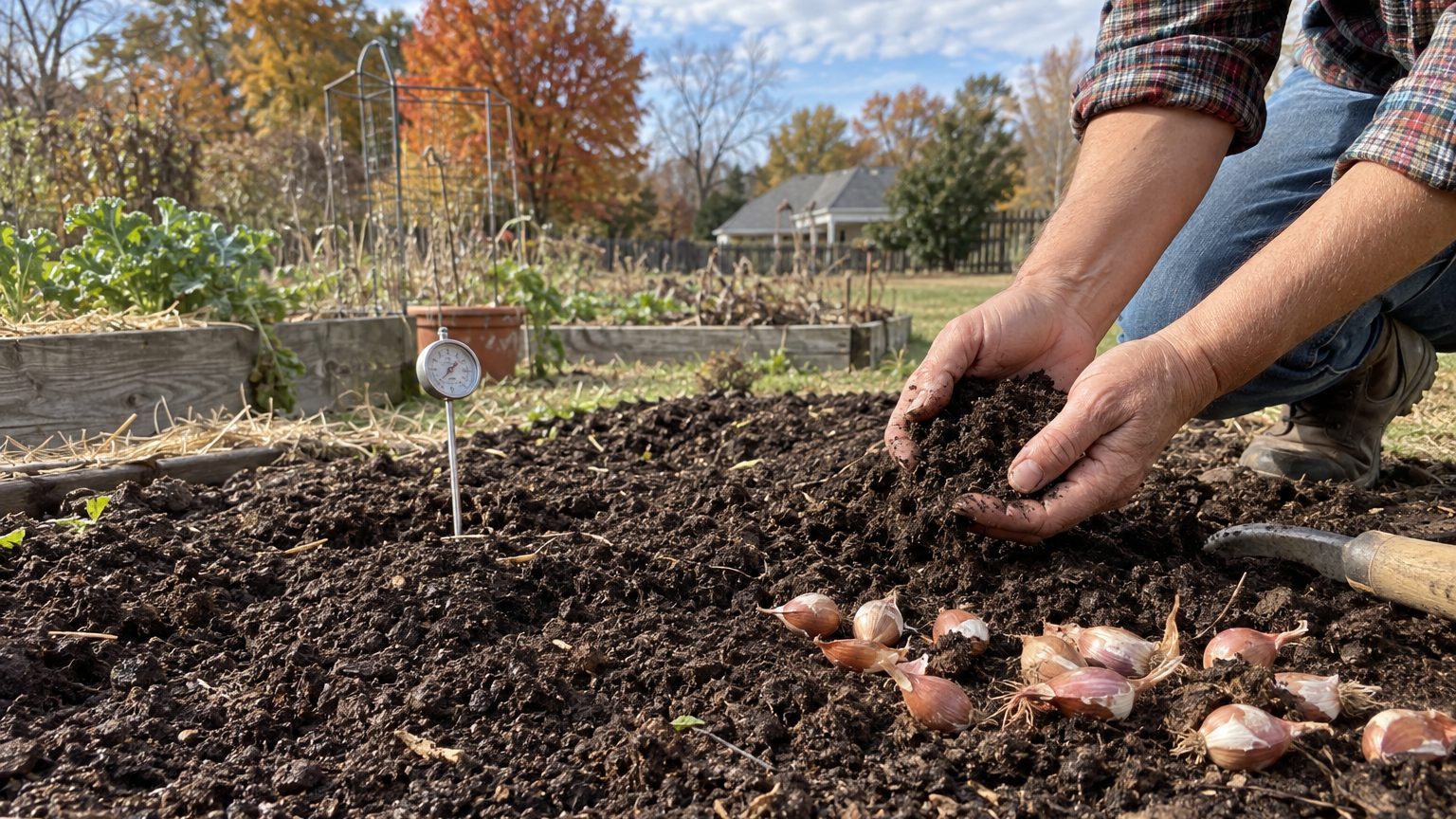

Yes, shallots can be grown in Alaska, and the practical window is spring. In Anchorage, the reference point for this page, the last spring freeze falls between May 3 and May 12 and the first fall freeze arrives between September 22 and October 1. That leaves room for one crop of bulbs, provided the ground has thawed and drained first.
When the soil is warm enough in Alaska
The date most gardeners want is a single square on the calendar. The closest honest answer comes from NOAA’s 1991-2020 Climate Normals for the Anchorage station (USW00026451): the last spring freeze at 32°F falls between May 3 and May 12, using the 30-70% probability band. A frost date is a probability, not a promise, so a freeze after May 12 is possible in any given year.
Frost is only a proxy. Shallots care about the soil, and soil warms after the frost risk ends, not along with it. In a Southcentral spring the top few inches can be thawed and soggy while the air already feels mild. Sets pushed into cold, waterlogged ground sit and rot instead of rooting. What you are waiting for is soil that has thawed past planting depth, crumbles in your hand instead of smearing, and no longer holds standing water after a rain.
Shallots tolerate cool conditions better than tomatoes or beans, so you do not need to wait for the first warm week. Planting in the days after the soil becomes workable, inside or just after that early-May window, is the usual logic. Raised beds help in Alaska. They thaw sooner and shed water, which matters more here than any fertilizer choice.
The Anchorage figures need a caveat. Anchorage is one of the mildest inhabited parts of Alaska, and the Interior and the far north have much shorter seasons. If you garden in Fairbanks, the Mat-Su Valley, the Kenai or a village on the coast, treat these dates as a reference point and not your own. Your local extension office is the right place to calibrate.
Autumn planting, and what differs from garlic
Garlic and shallots share the autumn-planting habit in milder climates, and this site has a whole garlic section that covers timing, mulching, curing and allium rotation in detail. Rather than repeat that here, read it for the shared practices and keep three shallot-specific points in mind. A shallot set is a small bulb that multiplies into a cluster, so the planting is more forgiving of size but not of rot. The sets are shallower and smaller than garlic cloves, which leaves them more exposed to heaving. And the crop is usually pulled earlier, so the curing happens in a different part of the season. The Growing Shallots: One Bulb In, a Handful Out guide covers the general method that this page adapts to Alaska.
How long the season lasts here
Put the two sets of dates side by side. The frost-free stretch at the Anchorage station runs about 143 days. Pairing the dates directly gives a range: from the latest spring date (May 12) to the earliest fall one (September 22), the window is 133 days. From the earliest spring date (May 3) to the latest fall date (October 1), it is 151 days.
| Scenario | Last spring freeze | First fall freeze | Days between |
|---|---|---|---|
| Short year | May 12 | September 22 | 133 |
| Typical (NOAA figure) | May 3 to May 12 | September 22 to October 1 | About 143 frost-free days |
| Long year | May 3 | October 1 | 151 |
Frost-free days are not the same as growing days, because shallots can start in cool soil and finish after a light frost. Still, the number tells you what is allowed. A 143-day window is enough for one planting to size up and cure. It is not generous enough to plan a relay of plantings the way a gardener in Georgia might. A second sowing started in midsummer would be racing the first fall freeze with little slack, so the first planting is effectively the only one. The site’s succession sowing guide explains how to stagger plantings where the season is long enough to support it. Here, use it as a reference for what you are giving up.
That short margin also changes the transplanting question. Starting shallots from seed indoors and moving them out buys weeks, but every transplant takes a root check when it goes into the ground, and in a short season that setback comes out of the bulbing period. Sets avoid most of that problem because they arrive with roots and energy stored. For a window this size, I would lean toward sets for the main crop and keep seed-started transplants as an experiment on the side.
Long summer daylight partly offsets the short season. Plants make a lot of leaf under those long days, which is useful for feeding the bulb, though the exact payoff depends on temperature and moisture. If you want to compare how other northern places handle a similar squeeze, Growing Shallots in Yukon deals with an even shorter runway.
Heat and water in Alaska
This page carries no figure for days above 90°F or for summer rainfall at the reference station, and I will not estimate either. What can be said is that heat stress is not the main threat in Alaska. Shallots in a hot climate need shade at the root and airflow. In a cool Alaskan summer the more likely problems are slow ripening, foliar disease and mildew when leaves stay wet for days. That is the calendar’s threat as much as the weather’s: a bulb that is still sizing up in late August has less time to finish and cure before the first fall freeze.
Practical measures follow from that. Space plants so air moves between them. Water at the base in the morning, if at all, since wet foliage is the usual starting point for fungal trouble. Rotate the bed so alliums do not return to the same soil for several years (the garlic section explains the logic, and it applies to shallots without modification). Choose a bed with good drainage and some sun, because a cool wet spot is where rot and mildew take hold fastest. Growing Shallots in Newfoundland and Labrador deals with a similar cool, damp problem from a maritime angle.
Autumn against spring, and the winter low
The real decision in Alaska is autumn planting against spring planting, and the winter minimum drives it. NOAA’s 1991-2020 normals put the mean daily minimum of the coldest month in Anchorage at 11.0°F. That is an average of nightly lows, not a record, so individual nights go well below it. The USDA Plant Hardiness Zone Map (2023) assigns Alaska as a whole a range of zones from 1a to 8a, which is too wide to be useful. This page does not give a single Anchorage zone, so check the map for your own location.
Where the ground freezes hard and stays wet through thaws, autumn-planted sets are at risk. Repeated freezing and thawing heaves small bulbs up out of the soil, and wet ground rots them. In those conditions spring is the safer call. A milder winter, or a bed with reliable snow cover and good drainage, is where autumn planting pays off: bulbs that root before winter start earlier and tend to be larger. Whether your site is that kind of place is a question for local experience. If you try autumn planting, treat it as a small trial next to a spring planting, not as your whole crop.
Which shallots suit Alaska
This page names no varieties, and that is deliberate. It has no trial data for Alaska, and a variety that thrives in a Pacific Northwest garden may sulk in Fairbanks. Naming one would be a guess dressed as advice. What can be done is to choose by type, working from what the Alaskan facts imply.
A short season favors the earliest-maturing types. Look for shallots described as early or quick to bulb, since every week saved in the field is a week of margin before the first fall freeze, which arrives between September 22 and October 1 in Anchorage. Sets generally get you there sooner than seed-grown shallots, which need more time and a transplant step. Seed-grown types can still be worth trying where you want to avoid carrying disease over from stored sets, but treat them as the riskier path given a window of roughly 133 to 151 days.
A cool, damp summer makes disease tolerance the first criterion after earliness. Look for descriptions that mention resistance or tolerance to mildew and foliar disease, and for types that cure down to a dry, tight neck. Heat tolerance and bolt resistance matter less here than in a hot state.
Curing and storage deserve caution. Pull bulbs when the tops have fallen and begun to dry, cure them somewhere dry, shaded and well ventilated, and inspect each bulb before you store it. A soft neck or a moldy base ends the question: that bulb goes to the compost, not the pantry. A bulb that looks firm is not proof it is sound, so check the neck and base on every bulb and recheck stored ones from time to time. No keeping time is guaranteed, because it depends on the type, the curing and the storage conditions. The garlic section covers the shared curing practices in more detail.
For the actual variety list, go to the University of Alaska Fairbanks Cooperative Extension Service. Its agents know what has been trialled in your region, and that is the only recommendation that means anything. A variety that has already survived Alaskan summers and winters in someone’s field beats anything on a seed packet from outside the state.
Common questions
Can I plant shallots in the fall in Alaska?
You can try, but spring is the safer choice. Where the ground freezes hard and stays wet, autumn-planted sets can rot or heave out of the soil. Try a small fall planting alongside a spring one before committing the whole crop.
When should I plant shallots in Anchorage?
Plant once the soil has thawed and drained, around or soon after the last spring freeze window of May 3 to May 12 at the Anchorage station. The soil’s condition matters more than the calendar date, and freezes after that window are possible.
Should I start shallots from seed or from sets?
With a frost-free stretch of about 143 days, sets are the lower-risk choice because they skip the transplant root check. Seed-grown shallots can work as a side trial, but they use up time you do not have much of.
How do I know if a cured shallot is safe to store?
Inspect every bulb. A soft neck or a moldy base means discard it, however good the rest of it looks. A firm appearance alone does not prove a bulb is sound, and this page cannot promise a storage time.