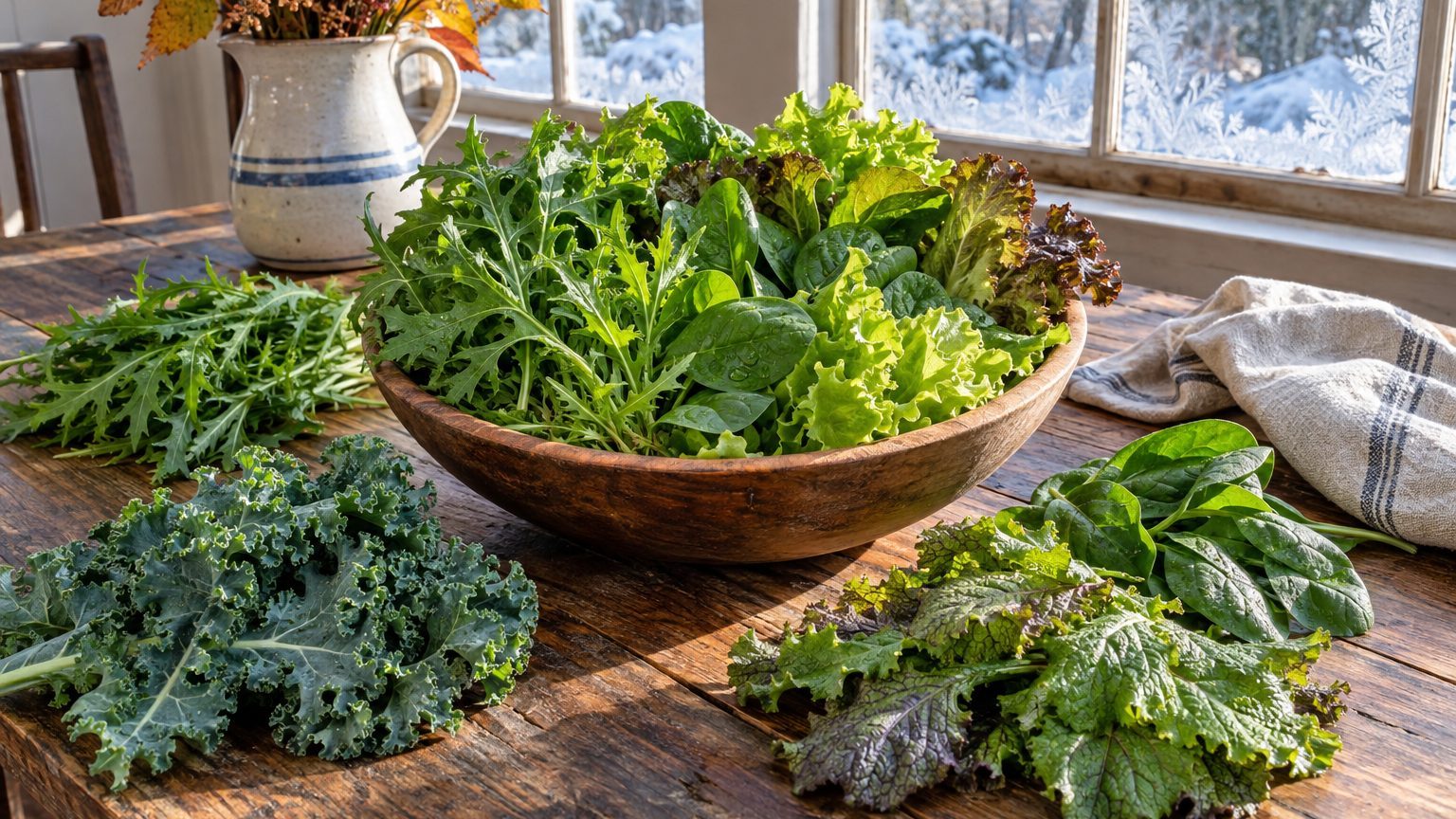

In Yukon, the best winter salad crops finish fast and shrug off cold: mâche, claytonia, spinach, mizuna, tatsoi and hardy kale. Heading lettuces, radicchio and endive are poor bets. Whitehorse’s frost-free stretch is short, and the coldest month is far too harsh for open-bed harvests. Here, “winter salad” mostly means protected growing and late-season picking.
The short answer for Yukon
Choose by type, not by catalog name. Small-leaf, cold-hardy greens that mature quickly fit this territory, with kale as the sturdy but slower option. Two dates from the WHITEHORSE A station (Environment and Climate Change Canada, 1981-2010 normals) explain why. The last spring frost falls on average June 5, and the first fall frost on average August 25. That leaves about 81 days between them.
Both are means, and a mean is the midpoint of a window, not a safe date. In half of all years the last spring frost lands after June 5. In the other half, the fall frost arrives before August 25. The same station puts the coldest month’s mean daily minimum at -19.2 °C (-2.6 °F), which is well beyond what these greens tolerate in an uncovered bed. This page has no summer heat figure, so the call rests on season length and winter cold alone.
| Type | Examples | Verdict for Yukon | Reason |
|---|---|---|---|
| Cold-hardy small leaves | Mâche, claytonia, spinach | Best bet | Take frost, mature quickly, suit cool conditions |
| Quick Asian greens and mustards | Mizuna, tatsoi, arugula | Good, sown early | Fast, but long summer days can push them to flower |
| Hardy kale | Curly and Russian types | Reliable for fall picking | Slower, but leaves keep coming after frost |
| Heading and slow crops | Radicchio, endive, large heading lettuce | Poor | Need a long, mild season that 81 days rarely gives |
Matching the type to how you grow
An open bed suits spinach, mâche and claytonia best, for a fall harvest rather than a winter one. A cold frame or unheated greenhouse stretches the picking into early winter for every type in the table except the slow heading crops. When to put seed in the ground is a separate question, covered in When to Sow Winter Salads in Yukon.
On the seed packet, look for “cold-hardy” and for the shortest days to maturity in a given type. In a season this tight, a week saved at sowing can decide whether a crop reaches harvest size before the cold stops it.
What will not work here
The slow crops fail first. Radicchio, endive and big heading lettuces want most of a season, and Whitehorse typically offers 81 frost-free days, fewer in a hard year. A crop that needs nearly all of them has no margin when frost comes early at the Whitehorse station, let alone in a colder district.
The August sowing trick
Gardeners in milder states sow in August for a winter harvest. Here the first fall frost arrives on average August 25, so seedlings sown that week emerge into frost rather than into the warm, bright weeks they need. Without cover, that approach has no room. Sowing under glass or fabric on or before the average frost date is the only version of it that holds up.
Open beds and unheated glass in January
The coldest month averages a daily minimum of -19.2 °C. An average of minimums means plenty of nights fall below it, and this page does not have the record low. For comparison, that is -2.6 °F, a figure that would be remarkable in most of the Lower 48. A single layer of row cover buys a few degrees, and a cold frame or unheated greenhouse buys more, but none of them closes a gap that wide on the worst nights. Plants in those structures tend to hold rather than grow through the darkest weeks, because daylight this far north is thin in midwinter. Plan on harvesting what grew in fall, not on watching new leaves appear in December.
Treating June 5 as a planting date is the quieter mistake. It is the average last frost, so about half of years bring a frost after it. Tender transplants set out that day are a coin flip. Hardy greens forgive this, which is another reason to favor them.
What changes across Yukon
Yukon is not one garden. The hardiness zone on file is 1b in the Canadian system, from Natural Resources Canada’s plant hardiness maps (1991-2020 normals), and it describes the reference city, Whitehorse, not the territory. This page does not have a zone for other communities, so it cannot give the spread. What it can say is that no single answer covers the territory.
That Canadian zone is not a USDA zone and does not convert to one. The Canadian system draws on seven climate variables, the USDA system on one, and Natural Resources Canada states that there are no simple conversions between them. Its own example is Canadian zone 4a, which overlaps nine USDA zones, from 3a to 7a. So advice written for a USDA zone cannot be borrowed for a Yukon garden.
The frost dates carry the same warning. They come from one station, and northern or upland districts run weeks behind it. A reader in the north or at altitude should shift in three ways: shorten the crop list to the fastest, hardiest types in the table, start under cover rather than in the open, and treat the 81-day window as a ceiling, not a typical year. Cold air also pools in valley bottoms and drains off slopes, so two yards a few miles apart can differ more than the averages suggest.
To find your own zone, use Canada’s Plant Hardiness Site and look up your community. For the wider picture of how these crops fit Yukon gardens, see Winter Salads for Yukon Gardens.
Where to check this for your own county
Yukon has no counties, so the equivalent is your community or valley. The place to start is Agriculture and Agri-Food Canada. This page links the federal department because it is the one address we could confirm was reachable. The territorial department’s own site refused our automated checks, so we could not vouch for it.
Once there, look for three things. First, a planting calendar for your area, since a calendar built on Whitehorse dates will mislead someone farther north. Second, results from variety trials near you. A green that did well in a trial in your region beats any ranking in a catalog, including the types in this article. Third, frost dates from the weather station closest to your garden, not the one nearest a big town.
A local recommendation beats a territorial one, and this page is the territorial one. It sits between a continental guess and a neighborhood answer. It also cannot supply a Yukon-specific calendar, because the facts behind it do not include one. One more mismatch: Canadian normals cover 1981-2010, while the US figures elsewhere on this site cover 1991-2020, so do not line the two sets of dates up.
Checking this against your own garden
Your own observations outrank every date here, and the best ones need no equipment. Three are worth tracking.
- Soil warmth by feel. In spring, push a hand into the bed at about the depth of your knuckles. If it still feels cold and clammy, the soil is behind. A bed that warms early is likely sunny and well drained, and one that lags is shaded or holds cold air.
- The first male flowers. Note the day willow catkins open nearby, or the first male flowers on squash if you grow them in a greenhouse. Compare that date from year to year to learn how your site runs against the Whitehorse averages.
- The first true leaves. The first true leaves are the ones after the rounded seed leaves. Count the days from sowing to their appearance in an open bed and under cover. The gap measures what your protection is worth.
Write the dates in a notebook for three seasons. One year is weather, and three begin to look like your climate.
Common questions
Can I grow salad greens outdoors through a Yukon winter?
Not in an open bed. The coldest month averages a daily minimum of -19.2 °C at the Whitehorse station. Cover extends harvests into early winter, but growth largely stops in the darkest weeks.
Which green is the safest starting point?
Spinach, mâche and claytonia are the sturdiest types on this page. They tolerate frost and mature quickly, which matters when typical frost-free time is about 81 days.
Is June 5 a safe date to plant out?
No. It is the average last spring frost at WHITEHORSE A, so frost comes after it in about half of years. Treat it as the middle of a window.
Can I use USDA zone advice with a zone 1b listing?
No. Zone 1b is from the Canadian system, which uses seven climate variables, and Natural Resources Canada says there are no simple conversions to USDA zones.