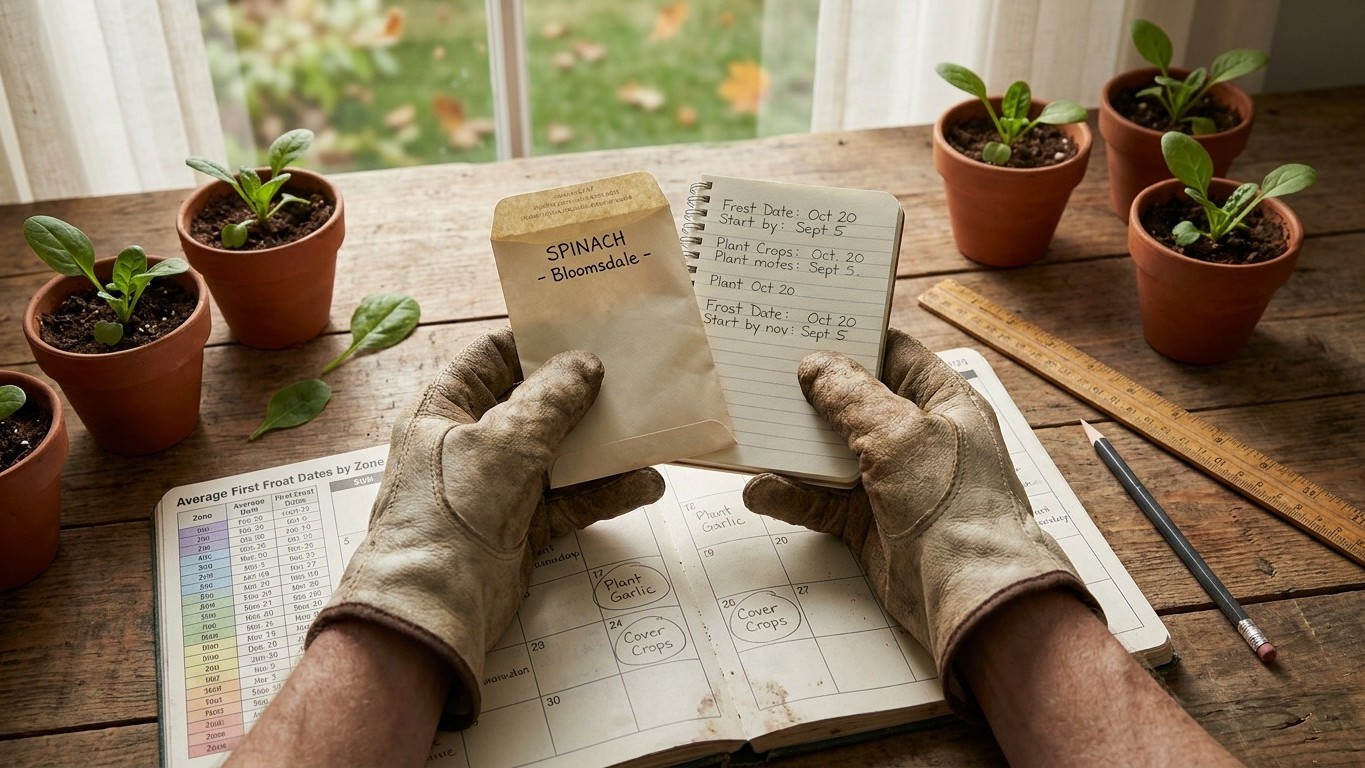

There’s no fixed fall planting date for spinach, and looking for one is the wrong approach entirely. Utah State University Extension puts it plainly: for a fall crop, plant 50 to 75 days before the anticipated maturity date. That means you start with the harvest you want, then count backward. The calendar never enters the equation until you’ve done that math.
The short answer

Utah State University Extension gives fall spinach growers one instruction, and it’s a counting instruction, not a date. Plant 50 to 75 days before the anticipated maturity date. Notice what’s missing from that sentence: a days-to-maturity number for spinach itself. The source doesn’t publish one. It never says “spinach takes 45 days” or “spinach takes 60 days.” It only tells you the window to work backward from the day you want to be picking leaves.
This matters because gardeners are used to seed packets and planting charts that hand them a fixed date, something like “sow by early September” regardless of where they live. Spinach doesn’t cooperate with that model, at least not according to this source. A grower in a high-elevation valley with an early first frost needs a completely different sowing day than a grower in a warm valley floor fifty miles away, even though both are chasing the same fall harvest. The 50-to-75-day window absorbs that variation. You pick your target harvest date based on your local frost timing and how much cool weather you expect, then you subtract.
The range itself, 50 to 75 days, is wide on purpose. Fall growing conditions swing more than spring conditions do. Early fall days can still run warm, slowing early growth, while late fall days cool fast and can stretch maturity out. A tighter window would be false precision. Utah State University Extension leaves room for that swing instead of pretending fall spinach behaves on a fixed clock.
Here’s the practical version. Say you want to be harvesting mature spinach leaves on a specific day this fall. Go to that date on the calendar. Count back 50 days for the early edge of the window, then count back 75 days for the late edge. That span, 50 to 75 days before your target, is when you should be putting seed in the ground. Not the first day of a particular month. Not “whenever the neighbor plants.” The number comes from your intended harvest, not from the season.
This counting-back logic also protects you from the single biggest fall spinach mistake, which is sowing too early into soil that’s still summer-hot. That’s covered in the next section, because it’s a separate mechanism from the counting itself, but it’s the reason the source frames fall planting as a countdown rather than a date on a page.
What actually decides it
Two separate forces control whether a fall spinach sowing succeeds, and they don’t overlap. One lives in the soil. The other lives in the sky. Mixing them up is how gardeners end up blaming the wrong problem when a fall crop fails.
Soil temperature and the germination window
Spinach seed can be sown once soils reach 40 degrees F, and germination performs best in the 55 to 65 degree F range, with seedlings taking 7 to 10 days to emerge once conditions are right. That range describes a cool-soil crop. The complication for fall sowing is the other end of the scale: temperatures above 80 degrees F reduce seed germination. In late summer, when fall sowing needs to happen to hit that 50-to-75-day countdown, soil is often still sitting well above 80 degrees F from a full season of sun. Seed dropped into that warm ground simply won’t come up reliably, no matter how carefully you counted the days.
This is why the fall sowing window isn’t blocked by cold, the way people assume. It’s blocked by heat. The window opens when soil temperature falls, not when a calendar page turns. That single distinction, warm soil versus cold soil, separates a fall spinach bed that germinates evenly from one that sits bare and patchy for weeks while the gardener wonders what went wrong.
Day length and bolting
The second force is day length, and it works against spinach in a very specific way. Long days push spinach toward bolting, the point where the plant sends up a seed stalk instead of producing more leaf. That’s the opposite of what long days do for a bulb crop like onions, where lengthening daylight triggers bulb formation. Spinach doesn’t want long days. It tolerates them poorly. As fall approaches and days shorten, that pressure eases, which is part of why fall is a workable season for this crop in the first place, even though the soil itself is still catching up from summer heat.
There’s a related heat effect worth separating out from bolting. Temperatures above 75 degrees F act as a growth ceiling and, at the same time, a bitterness threshold, the same number producing two different consequences for the plant. It’s not a date on the calendar. It’s a condition that either exists in your garden bed or it doesn’t, and it’s part of why timing fall spinach around a static day-of-month never lines up the way a grower expects.
How to do it
- Pick your target harvest date. Base it on when you want to be eating fall spinach, working around your area’s typical first hard frost.
- Count back 50 to 75 days from that harvest date. This gives you a sowing window rather than a single day, per Utah State University Extension’s fall guidance.
- Check soil temperature before sowing. Confirm it has dropped below the 80 degree F mark where germination declines. Fall sowing is delayed by heat, not by cold, so don’t sow just because the calendar window has technically opened if the soil is still hot.
- Wait for the soil to settle into a workable range. Seed can go in once soil reaches 40 degrees F, but germination performs best between 55 and 65 degrees F.
- Sow the seed 1/2 inch deep. This is the depth given for spinach planting generally, and it applies whether you’re working a spring or fall bed.
- Expect emergence in 7 to 10 days once soil temperature sits in that favorable range. Slower or spotty emergence usually points back to soil that’s still running too warm.
- Thin seedlings to 3 inches apart in the row, with rows spaced 12 inches apart. This spacing applies to fall sowings the same as it does earlier in the season.
- Choose a variety if you haven’t already. Utah State University Extension names Bloomsdale, Melody, Teton, and Olympia as spinach varieties, without publishing performance data on any of them for fall planting specifically.
- Track the shortening days as fall progresses. Bolting pressure from long days eases as the season moves forward, which works in your favor for a fall crop compared to a late-spring one.
What Goes Wrong
- Sowing on a fixed calendar date instead of counting back. A date like “Labor Day” or “first week of September” ignores your specific target harvest and local frost timing. Remedy: pick your harvest date first, then count back 50 to 75 days from it, as the source instructs.
- Seed going into soil that’s still above 80 degrees F. This is the single most common fall failure, since late-summer soil often hasn’t cooled down yet even though the countdown window has opened. Remedy: check soil temperature directly before sowing and wait until it has dropped, rather than sowing the moment the calendar window technically begins.
- Assuming cold is the obstacle, the way it is for many other fall crops. Growers delay sowing waiting for cooler weather in the wrong sense, or they misread a hot stretch as harmless. Remedy: remember the block is heat above 80 degrees F, not chill, so the window opens on a falling soil thermometer, not a falling air temperature alone.
- Expecting spinach to behave like a long-day crop, the way onions do. Some gardeners assume more daylight helps spinach grow, mirroring what they know about bulb formation in onions. Remedy: understand that long days push spinach toward bolting, an opposite mechanism, so shortening fall days actually work in the crop’s favor.
- Letting soil temperature climb above 75 degrees F during the growing period. This ceiling caps growth and pushes leaves toward bitterness at the same time. Remedy: time sowing so the bulk of leaf development happens after that threshold has passed for the season, using the counting-back method rather than guessing.
Common questions
Can I just use a fixed calendar date instead of counting back from harvest?
No, not according to Utah State University Extension’s guidance. The source frames fall spinach timing as 50 to 75 days before the anticipated maturity date, a countdown from your target harvest, not a fixed day tied to the season. Local frost timing and soil temperature vary too much for one calendar date to work everywhere.
What soil temperature actually stops fall spinach from germinating?
Temperatures above 80 degrees F reduce seed germination. That’s the ceiling to watch for fall sowing, since soil is often still hot from summer when the 50-to-75-day countdown window opens. The favorable germination range sits lower, between 55 and 65 degrees F.
Does spinach need long days to grow well, like onions need long days to bulb?
No. That’s a different crop entirely. Long days push spinach toward bolting rather than helping it develop, the opposite of what happens with a bulb crop like onions. Shortening fall days actually reduce that bolting pressure for spinach.
Which spinach varieties work for a fall crop?
Utah State University Extension names four: Bloomsdale, Melody, Teton, and Olympia. The source doesn’t publish performance data, days-to-maturity figures, or fall-specific comparisons for any of them, so choosing between them comes down to availability rather than documented data from this source.