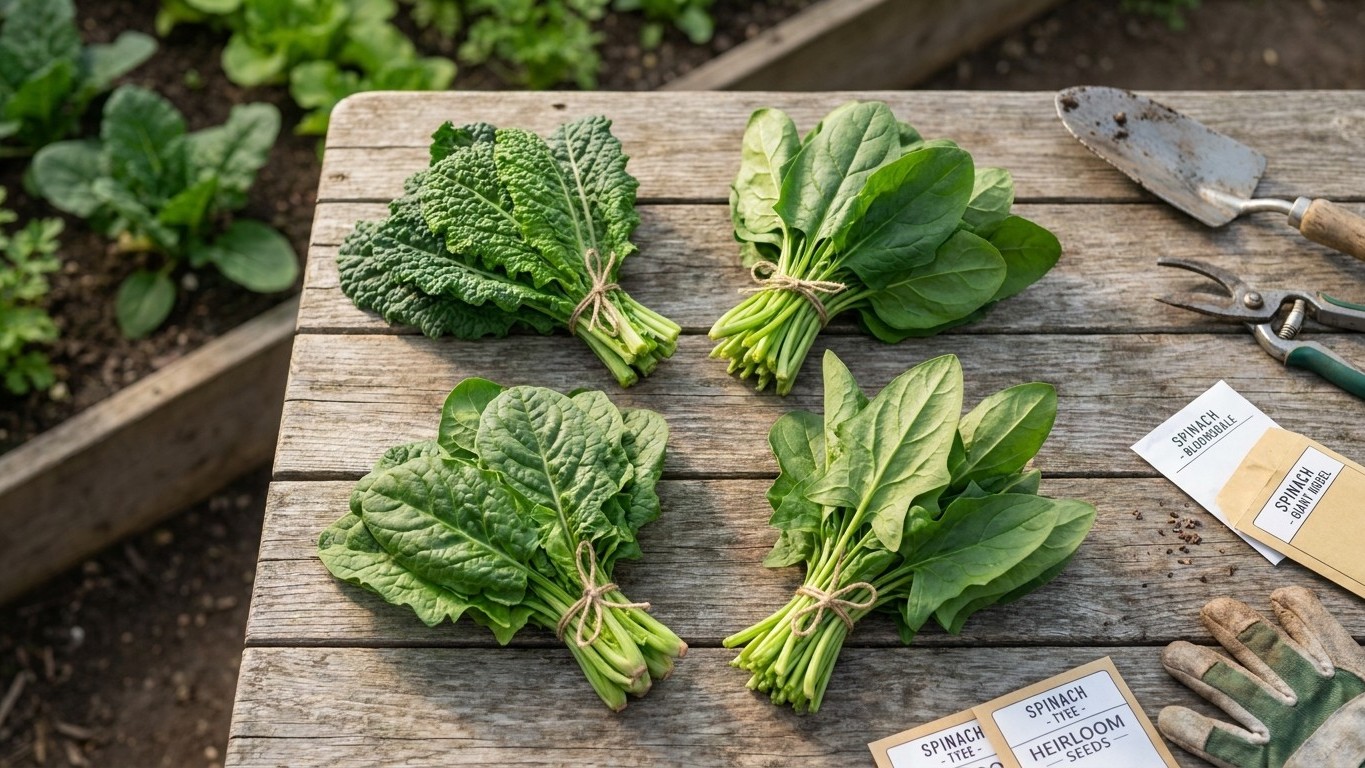

Utah State University Extension names exactly four spinach varieties for home gardeners: Bloomsdale, Melody, Teton, and Olympia. That’s the entire list. The extension publishes no days-to-maturity figures, no flavor notes, no bolt-resistance ratings for any of the four. If you’re hunting for a spec sheet to compare them, it doesn’t exist in this source.
The short answer
Four names, zero data. That’s what Utah State University Extension actually hands gardeners in its spinach guidance: Bloomsdale, Melody, Teton, and Olympia, listed and left there. No planting depth specific to one variety over another, no comparative bolt tolerance, no note about which one holds up longer in a warm spring. The publication simply says these are varieties suited to garden use in the state and moves on to cultural practices that apply to spinach as a crop, not to any single name on that list.
This matters because a lot of garden advice sites will happily invent the missing details, assigning a flavor profile to Bloomsdale or a bolt-resistance edge to Teton. Utah State University Extension doesn’t do that, and neither should anyone repeating its guidance. The honest position is to say plainly: these four varieties are recommended, and everything else about how they perform is a decision left to the gardener, or to seed packet information that comes from the seed producer, not the extension office.
Why would an extension service name varieties and then stay silent on their traits? Extension publications built for a whole state tend to favor breadth over depth. Utah’s growing conditions swing from high desert valleys to cooler mountain benches, and a variety that performs one way in Cache Valley might behave differently in St. George. Rather than make claims that don’t hold across that range, the guidance names varieties known to grow acceptably in Utah gardens and leaves the finer comparison to local trial and error.
The practical takeaway isn’t disappointing so much as clarifying. If you’re choosing among Bloomsdale, Melody, Teton, or Olympia, you’re choosing without an official tiebreaker. What the extension does offer, generously, is guidance on when and how to plant spinach so that any of the four has a fair shot at a full harvest before the plant does what spinach does under long days and warm soil: bolt, turn bitter, and stop being worth eating.
What actually decides it
Two separate mechanisms determine whether a spinach crop, regardless of which of the four named varieties you planted, succeeds or fails. They don’t overlap, and mixing them up is where a lot of garden confusion starts.
Long days trigger bolting
Spinach is a cool-season crop that reads day length as a signal to stop making leaves and start making seed. As days lengthen heading into summer, spinach plants shift into reproductive mode, sending up a flower stalk in a process gardeners call bolting. Once that stalk appears, the leaves turn bitter and the crop is effectively finished for eating purposes. This is the opposite of what long days do for a bulb onion, where lengthening daylight tells the plant to start forming the bulb. In spinach, long days push the plant toward seed, not toward more leaf growth, so the calendar itself works against a spring-planted crop that lingers too long in the ground.
Heat above 75°F stalls growth and turns leaves bitter
Temperature does its own separate damage. Once conditions climb above 75°F, spinach growth slows and the leaves that do form tend toward bitterness, the same threshold acting as both a growth ceiling and a flavor cutoff. That’s not a date on a calendar; it’s a temperature the plant crosses whenever local weather pushes it there, whether that happens in late spring or during an unusually warm fall. A gardener can dodge the day-length trigger by timing plantings around the shortest days of the growing season and still lose the crop to a heat spike that crosses 75°F at the wrong moment.
For a fall crop, Utah State University Extension gives a planting window based on your target harvest date rather than a fixed calendar day: plant 50 to 75 days before you want to start harvesting. That range accounts for cooling temperatures and shortening days working in the gardener’s favor as autumn approaches, the reverse of the spring squeeze.
How to do it
- Pick a planting window tied to temperature, not just the calendar. Spring plantings should go in while soil and air stay well under the 75°F growth ceiling. Fall plantings are counted backward from your desired harvest date, using the 50-to-75-day range Utah State University Extension provides for autumn crops.
- Check soil temperature before a fall sowing. Germination drops once soil climbs above 80°F, so a fall planting has to wait for soil to cool below that threshold rather than being blocked by cold. In a hot region, the sowing window opens only after soil temperature falls, not on a fixed date.
- Choose from the four named varieties. Bloomsdale, Melody, Teton, and Olympia are the varieties Utah State University Extension lists for garden use. Since the extension gives no comparative data, selection at this step comes down to what’s available and any seed packet information from the producer, not extension-level guidance.
- Sow at a shallow depth in well-drained soil. Spinach seed germinates best when moisture stays consistent and the seedbed isn’t compacted, standard cool-season crop practice that applies regardless of which of the four varieties you’re using.
- Watch day length as the growing season progresses. Once days start lengthening substantially heading toward summer, a spring crop is working against the clock. Plan to harvest before bolting starts rather than after you notice the flower stalk.
- Track air and soil temperature through the growing period. Crossing 75°F signals slowing growth and rising bitterness risk, whether that happens on schedule in late spring or unexpectedly during a warm stretch in fall.
- Harvest promptly once leaves reach usable size. Waiting past the point where bolting has started or temperatures have crossed 75°F won’t improve the crop; it will only make the leaves more bitter.
What goes wrong
- Seeds sown into warm fall soil never come up. Above 80°F, germination drops sharply. The remedy is patience: wait for soil to cool below that mark before sowing a fall crop, checking soil temperature directly rather than guessing from the calendar.
- A spring crop bolts before it’s worth harvesting. Long days push spinach into flowering regardless of variety. The remedy is to plant early enough, and harvest early enough, that the crop finishes before day length triggers the shift, rather than expecting any of the four named varieties to resist the mechanism on its own since no such resistance data is published.
- Leaves taste bitter despite looking healthy. This usually traces back to temperatures crossing 75°F, the same number that slows growth and degrades flavor. The remedy is timing plantings, spring or fall, so the bulk of leaf growth happens while temperatures stay under that threshold.
- A gardener picks a variety expecting a trait that isn’t documented. Assuming Bloomsdale resists bolting better than Melody, or that Teton tastes milder than Olympia, isn’t supported by anything Utah State University Extension has published. The remedy is to treat variety choice as a matter of availability and personal trial, not as a decision backed by extension data that doesn’t exist.
- A fall planting is timed off the wrong end of the season. Counting the 50-to-75-day window from the wrong target harvest date leaves a crop either too small to pick or overtaken by early cold. The remedy is picking a realistic harvest date first, then counting backward to find the sowing day.
Common questions
Which of the four spinach varieties is best for beginners?
Utah State University Extension doesn’t rank Bloomsdale, Melody, Teton, or Olympia against each other, so there’s no extension-backed answer to that question. Availability and personal preference are the practical deciding factors.
Does one of the named varieties resist bolting better than the others?
The source publishes no bolt-resistance data for any of the four. Bolting in all of them is driven by the same long-day mechanism, so timing the planting matters more than the variety name.
Can I plant spinach in summer if I keep it shaded?
The extension’s guidance centers on temperature and day length as the limiting factors, with 75°F marking the point where growth slows and bitterness rises. Nothing in the source addresses shading as a workaround, so that’s outside what’s published here.
Why does warm soil block fall planting instead of cold?
Germination drops once soil temperature climbs above 80°F, which is the opposite problem from what most fall vegetables face. A gardener planning a fall spinach crop needs to wait for soil to cool, not worry about an early frost keeping seeds from sprouting.