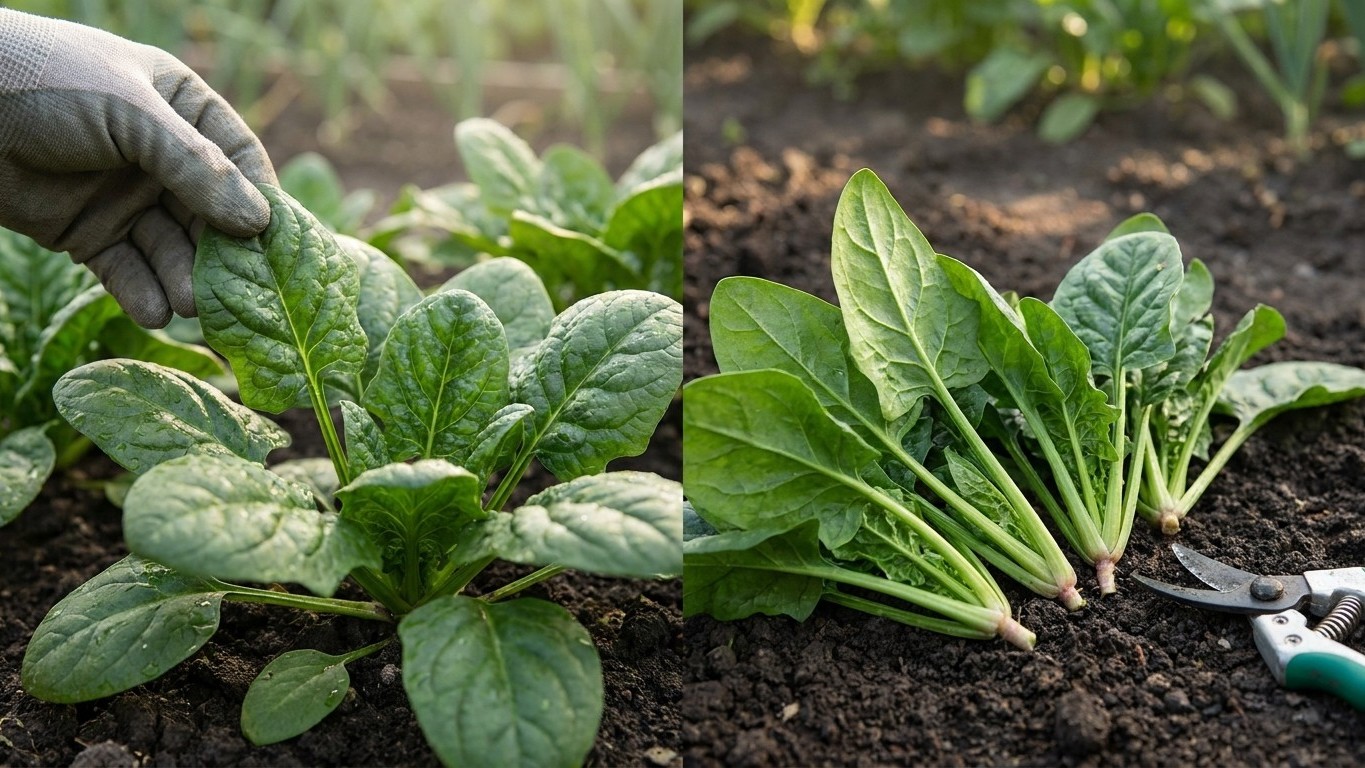

Both work, and Utah State University Extension confirms it right in its Spinach in the Garden guide: pick individual leaves anytime before the flower stalk forms, or cut the whole planting down to within 2 inches of the soil in one pass. The choice isn’t really about which method is “correct.” It’s about how much spinach you want now versus later, and how fast your plants are racing toward bolting.
The short answer

Utah State University Extension lays out the two options plainly. You can harvest leaf by leaf, taking outer leaves as they mature and leaving the center of the plant to keep producing, right up until a flower stalk starts to form. Or you can go all at once, cutting every leaf off to within 2 inches of the soil in a single harvest. The source doesn’t rank one method over the other. It simply describes both as valid, which tells you the decision belongs to the gardener, not the plant.
What does matter is timing relative to that flower stalk. Once it forms, the leaves turn bitter, and no amount of careful cutting fixes that. So the leaf-by-leaf approach works best when you want a rolling supply, a handful of leaves for a salad tonight, a few more in three days. The cut-it-all method makes more sense when a bed is clearly heading toward bolting and you want to capture everything at peak quality before it turns.
Storage backs up the case for a bigger single harvest. Utah State University Extension notes that spinach can be stored for 1-2 weeks at 32 F and 95 percent relative humidity. That’s a real window, not a same-day-or-lose-it situation. A refrigerator crisper drawer with a damp towel gets you reasonably close to those numbers for a home kitchen, so cutting the whole bed at once and working through it over a week or two is a practical option, not a wasteful one.
Leaf-by-leaf harvesting, on the other hand, suits gardeners who are watering on schedule (spinach wants 1-2 inches per week) and checking plants regularly anyway. If you’re already out there most days, pulling a few outer leaves costs nothing extra. The all-at-once method suits people who check the garden less often and would rather not gamble on catching the exact day before bitterness sets in.
What actually decides it
The real driver behind which method makes sense isn’t personal preference. It’s how close the plant is to bolting, and two separate mechanisms push it there.
Long days trigger bolting
Spinach is wired to respond to daylight length, and here’s the part worth getting straight: long days push spinach toward flowering, which is the opposite of what long days do to a bulb onion. Onions use long days to build the bulb. Spinach uses long days to bolt. Same variable, opposite outcome, and confusing the two is an easy mistake to make if you garden both crops. As days stretch out later in spring, spinach plants sense that shift and start committing energy to a flower stalk instead of leaf growth. That’s the exact moment Utah State University Extension flags as the end of the harvest window, since once the stalk forms, the leaves turn bitter.
Heat above 75°F turns leaves bitter
Temperature adds a second, separate pressure. Warm weather is a growth ceiling for spinach, and that same threshold, 75 F, is also the point past which flavor turns bitter. It isn’t a calendar date you can mark in advance. It’s a condition that shows up whenever the weather delivers it, whether that’s an early warm spell or a stretch of unseasonably hot days. Combine that with lengthening daylight and you get a narrow window where the plant is both daylight-triggered and heat-stressed toward bolting at nearly the same time. That’s why harvest timing for spinach is described as a race against bolting rather than something you schedule on a fixed day count.
How to do it
- Time the planting around soil temperature, not the calendar. For a fall crop, Utah State University Extension recommends planting 50 to 75 days before the date you want to harvest. In hot regions, that window doesn’t open until the soil cools, since germination drops once soil temperature climbs above 80 F. Warm soil is the actual obstacle for fall sowing, not cold weather.
- Water consistently through the growing period. Spinach needs 1-2 inches of water per week. Uneven watering stresses the plant and can hasten the shift toward bolting, so keeping this steady matters more than any single harvest decision.
- Check plants regularly as days lengthen. Look specifically for the start of a flower stalk. This is the signal that ends the harvest window, since leaves turn bitter once it forms.
- Pick your method based on what you see. If the planting still looks weeks away from bolting, harvest individual outer leaves as needed and let the center keep producing. If a flower stalk is starting or the weather has turned hot, cut all the leaves down to within 2 inches of the soil in one harvest.
- Store what you don’t use right away at 32 F and 95 percent relative humidity. Utah State University Extension notes spinach holds for 1-2 weeks under those conditions, which gives a cut-all harvest real staying power in the refrigerator.
What Goes Wrong
- Aphids build up on leaf undersides. Utah State University Extension lists aphids among the problems spinach faces. Check leaves regularly, especially the leaf-by-leaf harvest where plants stay in the ground longer, and remove or treat infested leaves promptly rather than letting populations grow.
- Slugs chew ragged holes, often overnight. This is another problem the source names directly. Damp mulch and cool, moist soil (conditions spinach likes) also favor slugs, so keep an eye on lower leaves and remove damaged foliage as part of your regular leaf-by-leaf picking.
- Flea beetles riddle leaves with small holes. Also listed as a spinach problem by Utah State University Extension. Light damage is cosmetic and doesn’t stop harvest, but heavier infestations call for closer monitoring and prompt removal of the worst leaves.
- The flower stalk forms before you get to harvest. This is the failure that matters most: once it appears, leaves turn bitter and there’s no fixing that batch. The remedy is prevention through timing, watching daylight length and heat closely as the season progresses, and leaning toward the all-at-once cut the moment conditions (long days, temperatures near or above 75 F) start pointing toward bolting rather than waiting for a “perfect” later harvest that may never come.
Common questions
Can I keep harvesting the same spinach plant all season?
Yes, with the leaf-by-leaf method, as long as you pick individual leaves before the flower stalk forms. Once that stalk appears, the remaining leaves turn bitter regardless of how you harvest them.
Is it better to cut spinach in the morning or evening?
Utah State University Extension’s guide doesn’t specify a time of day. The published guidance focuses on the flower stalk as the deciding factor, not the hour of harvest.
Which spinach variety holds up longest before bolting?
Utah State University Extension names Bloomsdale, Melody, Teton, and Olympia as spinach varieties, but the source publishes no performance data comparing them. There’s no verified basis for ranking their bolt resistance.
Why did my fall spinach planting fail to germinate?
Warm soil is the likely cause. Germination drops once soil temperature climbs above 80 F, so in hot regions the planting window for a fall crop doesn’t open until the soil has cooled, generally 50 to 75 days before the target harvest date.