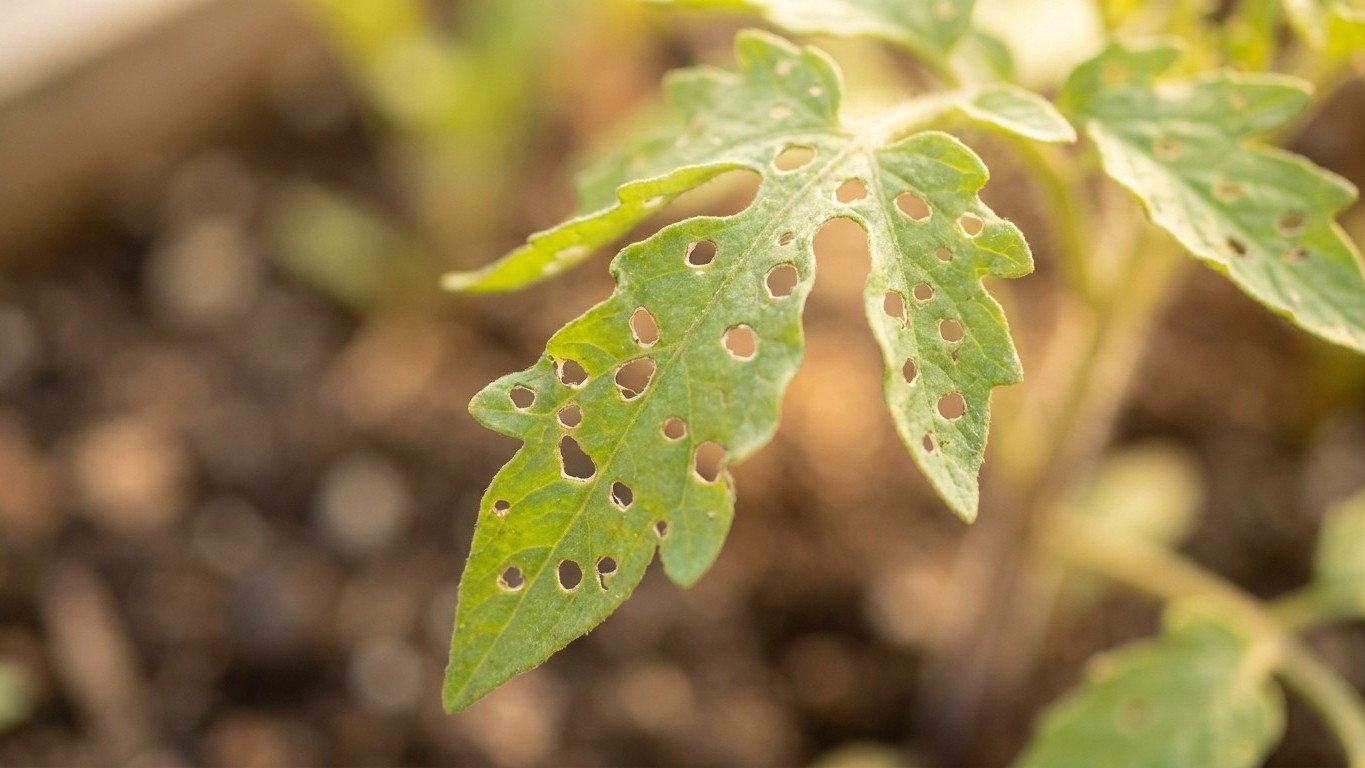

Tiny round holes scattered across the leaf surface, like someone took a hole punch to it in a dozen random spots, mean flea beetles. On an established tomato plant with plenty of foliage, this is mostly cosmetic and the plant will outgrow it. On a young transplant with only four or six leaves, it’s a different story: enough feeding can stall growth or kill the seedling outright before it ever sets fruit.
What the damage looks like

The detail that separates flea beetle damage from almost everything else on a tomato plant is the shape and distribution of the holes. They’re small, round to slightly irregular, rarely more than 1/8 inch across, and they don’t follow the leaf edge. Caterpillars and slugs chew inward from the margin, leaving a scalloped or ragged border. Flea beetles punch through the middle of the leaf blade, sometimes so densely that a badly hit leaf looks like it’s been shot with birdshot, which is exactly the nickname growers use for this kind of injury.
The holes themselves stay small because the beetles rarely eat all the way through in one spot on a mature leaf. On the youngest leaves near the growing tip, though, the tissue is thinner and the same feeding can leave the whole leaf tattered or curled. There’s no slime trail, no sticky residue, and no webbing associated with this damage. If you turn the leaf over, you generally won’t find anything clustered underneath, because these insects feed and move on rather than settling in one place the way aphids or mites do.
The insects themselves are easy to miss because they’re so small, usually under 1/8 inch long, dark and shiny, sometimes with pale stripes down the back depending on the species. The behavior gives them away faster than the appearance: disturb the plant even slightly, brush a leaf or cast a shadow over it, and they leap away instantly, hence the name. That jumping reflex, powered by enlarged hind legs, is the single most reliable field identifier. Aphids don’t jump. Neither do leafhoppers in quite the same explosive way, and certainly not slugs or caterpillars.
Feeding tends to concentrate on the top leaves and the newest growth, since that tissue is softest. On a plant that’s been in the ground a few weeks and has ten or more leaves, a scattering of shot-holes on the upper foliage is annoying but rarely worth treating. On a seedling still in its first two weeks outdoors, the same beetles working over a plant with only three true leaves can strip enough leaf area to set the plant back for good, which is really the only scenario where this pest deserves real concern.
Making sure it is this and not something else
Shot-hole damage has a short list of look-alikes, and each one separates out with a single check rather than guesswork.
Caterpillar or worm feeding
Young caterpillars, including early-stage hornworms or armyworms, chew ragged notches from the leaf edge inward and leave behind small dark droppings (frass) on the leaves below. Flea beetle holes sit in the middle of the leaf, not along the margin, and there’s no frass to find. Check the underside of nearby leaves for the caterpillar itself or its droppings before assuming beetles.
Slug and snail damage
Slugs and snails also chew irregular holes through the leaf blade, which can look similar at a glance. The tell is the silvery slime trail left behind, plus the timing: slugs feed at night and in damp conditions, so damage shows up without any insect visible during the day. No slime, no beetle sighted jumping off when you touch the plant, points away from flea beetles.
Leafminer tunnels
Leafminers create winding pale tunnels inside the leaf tissue rather than open holes clean through the leaf. Hold the leaf up to light; a tunnel shows as a squiggly translucent line, while flea beetle damage is a clean perforation you can see daylight through from either side.
Spider mite stippling
Mite damage looks like fine yellow speckling or bronzing across the leaf surface, not distinct holes, and comes with fine webbing on the underside in heavy infestations. No actual perforation forms with mites, which is the quickest way to rule them out.
When it shows up
Flea beetles are almost entirely a young-plant problem. The window of real risk runs from the moment a transplant goes into the garden until it’s established enough to be pushing out new leaves faster than the beetles can damage them, typically once the plant has a strong set of true leaves and is actively branching. Before that point, a seedling has little spare leaf area to lose, and heavy feeding on the first true leaves can stunt it permanently.
Adult beetles overwinter in garden debris and leaf litter, then emerge and start feeding as soon as the weather warms and tender new growth becomes available, which is why fresh transplants set out into a garden bed that still has old plant debris nearby tend to get hit hardest. Warm, dry stretches favor them; a cool, damp spell will often knock activity down on its own without any intervention. Stressed transplants, ones that went into the ground with root damage or without hardening off properly, seem to draw more attention, possibly because a stressed plant produces less of the volatile compounds that otherwise make tomato foliage less appealing.
Once the plant is well established, mid-season and later, flea beetles rarely matter even if you spot the occasional hole. The plant has enough leaf area that a few dozen shot-holes make no measurable difference to the fruit crop. The exception is a second wave of pressure on plants that were already stressed by drought or transplant shock and haven’t fully recovered, where continued feeding on the same limited foliage can compound the setback.
What to do now
- Cover young transplants. A lightweight floating row cover set over hoops immediately after transplanting is the cheapest and most reliable fix. It physically blocks the beetles from reaching the plant during the vulnerable first weeks and costs nothing but the material and a few minutes to install.
- Clean up nearby debris. Since adults overwinter and shelter in old plant matter and weeds, especially nightshade-family weeds growing near the bed, clearing that debris and mowing or pulling weeds around the tomato bed removes a hiding spot without any product cost.
- Use yellow sticky traps to gauge pressure. A few cards placed at plant height near the row won’t wipe out a population, but they tell you whether beetle numbers are actually high enough to worry about before you spend money on anything else.
- Apply kaolin clay. A spray-on kaolin clay product coats the leaf surface and makes it unrecognizable and unpalatable to the beetles. It’s approved for organic production, widely sold at garden centers, and needs reapplication after rain but doesn’t harm pollinators or predatory insects.
- Reach for spinosad only if pressure is severe on seedlings. Spinosad-based insecticides, sold under several garden-store brands, are labeled for flea beetles on vegetables and are less broadly toxic to beneficial insects than older broad-spectrum sprays, though they can still harm bees if applied while the plant is flowering, so treat foliage only and avoid open blooms. Check the product label for tomato-specific rates and days-to-harvest, and avoid reaching for general-purpose pyrethroid sprays, which will also kill the lady beetles and predatory ground beetles that keep other pests in check.
Stopping it coming back
- Hold transplants indoors a bit longer so they go into the garden with a stronger root system and more established leaves, past the stage where a few shot-holes matter.
- Rotate tomatoes and other nightshade-family crops (peppers, eggplant, potatoes) to a different bed each season, since beetles overwintering near last year’s planting site find a host waiting right where they emerge.
- Clear tomato and weed debris from the bed at season’s end rather than leaving it to overwinter, cutting down on the sheltered spots adults use to survive cold months.
- Plant a trap crop of radish or mustard greens a few feet away; flea beetles strongly prefer these to tomato foliage and will often concentrate there instead.
- Keep broad-spectrum insecticide use to a minimum through the season so that predatory insects, including ground beetles and lady beetles, stay established in the bed and help keep beetle numbers down without any spraying at all.
- Have row covers ready to install at transplant time every season rather than waiting to see damage first, since the protection only helps if it’s in place before beetles find the young plants.
Common questions
Will flea beetle damage kill my tomato plant?
Rarely, and only when the plant is still a small seedling with just a handful of leaves. Established plants with full foliage tolerate shot-hole feeding without any real drop in fruit production.
Do flea beetles spread disease to tomatoes?
They aren’t a major disease vector on tomatoes the way aphids or leafhoppers can be on other crops, so the concern here is leaf area loss on young plants, not disease transmission.
Can I just wash the beetles off with water?
A strong water spray will knock some off temporarily, but since they fly and jump readily, most return within minutes. It’s not a reliable control on its own, though it can reduce numbers slightly while a row cover or trap crop takes effect.
Are flea beetles the same on every vegetable in my garden?
No. Several related species specialize in different hosts, so the ones hammering your eggplant or radishes aren’t necessarily the same population working over your tomato seedlings, even though the damage looks identical across crops.