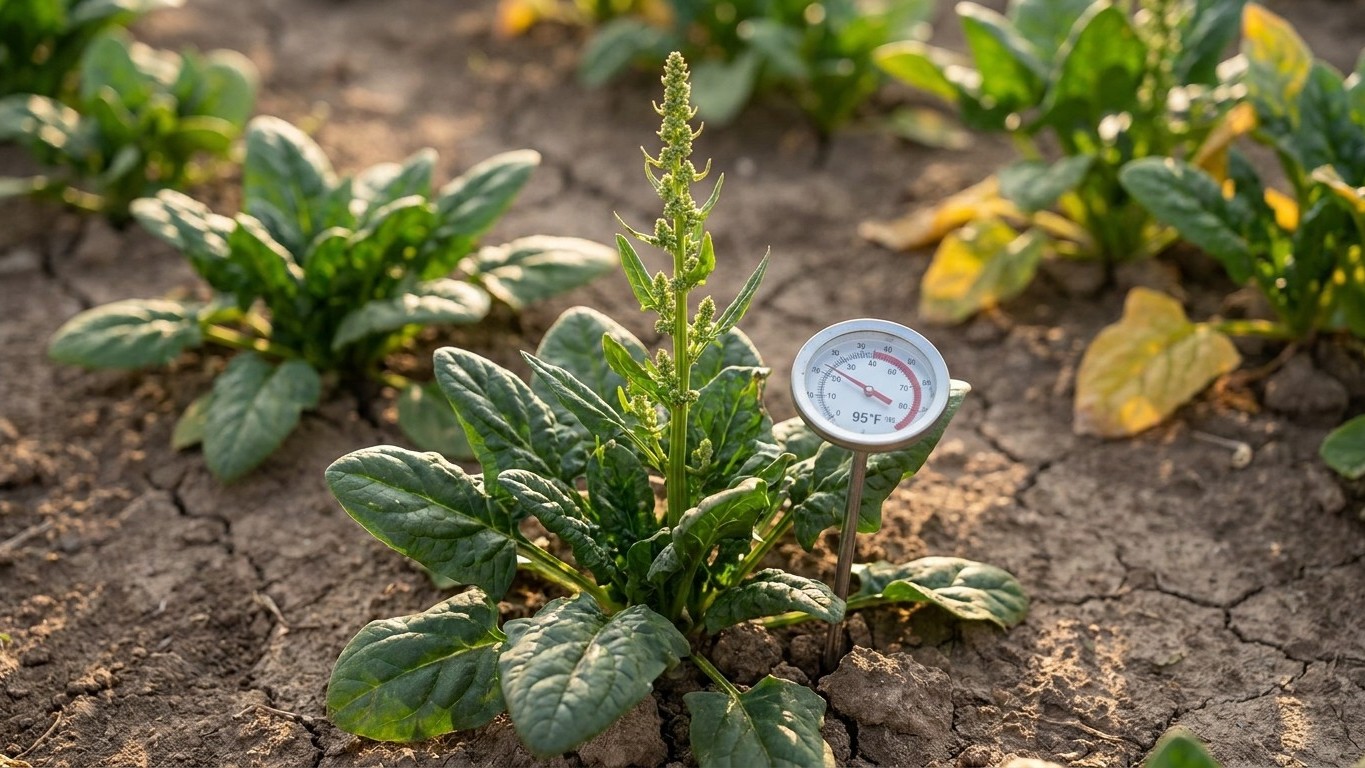

Spinach usually fails for one of two reasons: heat pushes it into bolting before you get a real harvest, or the soil was too warm (or too cold) for the seed to come up in the first place. Utah State University Extension pins the germination sweet spot at 55-65°F, and notes that temperatures above 80°F reduce germination outright. Everything else, aphids, slugs, flea beetles, watering mistakes, is secondary to those two thresholds.
The short answer

According to Utah State University Extension, spinach seed can be sown once soils reach 40°F, but the seed only germinates well between 55-65°F, and needs 7-10 days to emerge even under good conditions. Push past 80°F and germination drops off a cliff. That narrow window is the first place spinach goes wrong: gardeners sow too early into cold, slow soil, or too late into soil that’s already baking, and end up with a patchy stand or no stand at all.
The second, more common failure happens after the plants are already up. Spinach is a cool-season leaf crop, and once temperatures climb and days lengthen, the plant switches from making leaves to making a flower stalk. Utah State University Extension is direct about the consequence: individual leaves may be picked any time before the flower stalk forms, but once it forms, the leaves turn bitter. There’s no walking that back. The harvest window closes the moment bolting starts, which is why spinach growing is described as a race against the calendar rather than a crop you can harvest whenever it’s convenient.
Insects and slugs come third on the list of things that go wrong, and they’re the problems Utah State University Extension actually names for this crop: aphids, slugs, and flea beetles. None of them are unique to spinach, but a dense stand of tender young leaves growing in cool, damp spring soil is exactly the environment slugs prefer, and aphids find the undersides of spinach leaves an easy place to hide from casual inspection.
Storage adds a fourth failure point that has nothing to do with the garden. Spinach holds for 1-2 weeks at 32°F and 95 percent relative humidity. Anything warmer or drier than that, a crisper drawer that isn’t cold enough, a bag that’s been left open, and the leaves wilt or yellow well before the two-week mark. So when someone asks what goes wrong with spinach, the honest answer is a short list: bad timing on the sow date, bolting from heat and long days, a handful of predictable pests, and storage conditions that don’t match what the plant actually needs after it’s picked.
What actually decides it
Day length and heat push spinach to bolt
Spinach bolts when long days and warm temperatures arrive together, and that’s a fundamentally different mechanism than what happens in an onion patch. In onions, long days tell the plant to start forming a bulb, that’s the whole point of the crop. In spinach, long days do the opposite: they signal the plant to stop making leaves and put its energy into a flower stalk instead. The same environmental cue produces opposite outcomes depending on what’s growing. Utah State University Extension identifies 75°F as a meaningful threshold here. It functions as both a growth ceiling and a bitterness threshold, the same number carries two consequences. Once temperatures regularly sit at or above that mark, especially combined with the longer daylight of late spring, bolting accelerates and the leaves that do remain lose their mild flavor.
Soil temperature decides whether seed comes up at all
Separately from bolting, there’s the germination problem, and it’s governed by soil temperature rather than day length. Seed sown before soils reach 40°F mostly sits and waits. Seed sown into the 55-65°F range comes up in 7-10 days, which is the reliable outcome. Push soil temperature above 80°F and germination rates drop, regardless of moisture or seed quality. This is also why a fall crop is trickier to time than a spring one: the autumn sowing isn’t blocked by cold weather, it’s blocked by warm soil. In a hot region, the planting window for fall spinach doesn’t open on a fixed date. It opens when soil temperatures actually fall back into that germination range, which can be later than gardeners expect if the season is running warm.
How to do it
- Check soil temperature before sowing. Utah State University Extension allows sowing once soil reaches 40°F, but germination is far more reliable in the 55-65°F range.
- Sow seed 1/2 inch deep, 2-3 weeks before the last spring frost, so the crop gets its cool-season growth in before heat arrives.
- Wait out the 7-10 day emergence window. Don’t resow early just because nothing has shown yet; that’s the normal timeline at the right soil temperature.
- Thin seedlings, or transplant, to 3 inches apart within the row, keeping rows 12 inches apart, once true leaves appear.
- Water consistently at 1-2 inches per week. Spinach’s shallow root system doesn’t tolerate long dry stretches, and moisture stress is one more thing that hurries plants toward bolting.
- Watch the plants rather than a date on the calendar. Harvest individual leaves any time before the flower stalk forms, or cut the whole planting to within 2 inches of the soil for a single bigger harvest.
- For a fall crop, count backward. Utah State University Extension advises planting 50 to 75 days before the date you want to harvest, adjusted for when soil temperature actually drops out of the danger zone above 80°F.
- Cool the harvest fast. Store spinach at 32°F and 95 percent relative humidity, where it holds for 1-2 weeks.
What goes wrong
- Sowing into soil that’s still too cold. Seed sown right at the 40°F minimum germinates slowly and unevenly. Wait until soil temperature is closer to the 55-65°F range for a stand that comes up together in 7-10 days.
- Sowing into soil that’s already too warm. Above 80°F, germination drops sharply. For late spring or fall sowings, test the soil rather than guessing, and delay if it’s running hot.
- Bolting from heat and long days. Once temperatures push past 75°F and days lengthen, plants shift to a flower stalk and the leaves turn bitter. There’s no fix once it starts, only earlier harvest next time or choosing a fall planting window instead.
- Aphids. They colonize the undersides of leaves in cool, humid conditions. Check leaf undersides regularly through the growing period, since Utah State University Extension lists aphids among the crop’s recurring problems.
- Slugs. Cool, damp spring soil with dense young growth is ideal slug habitat. Reducing surface moisture and clearing hiding spots near the row helps limit damage.
- Flea beetles. These leave small shot-holes in leaves, particularly on young plants. They’re named specifically by Utah State University Extension as a spinach problem to watch for.
- Harvested leaves wilting fast. Spinach only holds 1-2 weeks even under ideal conditions of 32°F and 95 percent relative humidity. A warm refrigerator or an open bag shortens that window considerably.
- Uneven stands from crowding. Skipping the thinning step to 3 inches apart in rows 12 inches apart leaves plants competing for light and moisture, which can hasten bolting in the weaker plants.
Common questions
Does spinach need long days to grow well?
No. Long days are the trigger that pushes spinach toward bolting and bitter leaves, not something the plant benefits from. That’s the opposite of how long days function in a crop like onions, where they signal bulb formation. For spinach, shorter cool-season days are what you want during the leaf-growing stage.
How many days does spinach take to mature?
Utah State University Extension doesn’t publish a days-to-maturity figure for spinach. For planning a fall crop, the source instead advises sowing 50 to 75 days before the date you want to harvest, which accounts for slower cool-season growth rather than a fixed maturity count.
Which spinach varieties should I plant?
Utah State University Extension names Bloomsdale, Melody, Teton, and Olympia as spinach varieties, without publishing growth data, days to harvest, or performance comparisons for any of them. Choosing among them comes down to availability and personal preference rather than documented differences.
Can I plant spinach in fall instead of spring?
Yes, and in hot regions it’s often more reliable than a spring crop, because the plant matures during cooling temperatures instead of racing the heat. The catch is timing the sowing to soil temperature, not the calendar. The window opens once soil temperatures drop back down out of the above-80°F range that reduces germination, which may be later in the season than gardeners assume.