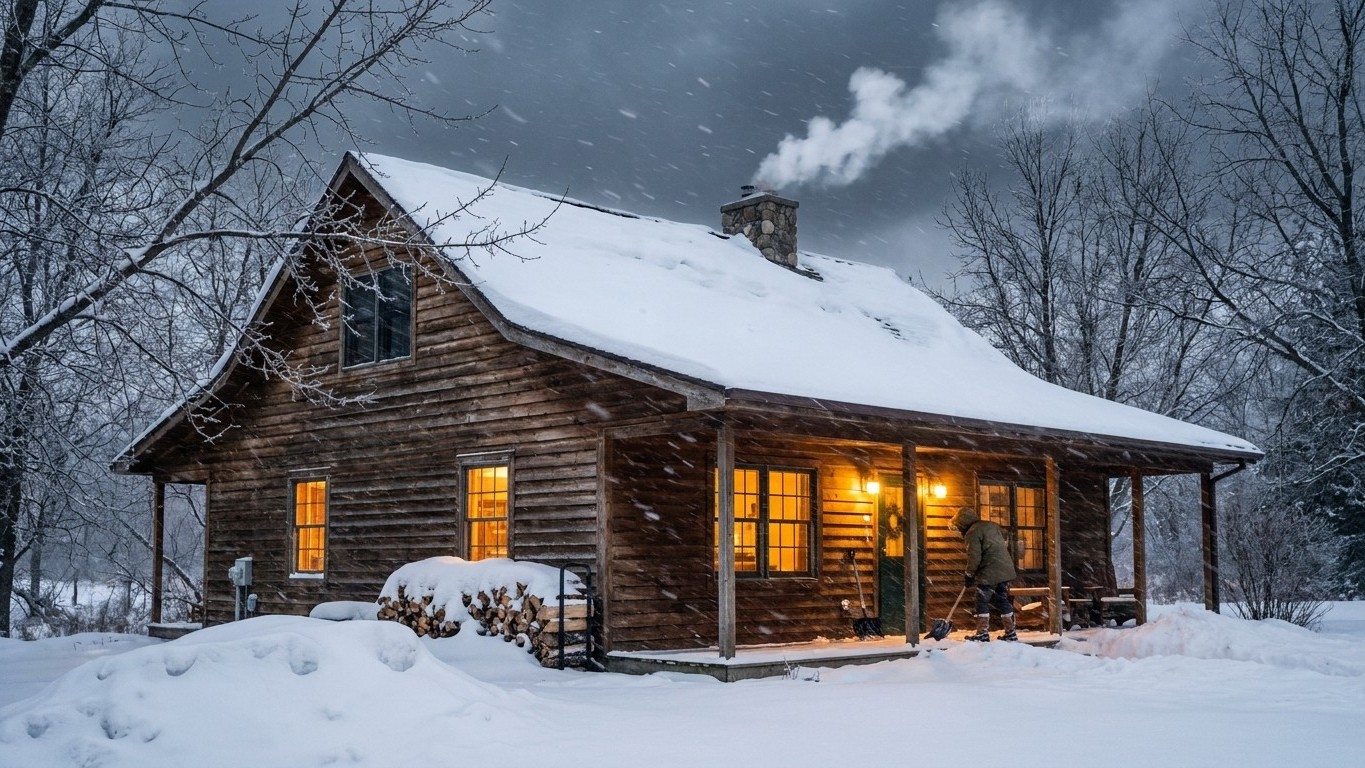

Minnesota winters don’t just get cold, they stay cold, and that single fact drives every heating decision a household here makes. The coldest month’s average low sits at 8.8°F, well below freezing for weeks on end. Whether you’re burning wood, running a furnace, or both, the numbers below show what that cold actually demands.
How cold it gets, and for how long

The average daily minimum in the coldest month, measured at the Minneapolis reference station, comes in at 8.8°F. That’s not the record low, and it’s not some abstract monthly average papering over warm afternoons. It’s the typical overnight floor, night after night, through the heart of winter.
A number like that changes what “heating season” means. In milder territories, a furnace or a wood stove might idle through a winter that hovers near freezing for a few months. When Does the Heating Season Start in Minnesota? Here, 8.8°F as a nightly minimum means sustained, hard-running heat for a long stretch, typically from October into April. The equipment isn’t just turning on, it’s working near capacity for days at a stretch when a polar air mass settles over the Upper Midwest.
What this means for equipment and fuel planning
Furnaces sized for milder climates get pushed harder here, and undersized wood stoves simply can’t keep up when the mercury sits in single digits for a week straight. Households that split heating between a primary system and a wood stove or insert need to plan fuel loads for a long season, not a short cold snap. Four to five months of real heating demand is the baseline to plan around, not the exception, and that long runway also shapes When Can You Turn the Heat Off in Minnesota?
That’s also why the seasoning and volume questions below matter so much in this territory. Wet wood or an undersized cord doesn’t just mean a chilly evening. It means running back to the supplier mid-January, when supply is tightest and drying time is nonexistent.
What a cord of wood is worth here
A cord is a volume, not a weight, and that distinction is where most firewood buyers get shorted. The standard measure is a stack 4 feet by 4 feet by 8 feet, which works out to 128 cubic feet of wood, bark, and the air gaps between splits. Two cords of birch and two cords of oak take up the same space on the ground. They do not deliver the same heat, because oak simply packs more wood mass into that stack.
According to Michigan State University Extension, a cord of well-seasoned hardwood delivers roughly 20 million BTU. That’s an average across species and assumes the wood is properly dried, not green off the stump. MSU frames that figure in a way that’s actually useful at the point of purchase: one cord is roughly equivalent to 145 gallons of #2 fuel oil, or 215 gallons of LP gas. For a household running wood alongside oil or propane heat, that comparison is the fastest way to judge whether a cord is worth what’s being asked for it.
| Cord dimensions | Volume | Heat value (seasoned hardwood) |
|---|---|---|
| 4 ft x 4 ft x 8 ft | 128 cubic feet | ~20 million BTU |
Given a heating season that runs four to five months in this territory, that 20 million BTU figure gives a rough sense of how many cords a wood-heavy household needs to lay in before the ground freezes. Undersized deliveries, or wood padded with rounds and short splits instead of a tight, measured stack, mean coming up short right when driveways ice over and dry wood gets hard to find.
How long wood takes to dry in Minnesota
Seasoning time isn’t a fixed number stamped on every species everywhere. It depends on humidity, summer heat, and airflow, which is exactly why a drying timeline that works in the humid Southeast doesn’t automatically apply to a Minnesota woodlot. MSU Extension sets the target at 20 percent moisture or less for burning, against green wood that can start out at over 60 percent moisture.
Split and stacked properly, with air moving freely through the pile, wood typically reaches that 20 percent mark after one full summer of drying. The key words are split and stacked. Rounds left whole, or wood piled in a dense heap with no airflow, dry far slower regardless of how much sun hits the pile. Red oak is the notable holdout: MSU flags it as slower to season than most other hardwoods because of its cell structure, so it needs more time on the stack before it’s ready to burn.
Burning too soon carries a real cost beyond a weaker fire. Wood that’s still holding 40 or 50 percent moisture spends a chunk of its combustion energy just boiling off water before it ever produces usable heat. That means less warmth per log, more smoke, and more creosote building up in the flue. Creosote buildup is what drives chimney fires and shortens the interval between chimney sweepings. None of that is dramatic on any single cold night, but it compounds over a five-month heating season, which is exactly the kind of season this state has.
Buying wood in late summer or early fall for the coming winter almost guarantees green wood unless it’s been seasoned by the seller for a full year already. Splitting and stacking in spring, for burning the following winter, is the more reliable path for anyone cutting their own.
Where to check before you buy
These figures describe conditions at the Minneapolis reference station, but Minnesota spans a wide range of terrain, from the Iowa border up to the Canadian boundary, and local conditions shift with latitude, elevation, and lake effect. A woodlot in the Arrowhead region dries on a different schedule than one near Rochester.
Species availability also varies by region, and burn restrictions, when local air quality or fire danger call for them, are set at the county or municipal level and can change from one year to the next. Before laying in a wood supply or planning a burn schedule, check with the University of Minnesota Extension for guidance specific to your county, including which species are locally abundant and whether any seasonal restrictions apply. That’s the source built to answer questions this general guide can’t, because it’s tuned to a whole state rather than one reference city.