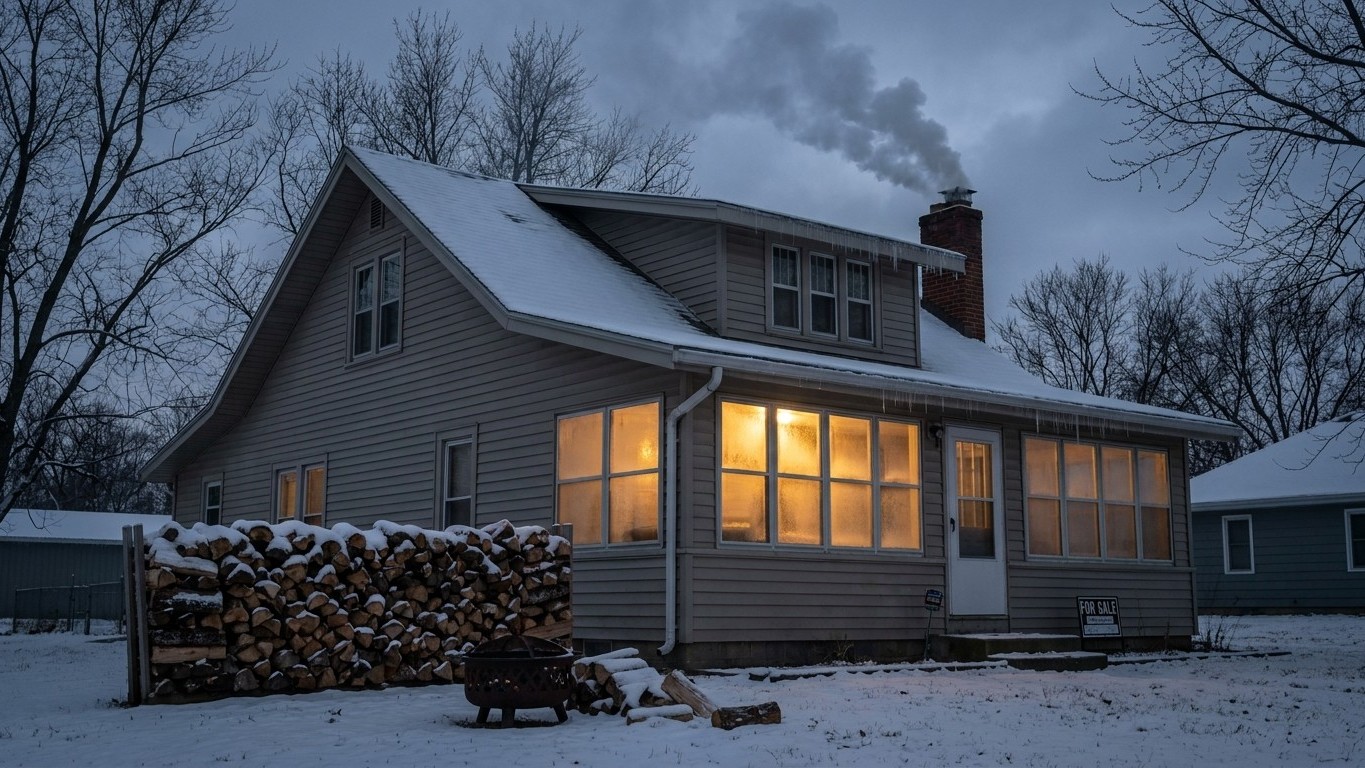

Missouri winters hover a few degrees below freezing on an average night through the coldest stretch, which sounds mild until you tally up how many weeks the furnace has to fight that chill. Here’s what the season actually demands from a house, and from the wood pile if you’re heating with a stove.
How cold it gets, and for how long

The coldest month in Missouri averages a daily low of 19.5°F, based on NOAA’s 1991-2020 Climate Normals for the Kansas City reference station. That’s the mean minimum, not the record low and not some cherry-picked cold snap. It’s the Temperature a typical night in January settles into, over and over, for weeks at a stretch.
Nineteen and a half degrees isn’t Arctic. But it’s cold enough that a furnace or wood stove isn’t cycling on and off for comfort. It’s running to keep pipes from freezing and to keep the living room above 65°F through the darkest part of the night. The number that matters more than the low itself is duration. A place that dips to 19.5°F for two or three nights a year is a different animal than one that sits near that mark from December through February, which is closer to the Missouri pattern, and knowing When Does the Heating Season Start in Missouri? helps homeowners plan for that long stretch of sustained heating.
That stretch changes what equipment makes sense. A furnace sized for occasional cold snaps will run nearly nonstop in a Missouri winter, driving up wear and fuel use. A wood stove, if that’s the heat source, needs a fuel supply that can carry a household through roughly four months of regular firing, not just a few cozy weekends. The mean minimum also explains why insulation and air sealing pay off more here than in milder territories: every degree of heat lost through a drafty window or an underinsulated attic gets multiplied by the sheer number of cold nights, not just the depth of any single cold snap, and knowing When Can You Turn the Heat Off in Missouri? helps homeowners spot the other end of that long heating stretch.
For homeowners weighing a furnace tune-up against a wood-burning setup, this figure is the baseline. It tells you the system needs to be built for sustained output, not peak output.
What a cord of wood is worth here
A cord of well-seasoned hardwood delivers about 20 million BTU, according to Michigan State University Extension. That’s the standard against which every load of firewood in Missouri should be measured, and it comes with a catch most buyers never think to check: a cord is a volume, not a weight or a guarantee of heat content.
The measurement is fixed by definition. A stacked cord runs 4 feet by 4 feet by 8 feet, which works out to 128 cubic feet of wood, bark, and the air gaps between the pieces. That volume doesn’t change whether the wood is soft pine or dense oak, and that’s exactly where firewood buyers get shorted. A cord of a dense species packs more actual wood mass into that same 128 cubic feet, and more mass means more BTU when it burns. A “cord” of loosely stacked, oddly shaped rounds can shortchange you on wood content even if the outer dimensions look right.
What 20 million BTU actually buys
| Measurement | Value |
|---|---|
| Cord dimensions | 4 ft x 4 ft x 8 ft |
| Cord volume | 128 cubic feet |
| Heat energy (seasoned hardwood) | about 20 million BTU |
| Equivalent in #2 fuel oil | roughly 145 gallons |
| Equivalent in LP gas | roughly 215 gallons |
MSU’s comparison to fuel oil and propane is useful for sizing up how far a cord actually goes: one cord of seasoned hardwood is in the same energy ballpark as 145 gallons of heating oil or 215 gallons of LP gas. Against a four-month Missouri heating season, that gives a household a rough sense of how many cords a wood-heated home might need to get through winter, though the exact count depends on the house, the stove’s efficiency, and how much of the heating load wood is actually carrying.
The seasoning matters as much as the species. Wet wood doesn’t just burn poorly, it burns backward: the fire has to boil off moisture before any of that stored energy reaches the room, so a green log spends part of its combustion heating water instead of heating you.
How long wood takes to dry in Missouri
Firewood needs to reach 20 percent moisture or less before it burns efficiently. Green, freshly cut wood can carry more than 60 percent moisture, which is why burning it feels like fighting the fire instead of enjoying it.
Split and stacked properly, so air moves freely between the rows, most green hardwood reaches that 20 percent threshold after one full summer of seasoning. The operative words are split and stacked. Wood left in whole rounds, piled in a heap, or covered too tightly to breathe can sit for a year and still be wet at the core. Airflow does the work; time alone doesn’t.
Red oak is the named exception worth knowing about if you’re buying or cutting your own in Missouri, where oaks are common. Its dense cell structure holds moisture longer than most other hardwoods, so a single summer often isn’t enough. Wood that looks and feels ready sometimes still has a wet interior, which is easy to miss if you’re only checking the surface.
Burning wood before it’s properly seasoned costs you twice. First, the heat output drops because energy is going into evaporating water rather than warming the house, meaning more wood burned for less comfort. Second, unseasoned wood burns cooler and produces more smoke, and that smoke condenses inside the flue as creosote. Enough creosote buildup and a chimney needs sweeping sooner than it should, and in the worst cases becomes a fire hazard. Neither problem shows up the first time you burn wet wood. Both compound over a season, which is why seasoning time isn’t a detail to skip past when planning a wood-heated winter.
Where to check before you buy
The figures here describe conditions at the Kansas City reference station, and Missouri stretches well beyond that single point. Elevation, river valleys, and exposure to wind all shift local conditions, sometimes by a meaningful margin from what a statewide average suggests.
For guidance tailored to a specific county, from which tree species are locally abundant to how wood should be sourced and stored in that particular climate pocket, the University of Missouri Extension is the resource built for exactly that. Extension offices also track burn restrictions, and those rules are worth checking every single year rather than assuming last winter’s rules still apply.
Open burning and outdoor wood-boiler rules in Missouri are set at the local level, meaning a county or municipality, not a single statewide standard, and they can change from one season to the next based on air quality conditions or local ordinance updates. What’s allowed in a rural township doesn’t necessarily apply within city limits, or in a neighboring county. Before hauling in firewood or planning to rely on a wood stove for a chunk of the winter’s heat, a quick call or visit to the local extension office settles both questions at once: what wood is realistically available nearby, and what the current rules allow for burning it.
What each heat source costs to run in Missouri
At Missouri’s average residential prices, this is what one million Btu of heat delivered into the house costs with each system. It compares fuels on the same unit: it is not a yearly bill, and it leaves out the price of the equipment.
| System | Cost per million Btu delivered |
|---|---|
| Electric resistance (baseboard, 100% efficient) | $40.91 |
| Heat pump at 8.1 HSPF2 (seasonal COP about 2.4) | $17.23 |
| Natural gas furnace at 97% AFUE | $14.85 |
Cheapest to run in Missouri: natural gas furnace, $2.38 less per million Btu than the heat pump.
Prices: U.S. Energy Information Administration (EIA), average residential prices. Efficiencies: ENERGY STAR criteria. A heat pump’s figure is a seasonal average; in the coldest weather its efficiency drops.