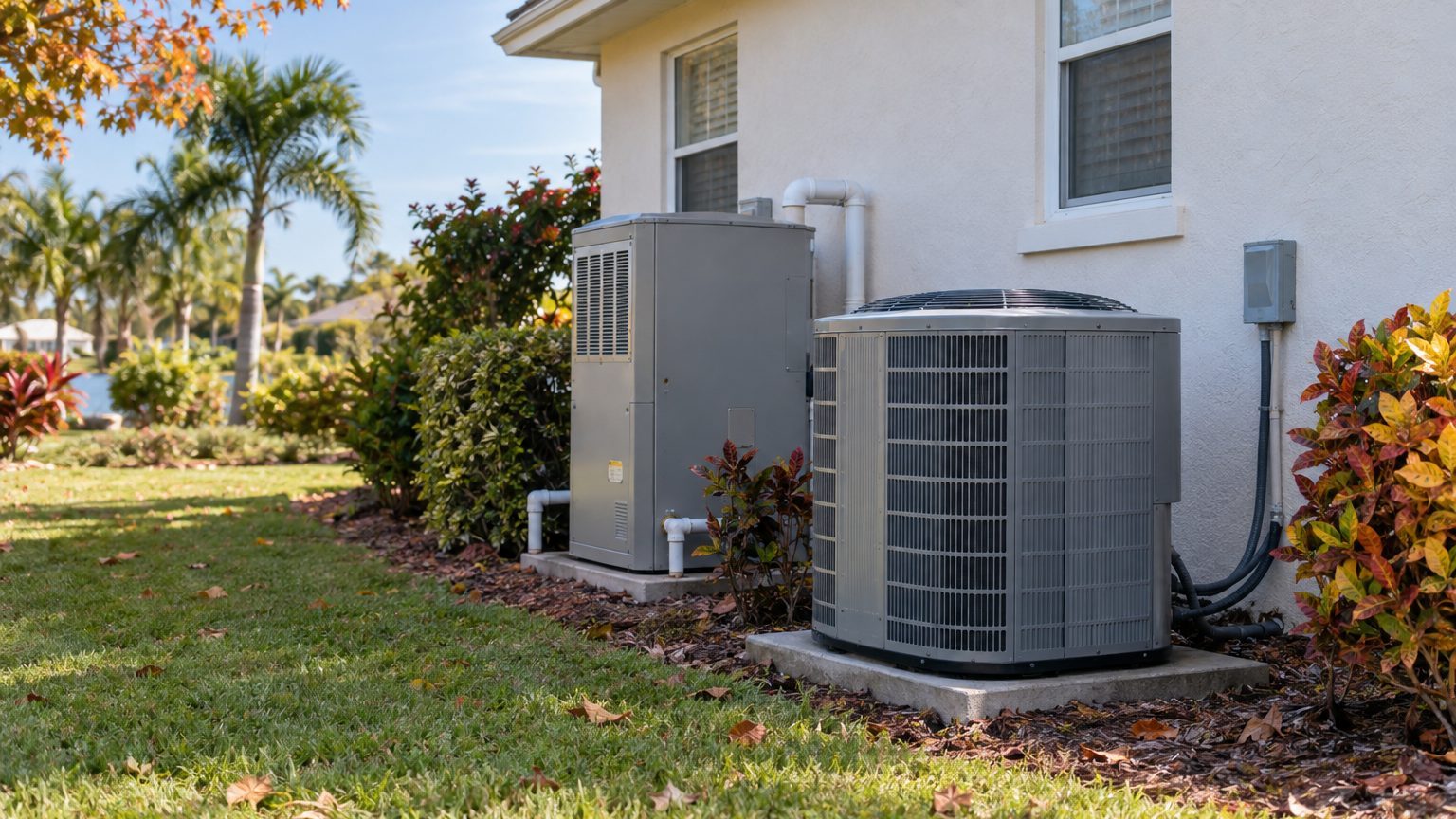

On running cost alone, a 95% AFUE gas furnace beats a heat pump in Kentucky. The gap is real but small, and a few ordinary situations flip the result. A house with no gas line is the biggest one. Whether the heat pump also replaces your air conditioner matters almost as much.
The short answer for Kentucky
Start with what one million Btu of heat costs once it reaches the living space. Using average Kentucky residential prices, a natural gas furnace at 95% AFUE delivers it for $14.44. A heat pump at 8.1 HSPF2 (a seasonal COP of about 2.4) delivers it for $17.62. Electric resistance, meaning baseboard or a plain electric furnace, costs $41.82. These figures are computed from U.S. Energy Information Administration residential prices, ENERGY STAR efficiencies and standard EIA energy conversions.
So the gas furnace is the cheapest of the three to run here, $3.18 less per million Btu than the heat pump. Compared with resistance heat, both are in a different league. The heat pump’s real rival in this state is the furnace, and the margin between them is small.
This compares running cost on the same unit of heat. It is not a yearly bill, which depends on your square footage, insulation, thermostat habits and rate plan. It is also not the price of equipment, which includes installation, ductwork changes and any gas line work. Your local utility’s rate and monthly customer charge can move the statewide averages, so pull a recent gas bill and compare it before you commit.
For a house that already has a working gas line, the gas furnace is the cheaper one to run; without a gas line, the heat pump wins easily over resistance heat.
What each option costs to run in Kentucky
| System | Efficiency used | Cost per million Btu delivered |
|---|---|---|
| Natural gas furnace | 95% AFUE | $14.44 |
| Heat pump | 8.1 HSPF2 (seasonal COP about 2.4) | $17.62 |
| Electric resistance (baseboard) | 100% efficient | $41.82 |
Electricity is priced at 14.27 cents per kWh, the average residential price for the year to date in the U.S. Energy Information Administration’s Electric Power Monthly, Table 5.6.B. Natural gas uses the EIA’s average residential price for the state, converted at about 1,037 Btu per cubic foot, with electricity converted at 3,412 Btu per kWh. Both are statewide averages, so use them to compare fuels, never as your own bill.
Fuel price is only half the arithmetic. Resistance heat turns each kWh into exactly one kWh of heat, which is why it lands so far above the others on the same 14.27-cent electricity. A heat pump moves heat from outdoor air into the house, so each kWh buys a seasonal average of about 2.4 times as much. A gas furnace at 95% AFUE turns 95% of the fuel’s energy into heat for the house.
The heat pump figure uses 8.1 HSPF2, the ENERGY STAR minimum for ducted split systems and single-package units. The same program asks 8.5 HSPF2 of non-ducted (ductless) systems, which have no duct losses and so must be better to earn the same label. What HSPF2 Measures, and Why Ductless Asks for More is worth a read before you compare quotes. These are minimums, not typical values, and you should compare HSPF2 with HSPF2: SEER2 measures cooling, not heating.
Before choosing, check your own gas rate and electric rate against these averages, because a $3.18 gap can narrow or widen with the utility you actually have.
How cold it gets, and what that does to a heat pump
Louisville’s airport station records about 3,936 heating degree days a year (base 65 F), according to NOAA’s 1991-2020 climate normals. That number adds up, for every day, how far the mean temperature sat below 65 F. Twice the degree days means roughly twice the fuel for the same house. It is a reference-city value, and a mountain county in the eastern part of the state can run far colder.
The coldest month at the same station has a mean daily minimum of 27.8°F. Think of a long, moderate heating season with occasional hard nights rather than a short, brutal one.
That profile suits a heat pump reasonably well, with one caveat. The 2.4 seasonal COP behind the $17.62 figure is an average over the whole season. In deep cold, a heat pump’s efficiency drops, and on the coldest nights a backup carries part of the load: electric resistance strips in the air handler, or a gas furnace in a dual-fuel setup. Resistance strips cost the $41.82 rate per million Btu, so the more hours they run, the more the heat pump’s advantage erodes.
At or near Louisville’s climate, those backup hours are a small slice of the season, which is why the heat pump’s seasonal figure sits fairly close to the furnace. For more on performance as outdoor temperatures fall, see How Cold Is Too Cold for a Heat Pump.
If you live in a colder, higher-elevation part of the state, ask any installer how the specific unit performs on the coldest nights and what the backup is, rather than relying on the seasonal rating alone. The sizing of that backup, more than the label on the heat pump, decides whether a cold snap shows up on your bill.
What homes in Kentucky already heat with
The federal Residential Energy Consumption Survey (RECS 2020) shows what Kentucky homes actually run on. Furnaces are the main equipment in 66% of homes, and central heat pumps in 22%. By fuel, electricity leads at 49%, natural gas follows at 43%, and propane serves 4%. The survey does not publish a reliable share for boilers or for fuel oil and kerosene, which means the numbers are too thin to report, not that the share is zero.
Nearly half of Kentucky homes heat primarily with electricity, and a sizable portion of those are likely off the gas network entirely. For such a house, the question is heat pump versus resistance heat, and $17.62 against $41.82 settles it on running cost. A house without a gas line also faces the cost of bringing one in, which the running-cost table does not capture.
Propane homes face a different comparison. Propane is delivered by a supplier, so the price per gallon comes from a quote, not a statewide average. Get that quote before deciding.
A house with a boiler and radiators is a different conversion altogether. A conventional heat pump does not connect to hot-water radiators, so switching means ductwork, ductless units or a hydronic-specific system. For a broader look at the options across the state, see Heating a Home in Kentucky.
When the other choice wins
The gas furnace is cheaper to run, but that doesn’t make it the right call everywhere. Several situations favor the heat pump even with a $3.18 per million Btu penalty.
No gas service, or a cooling need
With no gas line, the realistic alternatives are resistance heat at $41.82 or a heat pump at $17.62, and the heat pump takes it. Propane is a third option, but its cost depends entirely on a supplier’s quote.
Cooling changes the math as well. Louisville records about 1,742 cooling degree days a year, so summers lean on air conditioning for a good stretch. A heat pump heats and cools with the same equipment, while furnace-plus-AC means two systems to buy, service and replace. If your central AC is near the end of its life, a heat pump replaces the whole arrangement. Ductless units work the same way where ducts are missing or poor, and Ductless or Central walks through that choice.
Dual fuel and aging equipment
A dual-fuel setup pairs a heat pump with a gas furnace. The heat pump handles the mild and moderate hours, and the furnace takes over on the coldest nights. It is a sensible fit where the coldest nights are real but not constant.
An old system with years left is a separate matter. A working furnace with a good heat exchanger is often worth keeping, because the $3.18 saving per million Btu rarely repays the cost of a replacement by itself. When repairs start piling up, Repairing a Furnace or Replacing It lays out how to judge the moment.
Keep the furnace if it works and you have gas; choose the heat pump if you have no gas line, need new air conditioning, or want a dual-fuel pair. Rebates, tax credits and installed costs vary and change, so confirm them with your utility and a licensed contractor before you decide.
Common questions
Is a heat pump cheaper to run than electric baseboard heat in Kentucky?
Yes, by a wide margin. At average residential prices, the heat pump delivers a million Btu for $17.62, while electric resistance costs $41.82. Both use the same electricity price, so the difference comes entirely from efficiency.
Does a heat pump work through a Kentucky winter?
Generally yes. Louisville’s coldest month has a mean daily low of 27.8°F, and the heating season totals about 3,936 degree days. Efficiency does fall in deep cold, and a backup covers the coldest nights. Colder mountain counties lean on that backup more.
Does the $3.18 difference tell me my yearly bill?
No. It compares two fuels on the same unit of delivered heat at statewide average prices. Your annual cost depends on the house’s size, insulation and air leakage, plus your actual utility rates.