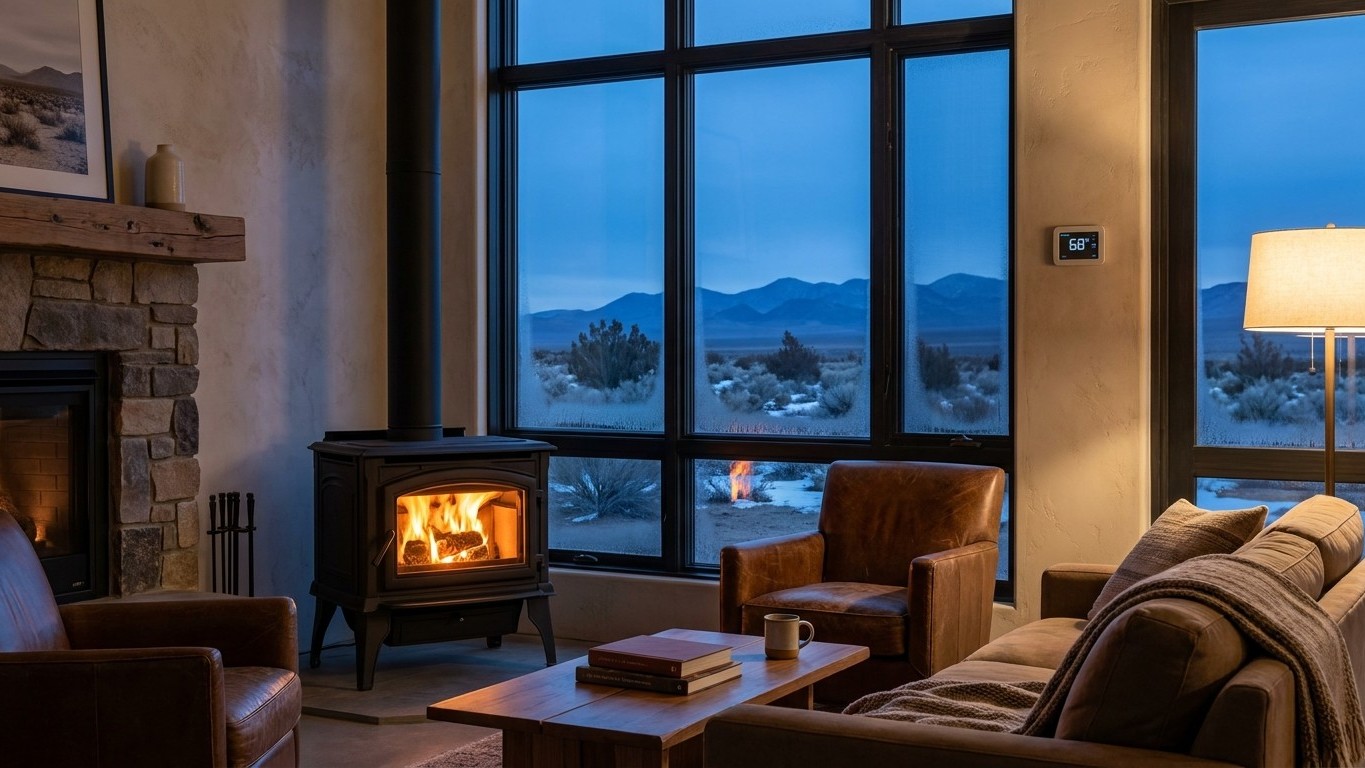

Winter in Nevada rarely feels brutal, but it lingers. The coldest month averages a nightly low of 39.6°F in the Las Vegas reference station, a figure that shapes how long a furnace runs and how much wood a woodstove burns before spring finally shows up.
How cold it gets, and for how long

That 39.6°F number is the mean daily minimum for the coldest month, not a record low and not a daytime average. It’s the Temperature a house settles into overnight, night after night, for weeks at a stretch. And that distinction matters more than most homeowners realize: a single hard freeze is easy to plan for, but a season that hovers just above or right at freezing every night for four straight months asks something different of a heating system.
A furnace or heat pump in a climate like this isn’t sprinting through a handful of brutal cold snaps. It’s running a marathon at moderate intensity, cycling on and off through a long, mild-cold stretch rather than fighting off the kind of deep sub-zero air that hits the northern Rockies or the upper Midwest. That changes the math on equipment sizing. A system oversized for occasional extreme cold will short-cycle constantly in a Nevada winter, wearing out components faster and doing a worse job of holding steady temperatures than a right-sized unit built for sustained moderate demand.
For anyone burning wood, the same logic applies to how a woodstove gets used. A stove doesn’t need to be run wide open to fight off a deep freeze most nights. It needs to hold a steady, moderate burn for a long season, which is exactly the kind of demand that rewards well-seasoned, dense wood over anything burned green or half-dried. The length of the season, not just its lowest point, is what determines how much wood a household actually goes through.
What a cord of wood is worth here
A cord is a volume, not a weight, and that single fact is where most firewood buyers get shorted. A true cord measures 4 feet by 4 feet by 8 feet, a stack totaling 128 cubic feet. Nothing else counts. A “face cord,” a “rick,” or a truckload eyeballed as “about a cord” can be a fraction of that volume, and there’s no way to know without measuring the stack yourself.
According to Michigan State University Extension, a cord of well-seasoned hardwood holds roughly 20 million BTU of heat energy. That’s an average across species and depends heavily on how dry the wood actually is, but MSU translates it into something a homeowner can picture: a cord of good hardwood puts out about as much heat as 145 gallons of #2 fuel oil, or 215 gallons of LP gas. In a climate that runs moderately cold for months rather than brutally cold for weeks, that stored energy gets stretched across a long, steady burning season rather than blown through in a handful of extreme-weather sprints.
| Measurement | Value |
|---|---|
| Cord dimensions | 4 ft x 4 ft x 8 ft |
| Total volume | 128 cubic feet |
| Heat energy (seasoned hardwood) | about 20 million BTU |
| Fuel oil equivalent | about 145 gallons of #2 fuel oil |
| LP gas equivalent | about 215 gallons |
None of that BTU value shows up if the wood hasn’t dried properly first. Which is where seasoning comes in, and where a lot of that promised heat quietly disappears before it ever reaches a living room.
How long wood takes to dry in Nevada
Seasoning isn’t a calendar date. It’s a moisture target, and MSU Extension puts the workable line at 20 percent moisture content or less, against green wood that can sit above 60 percent when it’s first cut. Everything about how long that takes depends on climate, and Nevada’s low humidity and hot, dry summers actually work in a wood-burner’s favor here compared to more humid parts of the country.
Split green wood, stacked so air can move through the pile, typically reaches that 20 percent mark after one full summer of drying. Two words matter in that sentence: split and stacked. Rounds left whole, or logs piled tight with no airflow, will take dramatically longer no matter how hot and dry the summer gets, because the moisture has nowhere to escape.
Red oak is the one species MSU flags by name as an exception. Its cell structure resists drying, so it takes longer to season than most other hardwoods even under the same stacking and same summer heat. Anyone buying or cutting red oak should plan on extra time before it’s ready to burn, not the standard single-summer timeline.
Burning before wood hits that 20 percent threshold costs a household twice. First, in performance: the fire has to boil off the wood’s own water content before it can produce usable heat, so a stove loaded with wet wood puts out noticeably less warmth per log than the same stove burning properly seasoned fuel. Second, in maintenance: unburned moisture and incomplete combustion send more creosote up the flue, and a chimney that would normally need sweeping once a season can need it twice when it’s fed green wood all winter. Neither problem is dangerous by itself, but both are avoidable with a summer’s worth of patience and a stack built for airflow.
Where to check before you buy
The figures here describe conditions at the Las Vegas reference station, and Nevada covers a lot of ground between low desert valleys and high mountain elevation. A property at higher elevation or in a more exposed location can run noticeably colder than the reference numbers suggest, which affects both furnace sizing and how fast a wood stack actually dries.
For local specifics, University of Nevada Reno Extension is the resource worth checking before buying a heating system or laying in a winter’s supply of firewood. It covers which species are actually available regionally, along with practical guidance suited to local conditions.
Burn restrictions are worth a direct look too, since they’re set at the local level and can change from one year to the next depending on air quality conditions and drought status. A rule that applied last winter isn’t guaranteed to apply this one, so checking current guidance before stocking a wood supply or planning to rely on a stove as a primary heat source is a small step that avoids a bigger headache once the weather turns.