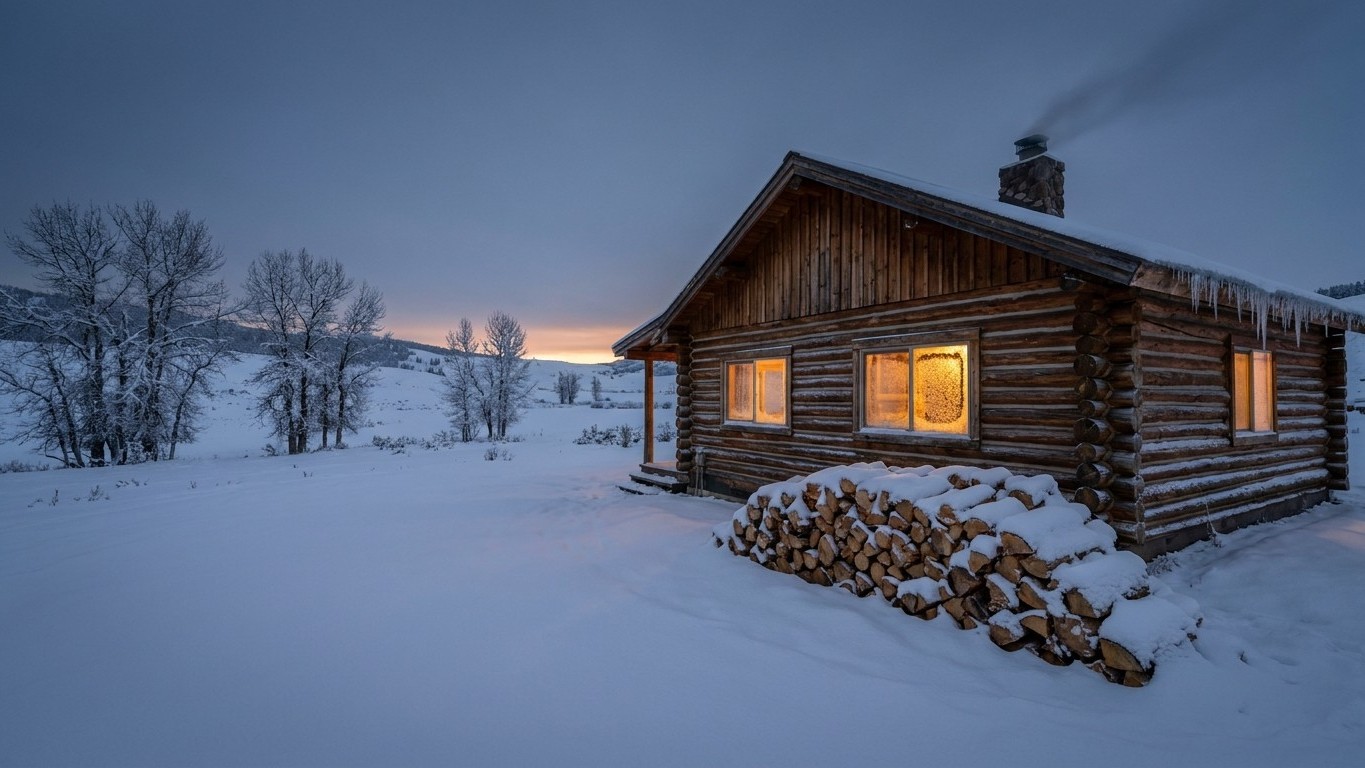

Wyoming’s winters don’t just get cold, they stay cold for a long stretch, and that’s the detail that actually shapes a heating bill or a woodpile. The mean daily low in the coldest month sits at 18.1°F, and that single number changes how a furnace runs, how much wood a household burns, and how early in the season the first fire gets lit.
How cold it gets, and for how long

At the Cheyenne reference station, NOAA’s 1991-2020 Climate Normals put the coldest month’s average daily minimum at 18.1°F. That’s not the record low that shows up in a bad news story about a polar vortex. It’s the ordinary overnight low, the temperature a heating system deals with night after night for weeks, not just once.
Eighteen degrees below freezing on a nightly basis is a different kind of workload than a mild coastal winter where the furnace cycles on and off for an hour and calls it a day. In Wyoming, equipment runs longer, more often, and against a bigger gap between indoor comfort and outdoor reality. A furnace sized for a Southern winter will run nearly nonstop trying to close that gap, and a wood stove will need reloading more than a weekend hobbyist expects.
Why duration matters more than the number itself
A single cold snap is manageable. A season that holds near or below freezing for four or five months is a different math problem entirely, because the heat loss compounds day after day rather than spiking and retreating. Two towns can share the same coldest-month minimum and still have very different heating seasons if one warms up in March and the other doesn’t loosen its grip until May. That’s the part a single temperature figure can’t tell you, and it’s exactly why knowing When Does the Heating Season Start in Wyoming? matters more than any national average once you’re planning for a specific elevation or valley.
Practically, this means insulation and air-sealing pay off faster here than in milder states, because every degree of heat retained gets used for months, not weeks. It also means backup heat sources, a wood stove, a propane heater, aren’t just for emergencies. In a winter this long, they’re often doing real, planned work.
What a cord of wood is worth here
A cord is a volume, not a weight, and that distinction is where most firewood buyers get burned, literally and figuratively. A standard cord measures 4 feet by 4 feet by 8 feet, or 128 cubic feet of stacked wood. Two cords of different species can look almost the same in a truck bed and still hold very different amounts of usable heat, because denser hardwoods pack more actual wood mass into that same stack, with less air between the pieces.
| Measurement | Value |
|---|---|
| Cord dimensions | 4 ft x 4 ft x 8 ft |
| Total volume | 128 cubic feet |
| Heat content (well-seasoned hardwood) | about 20 million BTU |
According to Michigan State University Extension, that 20 million BTU figure for a cord of well-seasoned hardwood roughly equals the heat from 145 gallons of #2 fuel oil, or 215 gallons of LP gas. That’s a useful yardstick for thinking about how many cords a Wyoming winter actually eats, especially given the long, cold stretch described above. It’s an average, not a guarantee: species and moisture content both move that number substantially, so a cord of soft, damp wood is not delivering the same heat as a cord of dry hardwood, even at the identical 128 cubic feet.
Seasoning time is the variable that decides which of those two cords you’re actually buying, and it’s worth understanding before the wood gets stacked in the yard.
How long wood takes to dry in Wyoming
MSU Extension’s guidance is direct: firewood should burn at 20 percent moisture or less, while green, freshly cut wood can run over 60 percent. That gap between 60-plus percent and 20 percent isn’t cosmetic. It’s the difference between wood that gives up its heat efficiently and wood that spends a good chunk of its energy simply boiling off the water trapped in its own cells before any warmth reaches the room.
Split green wood, stacked so air can move freely through the pile, typically reaches that 20 percent target after one full summer of seasoning. The key words there are split and stacked, not left in rounds in a corner of the yard. Rounds dry from the outside in, slowly, and a summer usually isn’t enough. Splitting exposes more surface area and lets Wyoming’s dry summer air do the work faster.
Red oak is the named exception in MSU’s guidance: its cell structure makes it dry more slowly than other hardwoods, so it needs more time on the stack than a single season typically provides. Burning it, or any species, before it’s actually reached that 20 percent mark has consequences beyond a weaker fire. Wet wood produces less usable heat per load, which means more trips to the woodpile and a stove that struggles to hold a bed of coals. It also builds creosote faster inside the flue, since the smoke carries more unburned moisture and particulate up the chimney. That means more frequent chimney sweeping and a higher chimney fire risk if the buildup goes unchecked. None of this is a reason to panic over a slightly early fire, but it’s a real reason to plan a summer’s worth of stacking time before the first cold snap arrives.
Where to check before you buy
Everything above describes conditions at the Cheyenne reference station, and Wyoming spans a huge range of elevation and exposure beyond that single point. A ranch at 7,000 feet in the mountains and a valley town at half that elevation can face genuinely different winters, different wood species availability, and different practical realities for stacking and seasoning wood outdoors.
The University of Wyoming Extension is the right place to check for local species recommendations and any seasonal burn restrictions before buying wood or lighting a stove. Burn rules, when they exist, are set at the local or county level and can change from year to year based on air quality conditions, drought status, or fire risk. What was allowed last winter isn’t automatically fine this winter, and a quick call or visit to the extension office before stacking a season’s worth of wood beats finding out about a restriction after the fact.
What each heat source costs to run in Wyoming
At Wyoming’s average residential prices, this is what one million Btu of heat delivered into the house costs with each system. It compares fuels on the same unit: it is not a yearly bill, and it leaves out the price of the equipment.
| System | Cost per million Btu delivered |
|---|---|
| Electric resistance (baseboard, 100% efficient) | $40.89 |
| Heat pump at 8.1 HSPF2 (seasonal COP about 2.4) | $17.22 |
| Natural gas furnace at 97% AFUE | $11.67 |
Cheapest to run in Wyoming: natural gas furnace, $5.55 less per million Btu than the heat pump.
Prices: U.S. Energy Information Administration (EIA), average residential prices. Efficiencies: ENERGY STAR criteria. A heat pump’s figure is a seasonal average; in the coldest weather its efficiency drops.