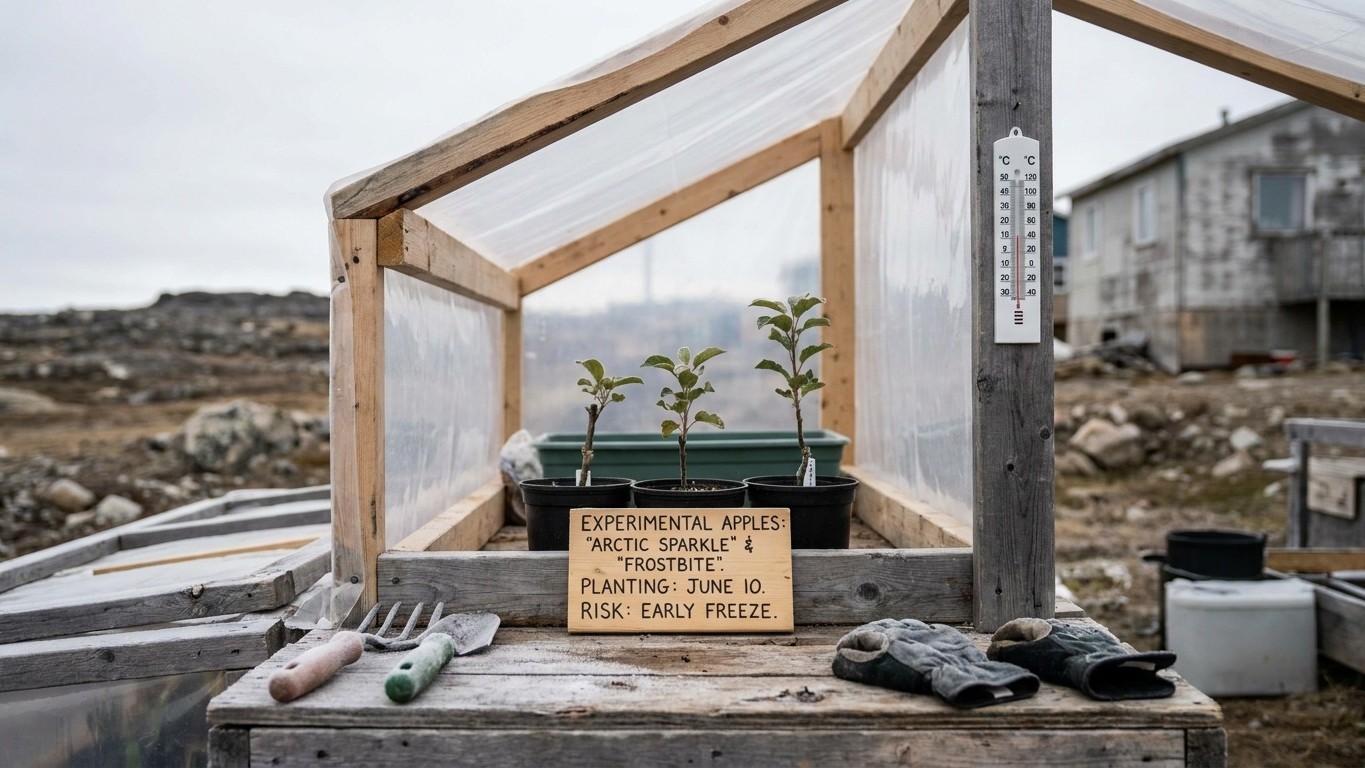

Apples aren’t a documented outdoor crop anywhere in Nunavut. Environment and Climate Change Canada’s 1981-2010 climate normals put the average nightly low for the coldest month at Rankin Inlet at -34.3 °C, a figure colder than the published hardiness range of any apple cultivar sold by North American nurseries. Before spending money on trees, check whether the community you’re growing in sits on open coastal tundra like Rankin Inlet or in a more sheltered inland spot, because that difference decides whether any perennial fruit tree is worth attempting at all.
Which varieties suit this climate

Canadian and American nurseries publish hardiness ratings for their apple stock, and the toughest end of that list is the group bred at Manitoba’s Morden Research Station and by the University of Saskatchewan for prairie farmyards: ‘Norland’, ‘Battleford’, ‘Goodland’ and the crabapple ‘Rescue’. For a closer look at how these cultivars compare, see The Best Apple Varieties for Nunavut. Catalogs commonly list these as hardy to Canadian plant hardiness zone 2 or 2b, a rating built around the average extreme minimum a site sees in a typical winter, which for a zone-2 site usually falls somewhere between -50°F and -40°F.
| Variety | Type | Nursery-listed hardiness | Bloom timing |
|---|---|---|---|
| ‘Norland’ | Dessert apple | Zone 2b | Early to mid-season |
| ‘Battleford’ | Crab-apple hybrid | Zone 2 | Early |
| ‘Goodland’ | Dessert apple | Zone 3 | Mid-season |
| ‘Rescue’ | Crabapple | Zone 2 | Early, heavy pollen |
| ‘Dolgo’ | Crabapple | Zone 2 | Early, reliable pollenizer |
That number looks close to Rankin Inlet’s situation until you read what it actually measures. ECCC’s -34.3 °C figure is not an occasional cold night. It’s the average low for every night across the coldest month. A zone-2 rating is built around a single hard freeze a tree shrugs off and recovers from, while a coldest month that averages near -30°F asks the wood to sit at that temperature for weeks on end, a condition no nursery catalog tests for. No apple cultivar’s published hardiness range is built around a coldest-month mean this severe, so no variety on the market can be called confirmed suited to Rankin Inlet’s winter on catalog information alone.
Chill hours are the other filter, and here the answer runs the opposite way from what the bloom-timing column above might suggest, a pattern mapped out in more detail in The Nunavut Apple Calendar, Stage by Stage. most guides on this subject. Low-chill varieties bred for the Deep South are wrong here for the reverse reason they’re wrong anywhere far north: Nunavut sits at the extreme long-chill end of the scale, with dormancy running far longer than any cultivar needs to break bud properly. If a tree with adequate cold hardiness were ever established this far north, an undersupply of chill would never be the problem holding it back. That’s a genuine contrast with a place like Ontario, where winter chill sits comfortably within range for most dessert apples and the limiting factor lies elsewhere in the season.
Before ordering anything, weigh the same three things a catalog page won’t spell out for you:
- Nursery-listed hardiness zone measures a single extreme low, not weeks of sustained cold
- Chill hours needed to break dormancy are a non-issue this far north
- No territorial trial data currently exists for any of these cultivars
No territorial extension service publishes a recommended apple variety list for Nunavut, and that absence is itself informative. Agriculture and Agri-Food Canada’s national variety trial network lists prairie-hardy cultivars for provinces well south of here, but that trial network does not extend this far north. Anyone growing an apple tree in Nunavut right now is doing so without a documented local precedent to follow.
Planting a pair that works here
Apples aren’t self-fertile. A single tree, however healthy, sets little or no fruit without a second variety blooming nearby whose pollen it can use. That rule doesn’t relax at the extreme edge of viable cold climates, so plant two trees minimum, never one, and pick partners that flower in the same narrow window rather than weeks apart.
Among the prairie-hardy varieties listed above, the practical pairing is a dessert apple like ‘Norland’ or ‘Goodland’ next to a genuinely hardy pollenizer such as ‘Dolgo’ or ‘Rescue’ crabapple. Both crabapples bloom early and produce abundant, compatible pollen, and their early timing lines up with the early bloom of ‘Norland’ and ‘Battleford’ more closely than with the slightly later bloom of ‘Goodland’. If you plant ‘Goodland’, check that your chosen pollenizer’s bloom window actually overlaps it, since a pollenizer that finishes flowering before the main variety opens isn’t a pollenizer at all that year.
Avoid the trap that catches new orchardists everywhere, not just here: some apple varieties carry sterile pollen and can’t pollinize anything, however good their own bloom looks. None of the crabapples named above have that problem, but if a named dessert variety from a catalog tempts you beyond this list, check its pollen status before ordering a pair around it. A pair that looks right on paper but doesn’t overlap in bloom, or where one partner is pollen-sterile, produces flowers and no fruit at all.
The frost that costs a crop here

Even if a tree survives Nunavut’s winter, the frost dates around it decide whether it ever sets fruit. ECCC’s 1981-2010 climate normals put Rankin Inlet’s average last spring frost at June 19 and the average first fall frost at September 13. Both are mean dates, not guarantees. In one year out of two, the real frost falls later than the average on either end, so treat June 19 as the middle of a window, not a line you can plant right up to.
How short the season really runs
Subtract one date from the other and the frost-free season at Rankin Inlet averages around 86 days, and because both ends are means rather than safe boundaries, the real window in a given year can run shorter than that from either side. Compare that to a place with earlier, more predictable springs, like the terrain covered in our Utah apple guide, where the frost-free season runs months longer and risk is driven by elevation rather than by the whole calendar tightening from both directions at once.
The mechanism that matters most for fruit, not survival, is timing relative to bud stage. A frost that hits while wood is still fully dormant does little damage. The same temperature after the buds show pink kills the open flowers outright while leaving the tree itself undamaged, so the wood looks fine all summer and the grower simply gets no apples that year. A late frost after bloom costs the crop, not the tree, and no spray or wrap saves flowers that are already killed once the frost has passed.
Where a tree survives the winter at all, the only real protection against a frost date this changeable is a later-blooming variety, since a bloom that opens later gives the frost fewer chances to catch it mid-flower. Among the varieties named above, ‘Goodland’ blooms later than ‘Norland’ or ‘Battleford’ for exactly this reason, though a later bloom also shortens the number of frost-free days left afterward to actually ripen fruit, which is its own problem at this latitude.
The apple year in Nunavut
Stage by stage
Dormancy runs from the first fall frost (September 13 on average, Rankin Inlet, ECCC) into whatever the following spring brings, and a tree in this climate spends far more of the year asleep than awake. Any container-grown tree needs its unheated shelter secured well before that date, not scrambled together after the first hard freeze catches it outdoors.
Green tip arrives once the ground warms past the point where roots can move water, and with a last spring frost averaging June 19, wood near Rankin Inlet has almost no margin between snowmelt and the frost date itself. A tree pushing green tip in early June is pushing straight into frost risk, not past it.
Pink and bloom are the flower stage described above, and the single point in the year where a late frost erases the crop without touching the tree at all. Growers watching for pink should already have a protection plan ready to deploy the night it’s needed, not improvised after the fact.
Petal fall and fruit set follow within days of a bloom that clears without a killing frost. From this point the clock is running against the first fall frost, on average September 13 at Rankin Inlet.
Harvest is where the season’s brevity bites hardest. ‘Norland’, one of the earliest-ripening cultivars on the prairie-hardy list, is commonly listed by nurseries as ready roughly 100 days after full bloom. Set bloom right after an average last frost of June 19 and count 100 days forward, and harvest lands close to the end of September, weeks after the average first fall frost of September 13. Even the earliest-maturing cultivar in this group is cutting it close against Rankin Inlet’s average frost window, and a season running even slightly cooler than average won’t finish it at all.
Local help
Nunavut’s territorial department doesn’t maintain a public variety list or spray-timing bulletin. For general orchard and crop guidance, Agriculture and Agri-Food Canada keeps a national site at agriculture.canada.ca, and it’s a reasonable starting point for tracking down regional trial data or asking a question a nursery catalog can’t answer. Confirm any variety or spray product locally before buying, since a federal site can point toward research but can’t tell you what actually survives on your particular lot.
Common questions
Can apples survive outdoors in Nunavut at all?
No cultivar sold by North American nurseries has a published hardiness range built around a coldest-month average low of -34.3 °C, the figure ECCC’s 1981-2010 normals give for Rankin Inlet, so no documented outdoor apple orchard exists in the territory. A container-grown tree moved into unheated but insulated shelter for winter is the only approach with any track record in comparably cold climates elsewhere, and even that isn’t documented specifically for Nunavut.
Ornamental and fruiting crabapples such as ‘Dolgo’ and ‘Rescue’ are commonly listed as suitable for Canadian plant hardiness zone 2, the hardiest rating nurseries generally publish for the genus, and they’re the closest thing to a realistic option among the varieties named on this page. They still don’t carry a rating built around a sustained monthly average near -30°F, so treat them as the best available option rather than a confirmed one.
Could I just grow an apple tree in a greenhouse instead?
A heated or well-insulated greenhouse sidesteps the winter cold problem but introduces a different one. Apple trees need a real period of winter dormancy to flower properly the following spring, and a greenhouse kept too warm through the cold months can leave a tree short of that rest. Anyone attempting this in Nunavut is working without local precedent, so treat it as an experiment rather than a plan.
Does the frost date matter if the tree is in a container I move indoors?
Yes, once the tree is outside for the growing season the same bloom-stage risk applies. A container tree wheeled out in early June to catch the light is just as exposed to a frost landing on open flowers as one planted in the ground, so watch bud stage rather than the calendar date.
Is any part of Nunavut milder than Rankin Inlet?
Likely, given how much latitude and coastline the territory spans, but no verified normals exist for a milder Nunavut community, so treat Rankin Inlet’s figures as a reference point rather than a description of the whole territory. If you garden somewhere else in Nunavut, your own frost dates and winter lows may differ, sometimes considerably.