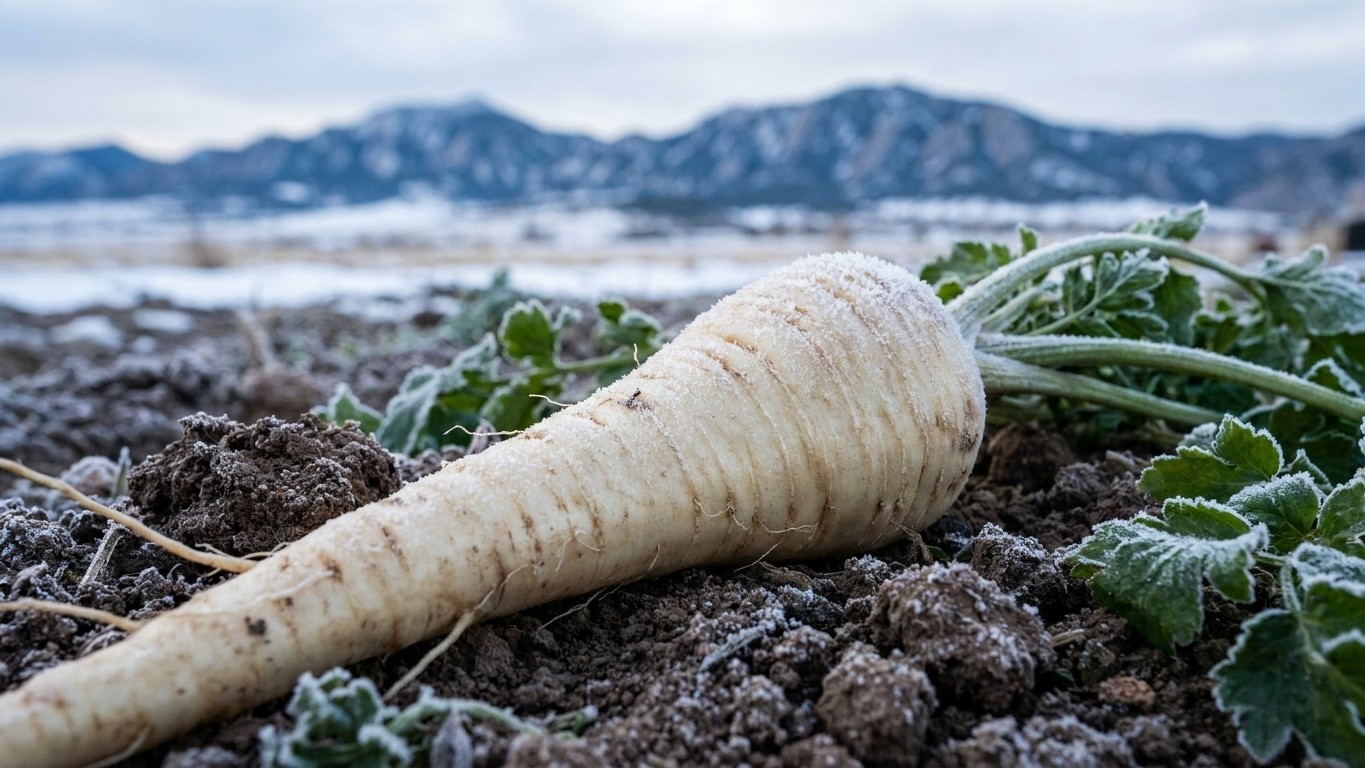

Lift parsnips in Nunavut late, after several weeks of frost, which the territory supplies without trouble. The difficulty is not the cold. It is getting a root to full size before the cold arrives. Once dug, a topped parsnip can keep four to six months, but only in steady, near-freezing, humid conditions and well away from ripening fruit. The sections below cover the frost, the calendar and the failures that cost gardeners their crop.
The short answer
Does this territory deliver several frosty weeks? Easily. At the Rankin Inlet reference station, the mean daily minimum of the coldest month is -34.3 °C. That is the average overnight low, not a record, and it sits far beyond what any parsnip needs. Parsnips taste best after several weeks of cool, frosty weather, which converts stored starch to sugar. A parsnip grown here will sweeten, provided it gets big enough first. The sweetening comes from frost exposure, not from a hardiness zone number, and in Nunavut the exposure is long and deep.
So the lifting rule follows from the mechanism. Dig after the roots have sat through several frosty weeks, not on the first cold night. Digging early gives you a pale, starchy root that has only grown. The other limit is the ground itself. At these temperatures soil locks up hard, and the sources behind this page do not say how long it stays diggable, or whether a parsnip left in the ground would survive a winter this cold. Treat the autumn lift as the plan, and pick a day when a fork still goes in.
The sweetening is the crop’s own business. Storage has its own rules, and the figure to know is the long one. USDA Agricultural Handbook 66 puts parsnip roots at 4 to 6 months in storage at 0 to 1 °C with 98% relative humidity. That is a long keeper by any standard, and it assumes both numbers are held steady. Almost no house does that. A cold porch or unheated entry can get the temperature right and miss the humidity badly, so expect the lower end of the range, or less, unless you pack roots in something that holds moisture.
Then comes the detail most guides skip. A parsnip is not chilling sensitive, so cold is not what ruins it in storage. Ethylene is. Parsnips produce almost none themselves, but exposure to low levels in cold storage turns them bitter, likely through a compound called xanthotoxin. A crate beside apples, or any ripening fruit, can spoil a sweet crop even at the perfect temperature. Keep them in a separate space. When you top them after digging, do not trim into the crown.
For the full picture of the crop here, start with Growing Parsnips in Nunavut. The chemistry behind the sweet flavor is covered in Will Parsnips Sweeten in Nunavut?
Does the season fit?
Parsnips are sown in place, and the clock of 100 to 120 days runs from seeding, not from emergence. Germination alone takes 14 to 21 days, so a bed that looks bare for two weeks is normal. Sowing is meant to happen 2 to 3 weeks before the last spring frost. Here is the arithmetic, using mean dates from the Rankin Inlet A station.
- The mean last spring frost is June 19. It is a midpoint, not a safe date: in one year out of two the last frost falls later. Treat it as the middle of a window.
- Sowing 2 to 3 weeks earlier lands between May 29 and June 5. Whether the soil is workable that early is a local question, and no figure for it is published here.
- Add 100 days to the earliest sowing and you reach about September 6. Add 120 days to the latest sowing and you reach about October 3. The crop therefore finishes somewhere across a month-long span.
- The mean first fall frost is September 13, again a midpoint, with frost arriving later in half of years. From June 19 to September 13 is roughly 86 days, shorter than the 100-day minimum even at the average dates.
- Compare the two. The best-case finish (September 6) beats the mean fall frost by a week. The worst case (October 3) runs three weeks past it. The sources behind this page do not say how much a parsnip keeps growing after the first frost, so none of that extra time can be counted on.
The verdict is tight at best, and not at all in a cool year. This is not a comfortable fit like the long, mild seasons farther south. A sowing at the very start of the window, in a good summer, can bring small to medium roots to the first frosts. A late or cold start probably cannot. Plan for modest roots rather than exhibition parsnips, and treat the crop as an experiment worth a small bed, not a staple.
One caution about the numbers. They come from a single station, and the Canadian normals use an older 30-year period than the US figures elsewhere on this site. Northern communities and island settlements can run weeks behind Rankin Inlet, which would shift every date above. Use these dates to see the shape of the problem, then adjust with your own first and last frosts.
What goes wrong here
Most parsnip failures are either soil trouble or time trouble. A few come after the harvest. Here they are, each with its fix.
- Forked roots from heavy or stony ground. A root that hits a stone or a clay layer splits into legs. Parsnips want deep sandy soil, and heavy soil must be double dug. Remove stones to the full depth of the bed. The state soil type is only a starting point, not a diagnosis, so dig a test hole and look.
- Forked roots from overwatering. This is a separate cause and it has a separate fix. Constantly wet soil can also produce forks, even in good ground. Water deeply and less often, and let the surface dry between waterings. Do not treat forking as a soil problem if the bed is loose and stone-free.
- A season that runs out. With about 86 frost-free days against a 100 to 120 day crop, this is the likeliest failure. Sow at the earliest workable date, keep the bed evenly moist through the 14 to 21 days of germination, and thin early so surviving roots are not crowded. Expect small roots and be glad of them.
- Digging up bare soil. Slow germination fools people into thinking the seed failed. Mark the rows and wait the full three weeks before you re-sow, or the second sowing falls behind the first by a precious fortnight.
- Lifting before the frost has done its work. A winter too mild to sweeten is not the risk in Nunavut, because the cold is abundant. The risk is impatience. A root dug right after the first frost has had only a short exposure and will taste starchy. Wait for several frosty weeks, then lift while you can still get a fork in the ground.
- Bitter roots from the storage space. Ethylene from apples or ripening fruit turns parsnips bitter even at the right temperature. Store them on their own, topped but with the crown intact, at 0 to 1 °C and high humidity.
Pests are a separate question and do not change the calendar above. What Eats Parsnip in Nunavut, and When covers what to watch for.
Common questions
How soon after sowing should seedlings appear?
Germination takes 14 to 21 days. That is slow, and it is normal. Keep the bed marked and evenly moist, and do not dig or re-sow until the third week has passed.
Can parsnips stay in the ground over winter here?
The sources behind this page do not cover it, and with a coldest-month mean minimum of -34.3 °C it would be a gamble. Lift after several frosty weeks, while the soil can still be worked, and move the roots into cold storage.
Can I store parsnips next to apples?
No. Parsnips are not hurt by cold, but even low levels of ethylene in cold storage make them bitter. Apples and other ripening fruit give off ethylene, so keep the roots in a separate space.
Does my hardiness zone tell me whether parsnips will sweeten?
It does not. Sweetening depends on how many frosty weeks the roots are exposed to, and a comfortable zone is not the same as several weeks of frost. Here the frost is plentiful, so the real limit is whether the roots reach size before it comes.