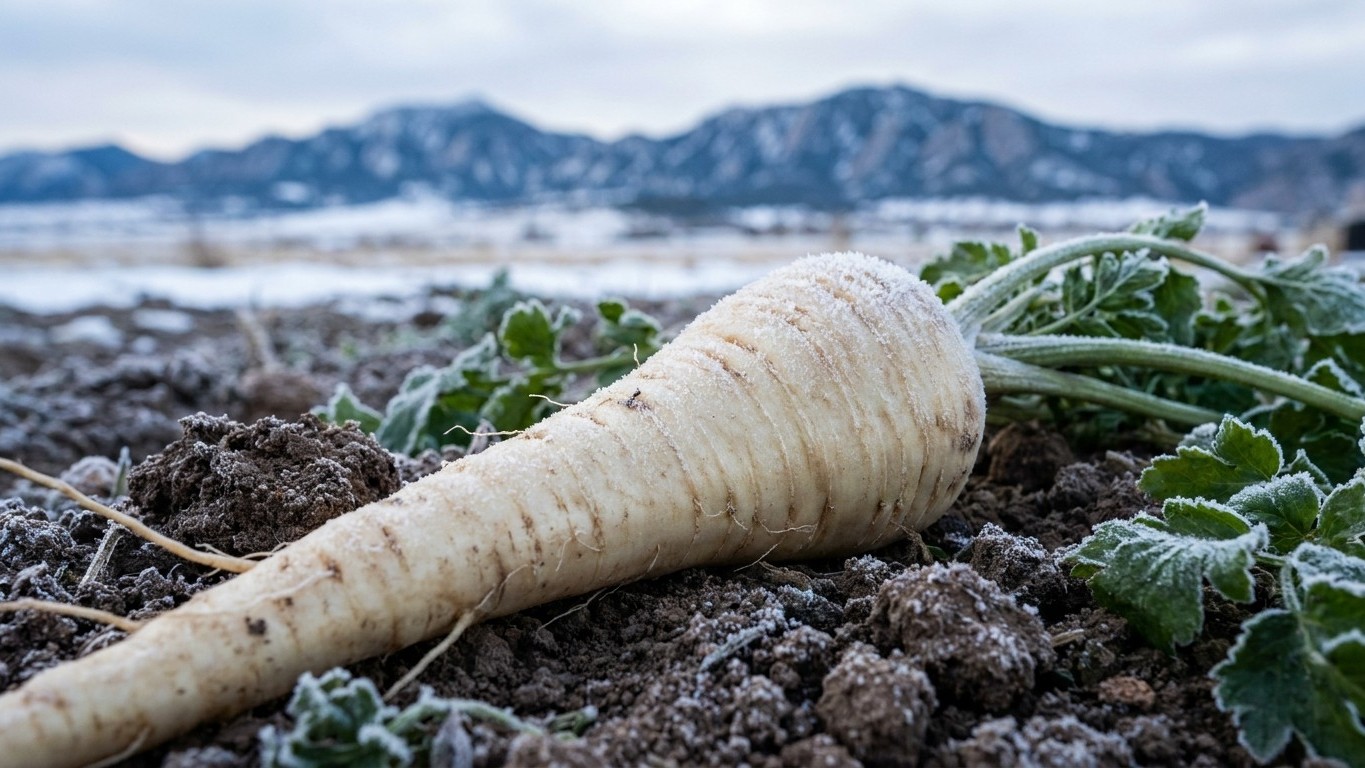

Nunavut’s parsnip trouble is mostly climate, not insects. The verified record for this page covers frost, season length, soil and storage, and it names no pest species for the territory, so none are listed here. The crop gets plenty of frost, which is the sweetening it needs. It is short of days to grow a full root first. Beyond that, the common ways to lose a crop are a forked root, a bare patch dug up too early, and bitter storage. For the full growing picture, start with Growing Parsnips in Nunavut.
The short answer
Does this territory deliver several frosty weeks? It does, with room to spare. At Rankin Inlet, the reference station for this page, the mean daily minimum of the coldest month is -34.3 °C. That is the average low on a normal day in the coldest month, not a record low. Parsnips taste best after several weeks of cool, frosty weather, because the cold converts stored starch into sugar. Nunavut supplies that in abundance. A parsnip that reaches harvest size here will sweeten, not merely grow.
That conclusion rests on frost exposure, and only on frost exposure. A territory’s hardiness zone says how cold the winters get, not how many frosty weeks a root sits through before you lift it. A mild-winter region can have a comfortable zone and still grow a perfectly good parsnip that never turns sweet. Nunavut has the opposite problem. The cold is guaranteed, and the open question is whether the root has had enough days to size up before the ground locks.
Utah State University Extension, the only authority behind these crop figures, puts the requirement at 100 to 120 days from seeding. It also recommends deep sandy soil, and says heavy soil must be double dug. Parsnips are sown in place, so those days run from the moment the seed goes into the ground, not from a transplant date. Germination alone takes 14 to 21 days. Plenty of gardeners see bare soil at day ten, assume the seed failed, and re-sow. Wait out the three weeks first.
One more risk waits after harvest, and it has nothing to do with cold. Parsnips are not chilling sensitive. USDA Agricultural Handbook 66 says roots keep 4 to 6 months at 0 to 1 °C with 98% relative humidity, but that assumes a steady temperature and humidity that almost no house can hold. The same handbook notes that parsnips make very little ethylene themselves, yet even low levels of ethylene in cold storage cause bitterness. So a sweet root stored beside apples or any ripening fruit can turn bitter, even at the right temperature. Keep them in a separate space. The details on timing and holding are in When to Lift Parsnips in Nunavut, and How Long They Really Keep.
Does the season fit?
Short answer: tightly, and at the long end of the range, not at all. The numbers below come from Environment and Climate Change Canada’s older 30-year climate normals for the Rankin Inlet A station. They are mean dates, which means the frost falls later than the date in one year out of two. Treat each one as the middle of a window, not a safe date. Northern districts of the territory run weeks behind this station. Here is the arithmetic in order:
- The mean last spring frost is June 19. Sowing 2 to 3 weeks before it puts seed in the ground between May 29 and June 5. Whether the soil is workable that early is not covered by the facts on file, so check your own bed.
- The mean first fall frost is September 13. From June 19 to that date is about 86 days. That is the average frost-free stretch, and it is shorter than the 100 days a parsnip needs.
- Count 100 days from May 29 and you land on September 6. Count 120 days and you reach September 26. The short end of the range fits just inside the mean first frost, and the long end runs 13 days past it.
- Count the same spans from a June 5 sowing and you reach September 13 at 100 days and October 3 at 120. The short end now lands exactly on the mean first frost date, with no slack at all.
- Subtract germination. The 14 to 21 days before a seedling shows are part of those 100 to 120, not extra. A root that was seeded late is already behind by the time you see green.
The verdict is that the season fits tightly at best. Because the dates are midpoints, in about half of years the frost arrives later than the mean, which gives the crop extra days, and in the other half it arrives earlier, which takes them away. This is arithmetic from average dates, not a measured yield. The fall frost that ends the growing window is also the one that starts the sweetening, so the late end of the range costs you root size more than flavor. Sowing earlier in the window is the only lever you control, and When to Sow Parsnips in Nunavut covers it in detail.
What goes wrong here
Four failures show up most often, each with its own cause and its own fix. The Utah State University Extension guidance covers most of them, and the USDA handbook covers the storage item.
- Forked roots from heavy or stony ground. A root that meets a stone or a dense layer splits or twists. The remedy is deep sandy soil, and where the ground is heavy it must be double dug before sowing. The facts on file include no Nunavut soil survey, so treat any regional soil description as a starting point and judge your own bed by digging it.
- Forked roots from overwatering. This is a separate cause and it can strike in perfectly loose ground. Water that keeps the soil constantly soaked is a recognised cause of forking. The remedy is to water in measured amounts and let the bed drain between waterings, rather than topping it up on a schedule.
- A season that runs out. With about 86 frost-free days on average and 100 to 120 needed, the crop has no margin. Sow at the earliest date the soil allows, and do not re-sow at day ten because nothing has shown, since germination takes 14 to 21 days.
- Bitterness from ethylene in storage. Parsnips are not chilling sensitive, so cold does no harm. Ripening fruit nearby does. Even a trace of ethylene in cold storage causes bitterness, so keep the roots well away from apples and similar fruit. Top them after harvest, but do not trim into the crown.
A winter too mild to sweeten, the failure that catches gardeners in warmer territories, is not one of Nunavut’s problems. Here the frost is more than enough. The risk comes earlier in the year, when the roots may not have finished growing.
Common questions
Do parsnips get sweeter in Nunavut’s cold?
Yes. Sweetening depends on several weeks of cool, frosty weather converting starch to sugar, and the territory’s cold is far past that threshold. The coldest-month mean daily minimum at Rankin Inlet is -34.3 °C.
Is the hardiness zone the same as frost exposure?
No. A zone describes how cold winters get. Sweetening comes from the number of frosty weeks the root sits through, and the two should not be swapped for each other.
How long should I wait before assuming the seed failed?
Germination takes 14 to 21 days. Wait the full three weeks before digging or re-sowing, because the 100 to 120 days run from seeding and there is little room to lose.
How long do parsnips keep once lifted?
Four to six months at 0 to 1 °C with 98% relative humidity held steady, which almost no house manages. Keep them away from apples and other ripening fruit, since ethylene turns them bitter even at the right temperature.