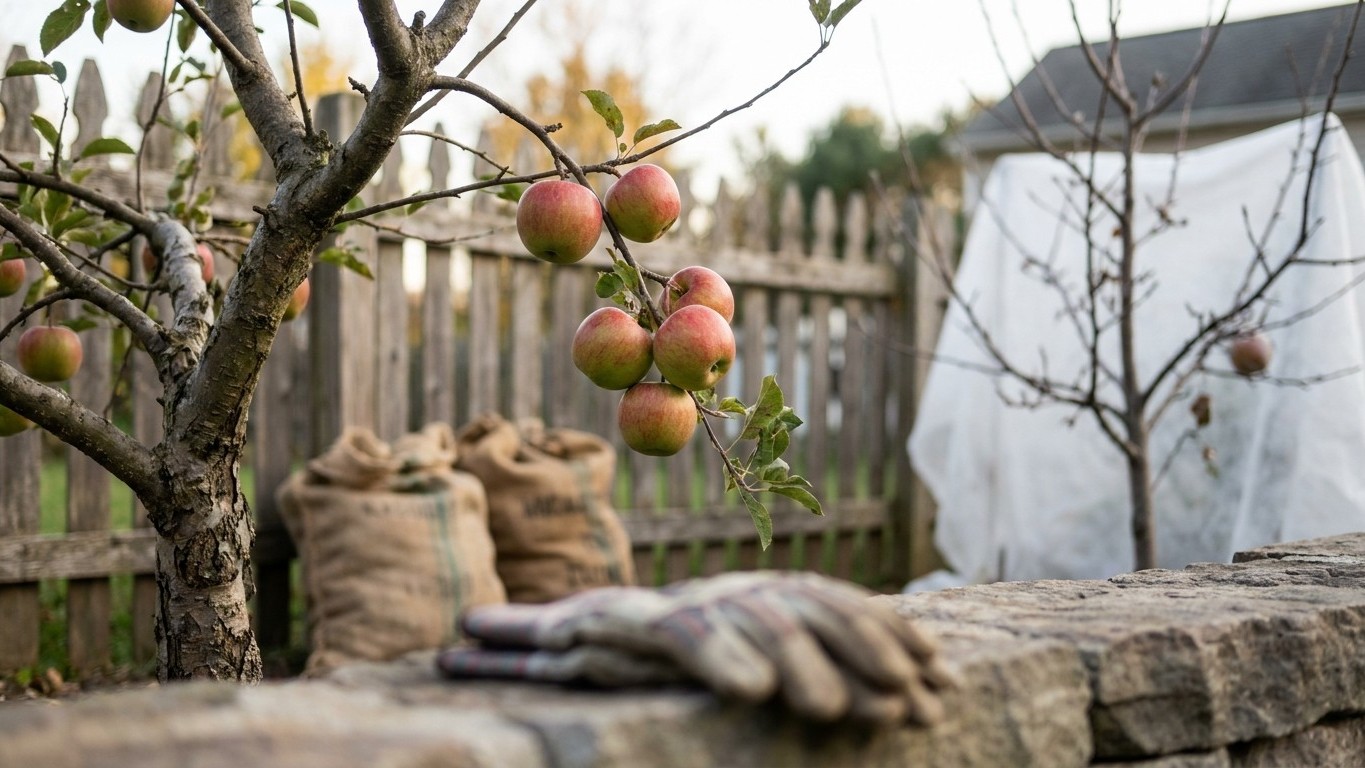

Apples grow across all of Pennsylvania, from the Philadelphia suburbs to the Allegheny highlands, though the varieties and the frost math change hard as you move north and up in elevation. NOAA’s 1991-2020 climate normals put Philadelphia’s coldest month at a mean daily minimum of 25.6°F, mild enough for nearly any commercial apple variety, while the USDA’s 2023 hardiness map spreads the state across zones 5a to 7b. Check your own zone and your local frost window before ordering trees, because a variety chosen for Philadelphia can bloom into a frost that a northern-tier grower would have already dodged.
Can you grow apples in Pennsylvania
Pennsylvania grows apples well from the Philadelphia suburbs clear up into the Allegheny highlands, but the tree that thrives in Chester County can lose its whole crop to a frost that a grower near Erie or Potter County would never even see. Cold doesn’t kill apples here; a mismatched bloom date does. Start by finding your own last-frost date and elevation, then pick a variety built to bloom after that date, not before it.
Philadelphia sits at the warm, easy end of that zone range. The northern tier counties and the Allegheny highlands run colder, often a full zone or two lower, and their frost calendar runs two to four weeks later in spring than Philadelphia’s. A grower near Erie or up in Potter County is not gardening in the same climate as someone in Chester County, even though both are technically “Pennsylvania” on a map.
Where the terrain gets tough is not really the cold itself, it is the length of the growing season and the timing of the last frost relative to bloom. In the higher Allegheny elevations, a variety that blooms early can lose its flowers to a frost that a Philadelphia tree would never see at that stage. That is a variety-selection problem, not a reason to give up on apples in that part of the state; The Pennsylvania Apple Calendar, Stage by Stage lays out exactly when bloom and frost risk overlap across the state’s growing regions.
The practical takeaway: pick your variety and your planting site with your own elevation and frost window in mind, not the statewide average. A south-facing slope with good air drainage buys real protection against the frost pockets that collect in low ground, and it matters more in the colder counties than anywhere near Philadelphia.
Which varieties suit this climate

Pennsylvania’s zone range, 5a to 7b per the USDA’s 2023 map, rules out almost nothing on hardiness grounds alone. For a fuller rundown of cultivars suited to these conditions, see this guide to Pennsylvania apple Best varieties. ‘Liberty’, ‘Enterprise’, and ‘Empire’ are all published as hardy to USDA zone 4, comfortably covering the coldest Pennsylvania counties. ‘Honeycrisp’ is rated to zone 3, and ‘GoldRush’, ‘Jonagold’, and ‘Winesap’ are all rated to zone 4 or 5, which fits everywhere from the Alleghenies down to Philadelphia.
Hardiness is only the first filter
Winter chill is the second, and it works the opposite direction from hardiness. An apple needs a minimum number of cold hours below roughly 45°F to break dormancy properly in spring. Give it too few and the bloom comes thin, uneven, and stretched over weeks instead of a tight, fertile burst. This is exactly what happens when a grower plants a low-chill cultivar bred for the Deep South or coastal California into a state with a real winter.
Pennsylvania sits at the moderate-to-high end of the national chill scale, so nearly every apple cultivar bred for the Mid-Atlantic and Northeast is already matched to it. This is the opposite problem from a grower in coastal Rhode Island, where milder winters and shorter chill accumulation shape a different shortlist, as covered in Growing Apples in Rhode Island: Varieties, Timing and Frost Risk. No low-chill southern cultivar belongs anywhere in Pennsylvania, from Philadelphia to the northern tier.
No Pennsylvania state extension variety trial list is cited here, so treat the following as catalog-documented characteristics rather than a PSU recommendation, and confirm current disease-resistance ratings before you order:
| Variety | USDA hardiness (catalog) | Bloom timing | Notable trait |
|---|---|---|---|
| ‘Liberty’ | Zone 4-8 | Mid-season | Strong scab resistance |
| ‘Enterprise’ | Zone 4-8 | Late | Scab and fire blight resistant |
| ‘Empire’ | Zone 4-8 | Mid-season | Reliable annual bearer |
| ‘Honeycrisp’ | Zone 3-7 | Mid-season | Needs thinning to size well |
| ‘GoldRush’ | Zone 5-8 | Late | Very long storage life |
Planting a pair that works here
Apples do not set fruit reliably on their own pollen. You need two trees that bloom at overlapping times, with at least one supplying fertile pollen, or the flowers open and drop without ever becoming apples. For Pennsylvania’s climate, pairing two mid-season bloomers like ‘Liberty’ and ‘Empire’ is a safe, well-documented combination, since their bloom windows overlap reliably across the zone range the state covers.
Watch for the triploid varieties. ‘Jonagold’, ‘Winesap’, and ‘Stayman’ all carry sterile pollen, meaning they need a second variety to pollinate them but cannot return the favor. Plant one of these and you still need a third, fertile-pollen tree nearby, or a neighbor’s tree close enough for bees to work between the two yards.
A flowering crabapple is the easiest fix if you only have room for one full-size apple tree, since most crabs bloom over a long window and supply fertile pollen to almost any apple variety blooming at the same time. The mechanics of matching bloom windows and telling fertile from sterile varieties are the same everywhere apples are grown, and the full rule is laid out in the pollination sections of both Growing Apples in Rhode Island: Varieties, Timing and Frost Risk and Growing Apples in West Virginia: Varieties, Timing and Frost Risk, worth a look if you are choosing between varieties from either neighboring guide.
The frost that costs a crop here

NOAA’s NCEI 1991-2020 climate normals put Philadelphia’s last spring frost, using the 32°F freeze probability band, between March 29 and April 6. That is the mild end of the state. The northern tier and the Allegheny highlands run two to four weeks later, so a grower there should treat that window as a starting point to push back, not a date to plant by.
Why the tree survives and the crop doesn’t
Once the buds open to the pink stage and into bloom, a hard frost does not usually kill the tree itself. It kills the open flowers, the delicate reproductive tissue that has to survive a freeze to become fruit at all. A grower can walk out the next morning, see the tree looking perfectly healthy, and not realize until midsummer that there is no crop coming, because the blossoms were already dead before the petals fell.
There is no way to fully frost-proof an apple bloom in a home orchard. Commercial growers run wind machines or overhead irrigation to hold air temperature above freezing during a frost event, tools out of reach for most home plantings. What actually works at garden scale is choosing a late-blooming variety, since a tree that opens its flowers a week or two after the frost risk has mostly passed sidesteps the problem instead of fighting it. ‘Enterprise’ and ‘GoldRush’, both late bloomers, are the more frost-forgiving picks for a site where spring frost lingers, which matters more in the Alleghenies than near Philadelphia. Growers dealing with mountain terrain and the same late-frost pattern in neighboring ridge country will recognize the tradeoffs described in Growing Apples in West Virginia: Varieties, Timing and Frost Risk.
A frost cloth thrown over a young, small tree on a clear, still night can hold a few degrees of protection right at the canopy, worth doing if a hard freeze is forecast right as the buds show pink. It is not a fix for a mature, full-size tree, where the volume of air involved makes covering impractical.
The apple year in Pennsylvania
Apple timing runs off the tree’s own stage, not the calendar, and each stage should be read against your local frost window rather than a fixed month.
- Dormancy: winter pruning, done anytime the tree is leafless and temperatures are above the teens, ideally finished before growth resumes.
- Green tip: buds swell and show the first green, typically as the last frost window from NOAA’s normals approaches for the milder counties.
- Pink: buds show color but haven’t opened, the last safe point to plan frost protection before flowers are exposed.
- Bloom: flowers open, pollinators need to be active, and this is the single most frost-vulnerable stage of the year.
- Petal fall: petals drop, signaling fruit set is underway and the frost risk to this year’s crop has mostly passed.
- Fruit set and thinning: young fruitlets appear in clusters, and thinning to one fruit per cluster in early summer improves size and prevents limb breakage.
- Harvest: timing depends on variety, running from late summer for early cultivars to well past the first fall frost window (NOAA’s normals put Philadelphia’s at November 5 to November 16) for late-storage types like ‘GoldRush’.
In the northern tier and the Alleghian highlands, push every one of these stages back by the same two-to-four-week margin that separates their frost dates from Philadelphia’s. A tree at green tip in the Philadelphia suburbs may still be fully dormant two counties north.
Local help
For a variety list built specifically for your county, and for spray timing tied to the actual pest and disease pressure in your part of the state, contact Penn State Extension. Their county offices carry the local calibration, since a fire blight or scab spray schedule that works near Philadelphia can be weeks off from one that works in the Alleghenies.
Common questions
Can I grow apples if I only have a small yard?
Yes, dwarf and semi-dwarf rootstocks keep a mature apple tree to 8-15 feet, and many varieties are available on these rootstocks. You still need a second, compatible pollinator tree nearby, even for a dwarf.
Why did my apple tree bloom but never set fruit?
The most common causes are a frost that killed the open flowers, a lack of a compatible pollinator tree blooming at the same time, or poor pollinator activity during a cold, wet bloom period. Check whether your bloom overlapped with a second variety before assuming frost was the cause.
How many years until an apple tree produces fruit?
Most standard trees take four to six years, while dwarf rootstocks can bear in two to three. A tree that blooms in its first or second year often benefits from having those early flowers removed so it puts energy into root and branch growth instead.
Do I need to spray my apple trees every year?
Most home orchards in Pennsylvania need some disease management, since fire blight and apple scab pressure exist statewide, but the schedule depends on variety resistance and local weather. Penn State Extension’s county offices can give a spray calendar matched to your area rather than a generic one.
Is it too late to plant apple trees if I missed the spring window?
Fall planting works too, generally after the tree goes dormant and before the ground freezes hard, and it lets roots establish over winter. Bare-root trees are typically only available in spring, while container-grown trees can go in either season.