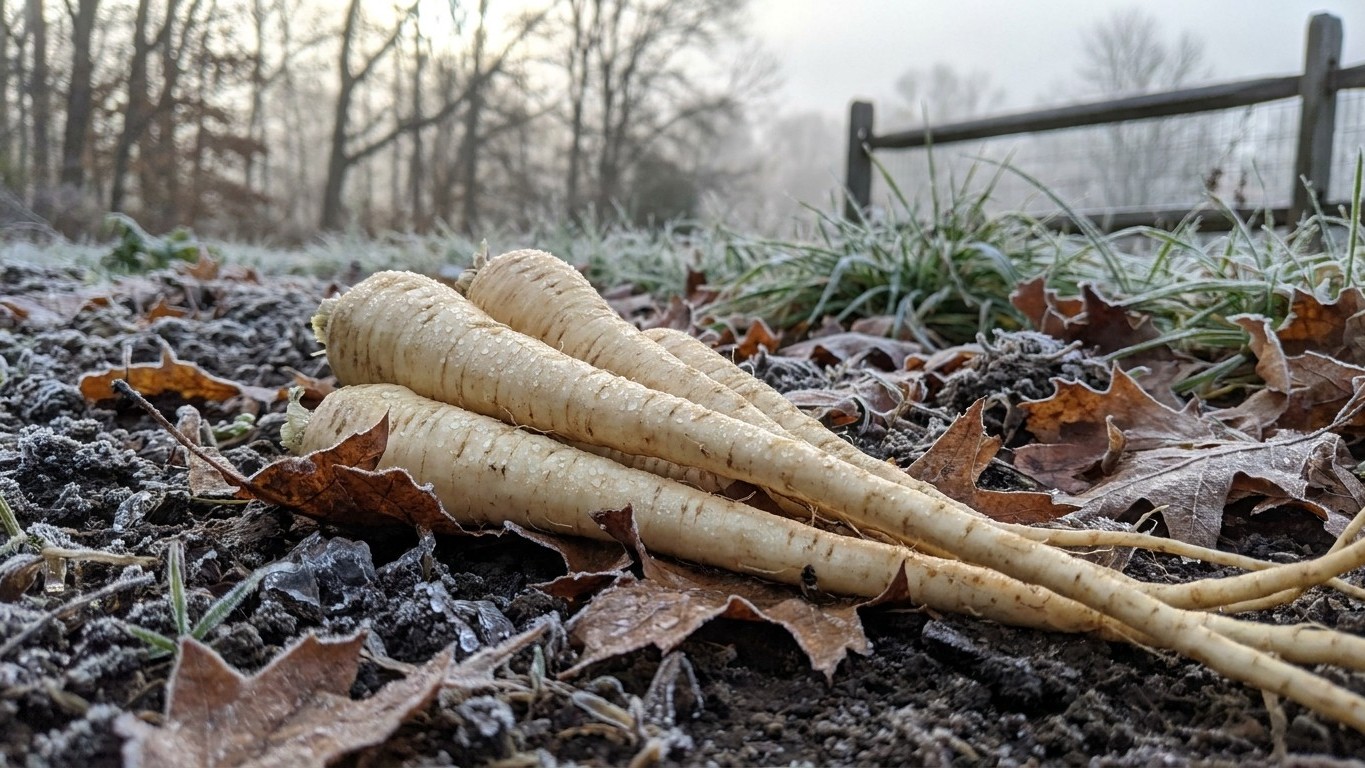

Wait for frost. In Pennsylvania, that means lifting parsnips from late fall into winter, after several frosty weeks have turned stored starch into sugar, not on the day the roots look big enough. Sown in place in March or early April, they reach full size by summer and then sit tight. Once dug, they keep four to six months, provided storage is cold, humid and nowhere near a fruit bowl. The sections below separate what the sources measured from what is only garden habit.
The short answer
Does Pennsylvania deliver several frosty weeks? Philadelphia, the mildest corner of the state, answers with a number. The mean daily minimum of its coldest month is 26.0°F, from NOAA NCEI’s most recent 30-year climate normals (reference station: Philadelphia). That is the average night, not a record cold snap, and it sits six degrees under freezing. A parsnip grown here will sweeten, not merely grow.
The frost window backs that up. NOAA’s freeze-probability band puts the first fall frost between November 5 and November 16, and the last spring frost between March 29 and April 6. Between those dates lie more than four months in which frost is a regular visitor. The northern tier and the Alleghenies run two to four weeks later in spring, so those regions are not short of cold. They have, if anything, more of it.
One distinction matters here. The sweetening comes from exposure to frost, not from a hardiness zone number. A zone describes whether a plant survives winter. It says nothing about whether the root spent enough cold weeks in the ground to change its chemistry. Utah State University Extension puts it plainly: parsnips taste best after several weeks of cool, frosty weather, which converts stored starch to sugar. A mild-winter state can grow a perfectly good parsnip that never turns sweet. Pennsylvania is not that state, and the longer story is in Will Parsnips Sweeten in Pennsylvania?
So when do you dig? The source gives “several weeks” without a hard number. Counting from the first fall frost, my reading is that late November is the earliest sensible dig in Philadelphia, and December is the safer bet. Colder parts of the state can wait a little longer. Nothing says the roots must come out all at once. Lifting them as you need them, while the ground is still workable, is a practical way to let the frost keep working.
Storage is where the best-kept secret sits. A parsnip is not chilling sensitive, so cold is not the danger. Ethylene is. The USDA’s Agricultural Handbook 66 notes that parsnips make very little ethylene themselves, but exposure to low levels of it in cold storage causes bitterness. That means apples, pears or any ripening fruit in the same fridge or cellar can ruin a batch even when the temperature is perfect. Keep them apart.
The same handbook gives the headline figure: roots can be stored 4 to 6 months at 32 to 34°F with 98% relative humidity. That is a long keeper by any standard. It also assumes those conditions are held steady, which almost no house does. A garage or basement that swings with the weather will give you less. Top the roots after digging, but do not trim into the crown. For the full crop picture, start with Growing Parsnips in Pennsylvania.
Does the season fit?
Parsnips are sown in place, and the clock of 100 to 120 days runs from seeding, not from the day seedlings show. The standard advice is to sow two to three weeks before the last spring frost. Here is the arithmetic for Philadelphia, step by step.
- Find the sowing window. The last spring frost falls between March 29 and April 6. Sowing three weeks before the earliest date means about March 8. Sowing two weeks before the latest means about March 23. That is the window: roughly March 8 to March 23.
- Allow for germination. Seed takes 14 to 21 days to come up, and parsnips are famously slow. Bare soil for the first two to three weeks is normal. Do not dig it up and re-sow, because you will lose the head start.
- Add the growing time. A hundred days from March 8 lands on about June 16. A hundred and twenty days from March 23 lands on about July 21. The roots are physically mature somewhere between mid-June and late July.
- Compare with the fall frost. The first fall frost arrives November 5 to November 16. The latest-maturing roots, the ones ready around July 21, still have about 107 days before the earliest frost date. The earliest ones have around 153 days to the later date. That is a wide cushion.
- Read the verdict. In Philadelphia, the season fits comfortably. Even a sowing slipped to April 6, the end of the last-frost band, comes to maturity around August 4 and still leaves three months before frost.
Colder regions shift everything later. If the last spring frost runs two to four weeks behind Philadelphia’s, the sowing window moves to roughly late March through the third week of April, and maturity lands between about the end of June and mid-August by the same arithmetic. That still looks workable, but the fall frost dates for the northern tier and the Alleghenies are not published here, so check your own county’s figures before trusting the margin. A cushion that is generous in Philadelphia could be thinner at elevation.
What goes wrong here
Most failures trace to soil, water or timing. Utah State’s guidance points to deep sandy soil, with heavy ground double dug. The state soil is a starting point, not a diagnosis, so test your own bed with a spade before trusting a map.
- Forked roots from heavy or stony ground. A root that meets clay or a rock splits around it. The remedy is preparation: loosen the bed deeply, double dig heavy soil as the source advises, and pull out stones before seeding. Pennsylvania has plenty of rocky, compacted ground, especially in the hills.
- Forked roots from overwatering. This is a separate cause with a separate fix. Constantly wet soil can also produce forking, even in well-prepared ground. Water deeply but not too often, and let the top layer dry between sessions.
- A season that runs out. A late start leaves roots small when frost comes. The fix is to sow in the March window above, and to wait out the slow germination. Bare soil at day ten is not failure. Reseeding is worth considering only after three weeks with nothing showing.
- A winter too mild to sweeten. Philadelphia’s 26.0°F average coldest-month minimum makes this a low risk here, but a lingering warm stretch can delay the process. Leave the roots in the ground longer rather than digging early. A mild winter cannot be fixed with a technique, only with patience.
- Bitterness in storage. If lifted roots taste harsh, suspect ethylene from nearby fruit before blaming the variety or the soil. Move them well away from apples and ripening produce.
- Damage from pests. Holes and tunnels are a separate problem from forking, and What Eats Parsnip in Pennsylvania, and When covers what to look for.
Common questions
How soon after the first frost can I dig parsnips?
Utah State University Extension says parsnips taste best after several weeks of cool, frosty weather, without naming a day count. With the first fall frost falling between November 5 and November 16 in Philadelphia, late November is the earliest reasonable dig, and December is safer. Taste one before you commit the whole row.
How long do lifted parsnips really keep?
USDA Agricultural Handbook 66 gives 4 to 6 months at 32 to 34°F and 98% humidity. That assumes the conditions stay steady, and a typical house, garage or basement does not hold them. Plan on a shorter life unless you can keep storage consistently cold and damp.
Can I store parsnips with apples?
No. Parsnips are not hurt by cold, but even low levels of ethylene in cold storage make them bitter, and ripening fruit gives off exactly that gas. Keep them in a separate fridge, crate or room.
Should I cut the tops off before storing?
Yes, top them after harvest. Do not trim into the crown, the shoulder where the leaves joined the root, because cutting there opens the root to damage. Leave a clean stub and brush off loose soil rather than washing the roots hard.