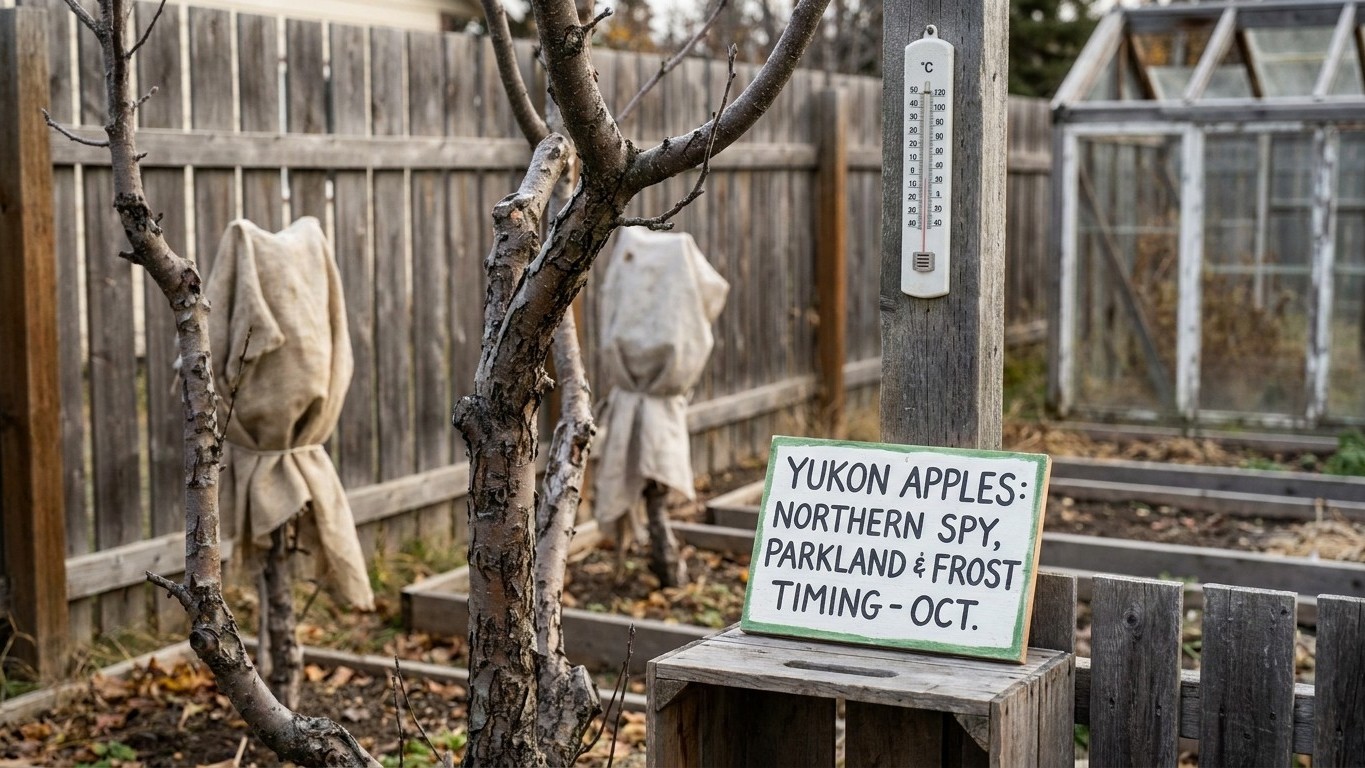

Apples can be grown in the Yukon, but only cultivars bred for extreme Prairie cold have a real chance. Whitehorse’s coldest month averages a daily minimum of -19.2 °C, according to ECCC’s 1981-2010 climate normals, and the frost-free window there runs on average from June 5 to August 25, also ECCC figures. The single thing to do before ordering a tree is check that its published hardiness rating covers winters this severe and that it ripens fast enough to fit inside that short window.
Which varieties suit this climate

Very few apple cultivars sold anywhere in North America are rated to survive routine winter lows in the range ECCC records for Whitehorse. The trees that do exist and reliably fruit this far north almost all trace back to the Prairie breeding programs at Morden, Manitoba, and the University of Saskatchewan, where the whole point was survival at temperatures most orchard cultivars never see. For a closer look at which cultivars make the cut, see The Best Apple Varieties for Yukon, and for a full season-by-season view of what to expect after planting, see The Yukon Apple Calendar, Stage by Stage.
Cultivars with published hardiness for this cold
Norland is one of the earliest-ripening dessert apples grown anywhere, a Morden release with a published hardiness rating that covers winters well below what a Southern or coastal cultivar would tolerate. Parkland, also from Morden, carries a similar cold rating with a slightly later ripening date. Goodland, from Saskatchewan breeding work, is rated for the same severe cold and produces a larger fruit, though it needs a bit more of the season to finish. September Ruby is a newer hardy release that colors well even with cool autumn nights, which matters near a first frost date this early.
For pollination, three crabapple selections do double duty: Rescue, Trailman and Dolgo are all rated extremely cold hardy, ripen small fruit early, and produce abundant fertile pollen, which makes them the standard partner tree for the dessert cultivars above.
| Cultivar | Type | Relative ripening | Role |
|---|---|---|---|
| Norland | Dessert apple | Very early | Primary fruiting tree |
| Parkland | Dessert apple | Early to mid | Primary fruiting tree |
| Goodland | Dessert apple | Mid-season | Primary fruiting tree |
| September Ruby | Dessert apple | Early autumn | Primary fruiting tree |
| Rescue | Crabapple hybrid | Very early | Pollinizer |
| Trailman | Crabapple | Very early | Pollinizer |
| Dolgo | Crabapple | Very early | Pollinizer, also used for jelly |
No Yukon-specific trial list confirms how these cultivars actually perform in a territorial orchard. These choices come from published hardiness ratings and Prairie breeding records, not a local extension trial, so treat them as the best available starting point rather than a guarantee.
Winter chill is not the limiting factor here
Winter chill and cold hardiness answer two different questions. Hardiness is whether the wood survives the winter at all. Chill is whether the tree accumulates enough cold hours to break dormancy evenly and bloom properly in spring, and a variety bred for too little chill will bloom thin and ragged even where it survives. Yukon sits at the opposite end of that scale from a Southern orchard. Winters here supply far more chilling than any apple cultivar needs, so chill deficiency is simply not a risk in this territory the way it is for growers picking low-chill cultivars in a place like Alabama, covered in Growing Apples in Alabama: Varieties, Timing and Frost Risk. The entire filter here is hardiness and how fast the fruit can ripen, not whether the tree gets cold enough to sleep.
Planting a pair that works here
Apples need cross-pollination from a second tree blooming at the same time, and at least one of the pair needs to shed fertile pollen. This matters more in a short, cold season than almost anywhere else, because there is no margin for a mismatched bloom window to cost a year’s crop.
Given the varieties that actually suit Whitehorse’s climate, the realistic pairs are a dessert cultivar with one of the hardy crabapples. Norland paired with Rescue works because both are early bloomers and Rescue is a heavy, reliable pollen producer. Parkland pairs the same way with Trailman. Goodland and September Ruby will also take pollen from either crabapple as long as their bloom periods overlap, which is worth watching in the specific spring rather than assumed from a catalog date.
The mistake to avoid is planting two dessert cultivars that both happen to carry sterile or weak pollen, which is common among some heavily bred cold-hardy selections. A pair like that can flower beautifully and set almost no fruit. If you are unsure whether a given cultivar’s pollen is fertile, treat one of the hardy crabapples as cheap insurance rather than an optional third tree, since it blooms early enough to overlap with nearly all of the dessert cultivars listed above and costs little in orchard space.
The frost that costs a crop here

Whitehorse’s average last spring frost falls on June 5, according to ECCC’s 1981-2010 climate normals for station Whitehorse A. That date is a mean, not a guarantee: frost lands later than June 5 in roughly half of all years on record, so treat it as the middle of a risk window rather than a safe cutoff, and expect other parts of the territory, especially higher ground or river valleys with poor drainage of cold air, to run behind Whitehorse’s own average.
What frost actually kills
The damage that matters is not to the tree. Once buds have opened to the pink stage and especially once blossoms are open, a frost kills the flowers themselves, not the wood or the tree as a whole. A tree can look completely healthy through the following summer while carrying no fruit at all, because the flowers that would have become apples were the part that froze. This is the single most common way a Yukon apple grower loses a season’s crop without losing a tree.
There is not much a home grower can do to protect open blossoms across a full-size tree once frost is forecast at pink or bloom stage. Covering a young or espaliered tree overnight with a sheet or frost cloth can save a marginal night, but it is not practical for a mature tree at scale. The more durable protection is choosing a later-blooming cultivar in the first place, since a variety that opens its flowers a week or two after the earliest bloomers has a real chance of missing the tail end of the frost window entirely. This is one more reason the dessert cultivars and crabapples named above, all bred and selected under short-season Prairie conditions, tend to bloom later relative to bud break than a Southern-bred apple would.
Growers much farther south face the opposite kind of frost problem, arriving later in the calendar but with far more warmth and a longer season once it clears, a contrast covered in Growing Apples in Kansas: Varieties, Timing and Frost Risk.
The apple year in Yukon
Apple timing is read off the tree’s stage, not a date on the wall, but the stages themselves cluster around Whitehorse’s own frost dates and shift with them from year to year.
Dormancy through bloom
- Dormancy: the tree sits fully hardened off through the long cold season, the state its buds need to survive winter lows that average -19.2 °C in the coldest month per ECCC.
- Green tip: buds swell and show the first green as the soil and air warm, typically well before the mean last frost of June 5, which is exactly why this stage still carries real frost risk on the wood, though not yet on flowers.
- Pink: blossom buds show color but have not opened. This is the point where a late frost starts to threaten the flowers rather than just the twig, and it often lands close to or after ECCC’s June 5 average last frost.
- Bloom and petal fall: flowers open and pollinators, wild or kept, move pollen between the dessert cultivar and its crabapple partner. Any frost landing during this stage is the one that costs the crop, as covered above.
- Fruit set: pollinated flowers swell into small fruit over the following weeks, the point at which a grower can finally see whether the pairing worked.
- Harvest: early cultivars like Norland and the crabapples finish well before the mean first fall frost of August 25, while mid-season cultivars like Goodland run closer to that date and carry more risk of an early frost cutting the season short.
Because the gap between a June 5 mean last frost and an August 25 mean first frost leaves a frost-free season averaging roughly 80 days, and because that average hides years that run shorter, the whole point of choosing very early cultivars is to make sure fruit finishes before the first fall frost arrives rather than racing it.
Local help
For variety lists that reflect current territorial trial results and for spray timing specific to the pests present in the Yukon, contact Agriculture and Agri-Food Canada through its main site, since the territorial department’s own pages could not be verified directly. Start at agriculture.canada.ca and ask to be pointed toward whatever local or Prairie regional office handles tree fruit for the territory.
Common questions
Can I grow Honeycrisp in the Yukon?
It is a poor bet. Honeycrisp’s published hardiness rating does not cover winters as cold as Whitehorse’s, where ECCC’s normals put the coldest month’s average daily minimum at -19.2 °C, and it ripens later than the Prairie-bred cultivars that were specifically selected to survive and finish fruit in this kind of season.
Should I use dwarf rootstock or standard?
Standard or semi-dwarf rootstock is the safer choice here. Dwarfing rootstocks are often bred for controlled orchard size in milder climates and are frequently less cold hardy at the root and crown than the seedling or hardy rootstocks used under Prairie and northern conditions.
Do I need more than one pollinator tree per apple?
One reliable pollen source is usually enough if it blooms at the same time and is close enough for insects to move between the trees, generally within the same yard. Planting a hardy crabapple as that pollinator, rather than a second dessert cultivar of uncertain pollen fertility, removes most of the guesswork.
What if a hard frost hits after my tree is already in bloom?
Expect that year’s fruit set to be reduced or lost even though the tree itself survives, since the frost damage lands on the open flowers rather than the wood. There is little that protects a mature, full-size tree from this outdoors, which is why choosing a later-blooming cultivar matters more here than in a milder climate.
Can I grow apples in a container and bring them inside for winter?
It is possible with a dwarfed cultivar on a hardy rootstock, but containers expose roots to cold far more severely than the same tree planted in the ground, since soil in a pot cools and freezes faster than open ground. Anyone trying this in a climate as cold as Whitehorse’s should plan on moving the container into an unheated but frost-buffered space, like an attached garage, for the coldest months rather than leaving it outdoors.