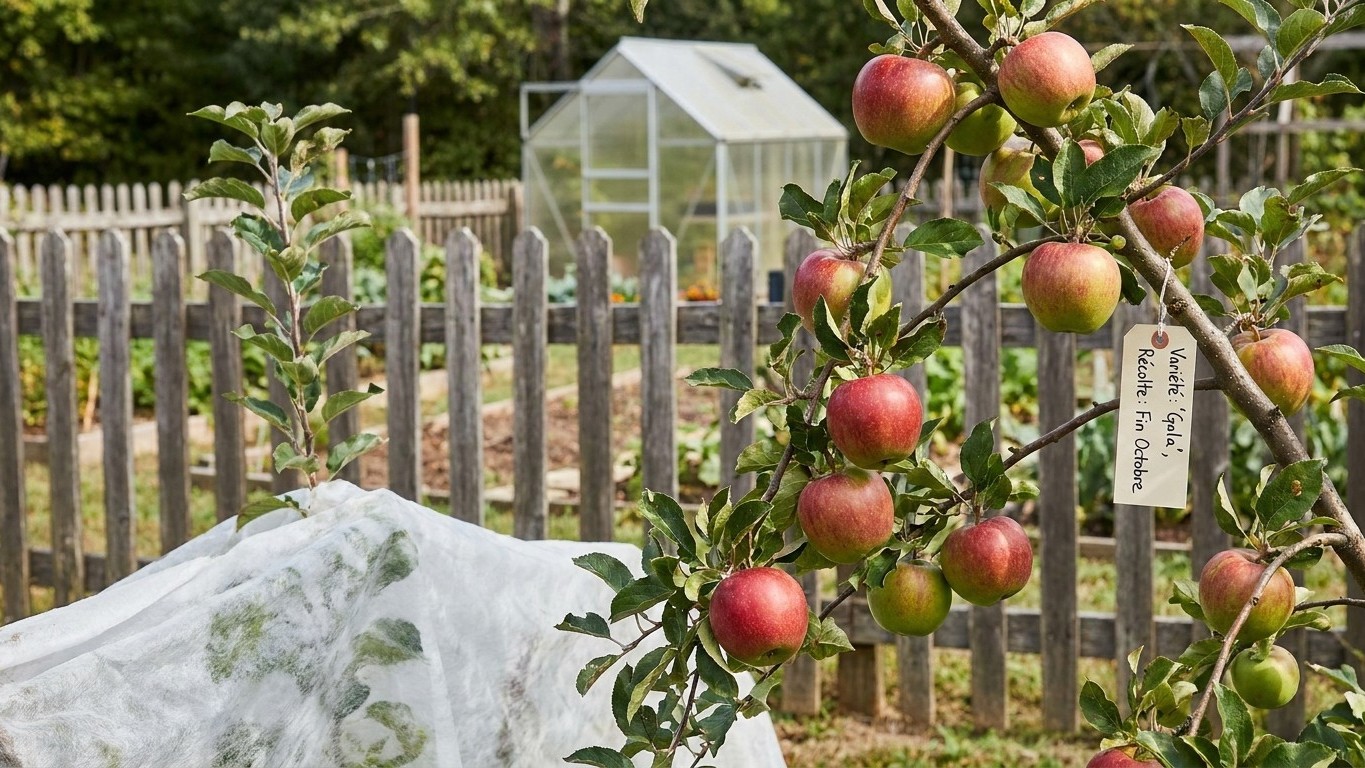

Yes — apples grow in Alabama, but which one you plant depends on what part of the state you’re standing in. Alabama winters are mild enough that the tree itself is never really at risk; the real question is whether it gets enough cold hours to break dormancy and flower well, and that’s what separates a healthy tree loaded with fruit from a healthy tree that blooms thin every spring. Before you pick anything at the nursery, find out roughly how many winter chill hours your county sees in an average year, because that number decides more than the zone map does.
Can you grow apples in Alabama
Apples grow across most of Alabama, but the state spans three USDA hardiness zones, and that range matters more than most gardeners assume. The USDA Plant Hardiness Zone Map, built on 1991-2020 normals, places Alabama in zones 7a through 9a, meaning winter lows run from around 0°F in the coldest pockets of the north down toward 20°F in the far south near the Gulf. NOAA’s NCEI 1991-2020 Climate Normals put the average minimum temperature of the coldest month at Huntsville at 31.8°F, a mild reading for a tree that needs real winter cold to set fruit well.
Hardiness is only half the picture
Apple trees are cold-hardy enough to survive an Alabama winter almost anywhere in the state. Even the warmest zone 9a pockets rarely drop cold enough to kill a dormant apple tree outright. The problem for most of Alabama is not survival, it is winter chill, the number of cold hours a tree needs to break dormancy evenly and flower well. A tree planted somewhere too warm for its chill requirement leafs out patchy and flowers thin, even while the tree itself looks perfectly healthy.
North Alabama, in the hill country around Huntsville, sits closer to the chill hours a standard apple variety wants than the coastal south does. Central and south Alabama, including the Black Belt and the Gulf Coastal Plain, run warmer overall and need varieties bred specifically for low-chill conditions. Treat your own county, not a statewide average, as the deciding factor, and check The Alabama Apple Calendar, Stage by Stage to see how that timing plays out where you live. The Huntsville figures above describe conditions at that one reference station, and other parts of the state read differently.
Elevation and local topography change the picture within a single county. A hillside orchard with good air drainage in the Appalachian foothills of northeast Alabama often runs several degrees cooler on winter nights than a low-lying site nearby, which nudges effective chill hours upward without changing the county’s official hardiness zone. Site selection, not variety choice alone, decides how well a marginal chill match performs.
None of this rules out apple growing anywhere in the state. Northern Alabama, at higher elevation and closer to the Tennessee line, is the easiest part of the state for standard-chill and even some higher-chill varieties, while central and southern Alabama are better matched to varieties suited to warmer winters — see The Best Apple Varieties for Alabama for picks tailored to each region’s chill hours.es bred for the Deep South’s short, mild winters. Use the zone map as a starting point, then confirm your own county’s typical winter lows before ordering trees.
Which varieties suit this climate

Once you know which end of Alabama’s chill range you are working from, variety choice narrows fast. Across the warmer two-thirds of the state, low-chill varieties bred for the Deep South are the reliable choice. ‘Anna’ and ‘Dorsett Golden’ are the two most widely sold low-chill apples, each needing roughly 200 to 300 hours of winter chill according to their published nursery descriptions, a fraction of what a Northern apple demands. ‘Ein Shemer’ sits at the low end too, bred in Israel for a mild-winter climate similar to south Alabama’s.
Matching chill to region
Further north, especially around Huntsville, moderate-chill varieties such as ‘Gala’ (around 500 hours) and ‘Fuji’ (400 to 500 hours) have a better shot at flowering evenly, though growers there are still working near the edge of those varieties’ comfort range rather than deep inside it. ‘Granny Smith’, also moderate to higher chill, is worth trying only in the coolest pockets of north Alabama, and even there it should be treated as a gamble rather than a safe bet.
| Variety | Approx. chill hours (catalogue) | Best fit in Alabama |
|---|---|---|
| ‘Anna’ | 200-300 | Central and south Alabama |
| ‘Dorsett Golden’ | 250-300 | Central and south Alabama, pairs with ‘Anna’ |
| ‘Ein Shemer’ | 100-200 | South Alabama, Gulf Coastal Plain |
| ‘Gala’ | ~500 | North Alabama, higher elevation |
| ‘Fuji’ | 400-500 | North Alabama |
| ‘Granny Smith’ | 500-600 | Coolest pockets of north Alabama only |
Higher-chill heirlooms common in cooler states rarely perform well anywhere in Alabama. ‘Arkansas Black’, a dense, dark-skinned, late-keeping apple documented in more detail in Growing Apples in Arkansas: Varieties, Timing and Frost Risk, wants more accumulated cold than most Alabama counties reliably deliver, and it belongs only at the extreme cool edge of the state’s zone range if you plant it at all. The long-chill varieties that fill orchards further north, covered in Growing Apples in Michigan: Varieties, Timing and Frost Risk, would sit dormant into a warm Alabama spring and never flower in the numbers needed to crop.
Treat the ranges above as catalogue figures rather than a local recommendation, and check with the Alabama Cooperative Extension System before committing to a variety near the edge of its range.
Planting a pair that works here
Apples need a second, blooming-at-the-same-time tree with fertile pollen nearby, whether that is a second variety planted on purpose or a crabapple in a neighboring yard. In the low-chill zones that cover most of Alabama, the most reliable pair is ‘Anna’ with ‘Dorsett Golden’. Both bloom early and at the same time, and both carry fertile pollen, so either one pollinates the other without needing a third tree in the yard.
What to avoid
Some widely sold varieties, including several strains of ‘Gala’, produce pollen that is effectively sterile, a trait called triploidy. A triploid variety needs two other trees nearby: one to pollinate it, and a second, pollen-fertile variety it can in turn help pollinate, since it cannot return the favor. Planting two triploid varieties side by side and expecting them to fruit off each other is a common and costly mistake, one that shows up as years of good bloom and no apples. Check a variety’s pollen status before buying anything beyond the ‘Anna’ and ‘Dorsett Golden’ pair.
Bloom timing matters as much as pollen fertility. Two varieties that both flower well but two or three weeks apart function as two solo trees in practice, since few bees are still working the first tree’s flowers by the time the second one opens. ‘Anna’ and ‘Dorsett Golden’ were bred as a matched pair specifically to avoid this problem, flowering within days of each other in most seasons. If you add a third variety later, check its published bloom window against both, and plant all your trees within about 100 feet of each other so pollinating insects reliably move between them on a single visit.
The frost that costs a crop here

NOAA’s NCEI 1991-2020 Climate Normals put Huntsville’s last spring freeze, in the 30 to 70 percent probability band, between March 19 and April 3, and the first fall freeze in the same band between November 2 and November 16. Those dates describe the airport weather station near Huntsville specifically. Suburban and rural gardens elsewhere in the state typically see their last spring frost later and their first fall frost earlier, often by one to two weeks and more at elevation, so check your own county’s freeze data before relying on the Huntsville window.
Why bloom timing, not tree hardiness, decides the crop
The real risk to an Alabama apple crop is not winter cold killing the tree. It is a frost landing after the buds have opened to the pink stage or into full bloom, which kills the flowers themselves while leaving the tree completely undamaged. A grower can walk out in May, see a healthy, leafed-out tree, and still get no apples that year, because the frost that mattered came and went weeks earlier during bloom.
Apple bloom in Alabama typically falls close to, or even within, the last-frost window described above, which makes a late cold snap after an early warm spell a real and recurring risk rather than a rare event. There is little a grower can do to stop a hard freeze once blossoms are open on a mature tree. Covering large trees is impractical, and orchard heaters and wind machines are commercial-scale tools, not backyard ones. Watering the orchard floor the evening before a forecast freeze adds a small amount of protective humidity, and a site with good air drainage, where cold air flows downhill away from the trees rather than pooling around them, loses fewer blossoms than a low frost pocket in an otherwise identical planting.
The more dependable fix is variety choice. A late-blooming variety pushes its flowering past the point where a late frost is likely, trading a few days of the growing season for a much better chance of keeping its blossoms intact. In a state where the last frost date itself runs into early April at the Huntsville reference station, and later still in many surrounding counties, choosing a variety documented as blooming on the later side of its group is the single most effective frost strategy available to a home grower.
The apple year in Alabama
Dormancy through bloom
Dormancy runs from leaf drop in fall through the coldest stretch of winter, and it is the only window when bare-root trees should go into the ground or structural pruning should happen. Green tip, the first sign of buds swelling and showing a sliver of leaf, often starts before the Huntsville area’s last-frost window of March 19 to April 3 has closed, which puts an early-breaking tree at the tail end of the region’s normal frost risk. Pink stage, when the flower buds show color but have not opened, usually follows within a week or two, and this is the point where a frost stops costing wood and starts costing the whole year’s crop. Full bloom in most seasons overlaps the back half of that same frost window, which is why a late-blooming variety carries a real advantage here rather than a marginal one.
Petal fall through harvest
Petal fall, when the blossoms drop and tiny green fruit start to show, is the point to thin overcrowded clusters down to one apple per cluster, which improves fruit size and reduces limb breakage later on. Fruit set follows over the next few weeks, and this is when a home grower can finally count on the year’s crop being locked in, assuming no late frost interrupted bloom. Harvest timing depends entirely on variety, ranging from midsummer for the earliest low-chill types to well into fall for later-keeping varieties, and it should happen well ahead of the first fall freeze, which NOAA’s NCEI normals put at Huntsville between November 2 and November 16, since fruit left hanging past that point risks freeze damage even though the tree itself tolerates the cold fine.
Between fruit set and harvest, an Alabama apple tree also has to get through the state’s long, humid summer, when fungal diseases such as cedar-apple rust and fire blight find easy conditions. Regular inspection through the summer months, and removing any blighted shoots as soon as they show, does more for the eventual harvest than anything done earlier in the season.
Local help
For county-specific variety trial results and current spray timing guidance, contact the Alabama Cooperative Extension System through aces.edu. Extension offices track how varieties actually perform in their own counties year to year, and they can tell you whether a marginal-chill variety is cropping well nearby, information no national catalogue or hardiness map can provide.
Common questions
Can I grow apples near Mobile or the Gulf Coast?
Yes, but stick to low-chill varieties such as ‘Anna’, ‘Dorsett Golden’ or ‘Ein Shemer’. Standard-chill varieties like ‘Gala’ or ‘Fuji’ often fail to break dormancy evenly in the mildest coastal winters and produce a thin, scattered bloom.
Do I really need two apple trees, or will one produce fruit alone?
Almost all apple varieties need a second, compatible variety blooming nearby to set fruit. A handful of varieties are marketed as partly self-fertile, but even those crop better and more consistently with a pollen partner in the yard.
How many years until a newly planted apple tree bears fruit in Alabama?
That depends more on the rootstock and variety than on the state. Check the nursery tag for the specific tree, since dwarfing rootstocks generally bear sooner than standard ones, and no single figure applies to every planting.
A frost hit my apple tree while it was blooming. What do I do now?
Nothing fixes it after the fact. Wait a few days, then check the center of several flowers. A blackened or mushy center means that blossom will not set fruit, while a green, firm center means it may still develop normally.
Is Alabama’s summer heat too much for apple trees?
No, summer heat is not the limiting factor for apples here. Winter chill and spring frost timing are the real constraints. The main summer issue is disease pressure from humidity, not heat stress on the tree itself.