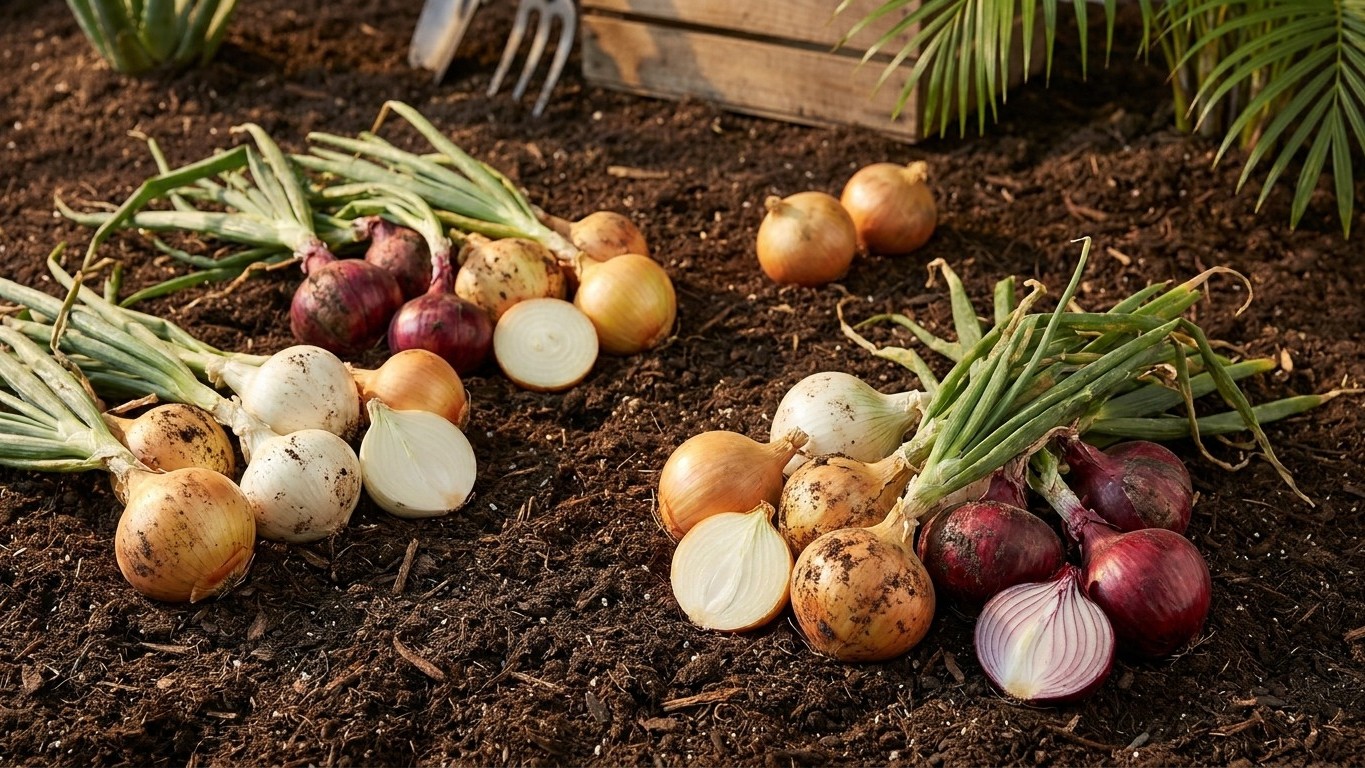

In Yukon, onions face two main insect threats: root maggots, which hit seedlings and young bulbs early in the season, and thrips, which rasp the leaves during warm, dry stretches. Whitehorse sits at 60.71 degrees north and gets 18 h 45 of daylight on the longest day, so the plant spends its summer under very long days. That shapes when each pest has something to eat. Exact Yukon emergence dates are not published here, so timing below follows the plant’s growth stages.
The short answer for Yukon
Pests do not arrive on a calendar date. They arrive when the plant offers something worth eating, and day length decides much of that. Onions switch from making leaves to making a bulb according to hours of daylight, not warmth. At 60.71 degrees north (the latitude of the Whitehorse station, used here as the reference city), the longest day runs 18 h 45. That is well above the 14 to 16 hours a long-day onion waits for, so the trigger arrives with room to spare.
The practical effect is a two-stage season. First comes a leafy phase, when the plant is mostly green tissue and a small, tender base. Then comes bulbing, when the base swells and the outer layers harden. Each stage attracts different trouble. Root maggots are a pest of the early, tender stage: flies lay eggs near the base of young plants, and the larvae tunnel into the stem and developing bulb. Thrips are tiny insects that scrape the leaves, leaving silvery streaks, and they do best in warm, dry weather. In a cool northern summer, that tends to mean short windows rather than a long season of pressure.
Third comes the storage phase, which is not an insect problem but where earlier damage shows up. A bulb with maggot tunnels or a wounded neck rots first. Clemson Cooperative Extension puts ideal storage conditions at “between 45 °F and 55 °F, and 50 to 60 percent humidity.” Onions want it dry, which is the opposite of what carrots and other roots want, so a single cellar cannot hold both well.
Curing comes before any of that. Bulbs go into storage only once the necks are tight and the skins papery, never straight from the ground. A damaged bulb that gets binned at curing time costs you one onion. The same bulb in a crate costs you the neighbors too.
For a full growing plan, start with the parent page, Onions in Yukon. For sowing and transplant timing, the When to Plant Onions in Yukon page covers it. Variety choice is on The Best Onion Varieties for Yukon. This page stays on what eats the crop and when.
What will not work here
The usual northern warning is that long-day onions will never bulb where days stay short. Yukon turns that around. At 18 h 45 of daylight, long-day types get their trigger easily. The mistake in Yukon is the opposite one: planting onions bred for lower latitudes. A short-day variety begins bulbing at about 12 hours of daylight, a threshold published by Clemson Cooperative Extension. Yukon passes 12 hours early in spring, so these plants start bulbing almost at once, with very little foliage behind them.
Bulb size follows leaf size. Whatever the plant has built by the time day length triggers bulbing is what the bulb gets. A short-day onion triggered after a few weeks of growth makes a small bulb and cannot grow any larger. Planting late does not delay the harvest, it shrinks it, because the trigger arrives on the sun’s schedule rather than yours.
The pest angle makes this worse. A plant with few leaves has little to lose and little to spare. A maggot tunnel through a thumb-sized bulb is a total loss, while the same tunnel in a large bulb may leave most of it usable. Small, early-bulbing onions are also the ones that struggle to reach storage size.
These are the types to avoid, with the reason for each:
- Short-day onions: they trigger at about 12 hours of daylight, so they bulb early under Yukon’s long days and stay small.
- Warm-climate sweet onions bred for southern states: most are short-day types, with the same early-trigger problem and thin skins that store poorly.
- Any onion planted late in the season: the plant has less time to grow leaves before the trigger, so the bulb is smaller, however good the variety.
- Intermediate-day types as a default: they sit between the other two groups, so check the variety’s stated day-length need before assuming it will reach full size.
Long-day varieties are the group that fits this latitude. The details of which ones suit a short growing season are on the best varieties page. A last caution: a plant that stalls and sits as leaf for weeks does not escape pests. It stays tender longer, and it stays exposed.
What changes across Yukon
A territory is not one latitude. The figures above belong to the Whitehorse station, 60.71 degrees north, and Yukon stretches well north of that, past the Arctic Circle in the far north. Near the border with British Columbia, the reference city is close to the southern edge of the territory. Going north, the longest day gets longer, and north of the Arctic Circle the sun does not set around the June solstice.
For onions, a longer day pushes in one direction only. It guarantees the bulbing trigger for long-day types, but it does not make the season any longer. Frost dates, not day length, set the outer limits. Pest timing follows local warmth, so a garden farther north may see the early flights of maggot flies later in the calendar than Whitehorse does. I have no Yukon community-level data to give you a date, and none is published here.
| Location | Latitude | Day length at solstice | What it changes |
|---|---|---|---|
| Whitehorse (reference city) | 60.71 degrees north | 18 h 45 | Long-day onions trigger easily; short-day types still bulb far too early |
| Southern Yukon, near the BC border | Slightly south of the reference | Slightly less than 18 h 45 | Very close to Whitehorse; same advice, with a possible small shift in pest timing |
| Central and northern Yukon | Farther north than the reference | More than 18 h 45 | Trigger is never in doubt; the limit is frost-free time, and pest windows start later |
| Above the Arctic Circle | Check your own | Sun does not set near the solstice | Growing onions here is a different project; confirm local conditions first |
Only the first row carries measured figures from this page’s sources. The other rows are directional. For anything beyond Whitehorse, treat the numbers as a starting point and confirm your own latitude before planning around them.
Checking this against your own garden
The 60.71 degrees north and 18 h 45 figures are for one station, not for every garden in Yukon. A garden a few hundred miles away can sit in a different pest rhythm and a different frost calendar. Before you build a plan, there are some checks you can do this week.
- Look up your garden’s latitude with any mapping tool and compare it with 60.71 degrees north. If you are far from Whitehorse, expect a different day length and a different pest start.
- Find your own last spring frost and first fall frost from a local source. This page does not carry frost dates, and a figure from another community will mislead you.
- Check your seed packet or plant tag for the variety’s day-length group. If it says short-day, expect small bulbs.
- Walk the bed and look at the base of young plants for wilting or tunneling. Early damage shows at the stem, not in the leaf tips.
- Inspect leaves on warm, dry days for silvery streaks, the typical sign of thrips.
- Set up a curing spot and a storage space that stays between 45 °F and 55 °F, with humidity near 50 to 60 percent, before harvest. Pick the place early, not on the day you pull the bulbs.
For anything specific to your community, the Yukon agriculture branch or a local gardening group is a better source than a territory-wide guess. County extension offices exist in the lower 48. In Yukon, the equivalent is local agricultural advisory services, and they know which pests have been showing up in your area this year.
Common questions
What is the most common insect pest of onions in Yukon?
Root maggots are the main worry for young onions in cool northern gardens, and thrips are the second. No Yukon-specific monitoring figures are published here, so the best signal is what you see in your own bed: wilting seedlings point to maggots, and silvery streaks on leaves point to thrips.
Do long days protect onions from pests?
No. Long days trigger bulbing, which at Whitehorse’s 18 h 45 happens reliably for long-day varieties. They do not change when maggot flies lay eggs or when thrips show up. Those follow local temperature and plant stage.
Can I fix a short-day onion by planting it earlier?
Earlier planting gives the plant more leaf before the 12-hour trigger, which helps. It does not change the trigger itself. A short-day variety still starts bulbing early under Yukon’s long days, so a long-day type is the better starting point.
Should I store onions that have pest damage?
Set damaged bulbs aside and use them first. Only fully cured bulbs, with tight necks and papery skins, go into storage. Clemson Cooperative Extension recommends 45 °F to 55 °F and 50 to 60 percent humidity, and a bulb with tunnels will rot long before the sound ones around it.