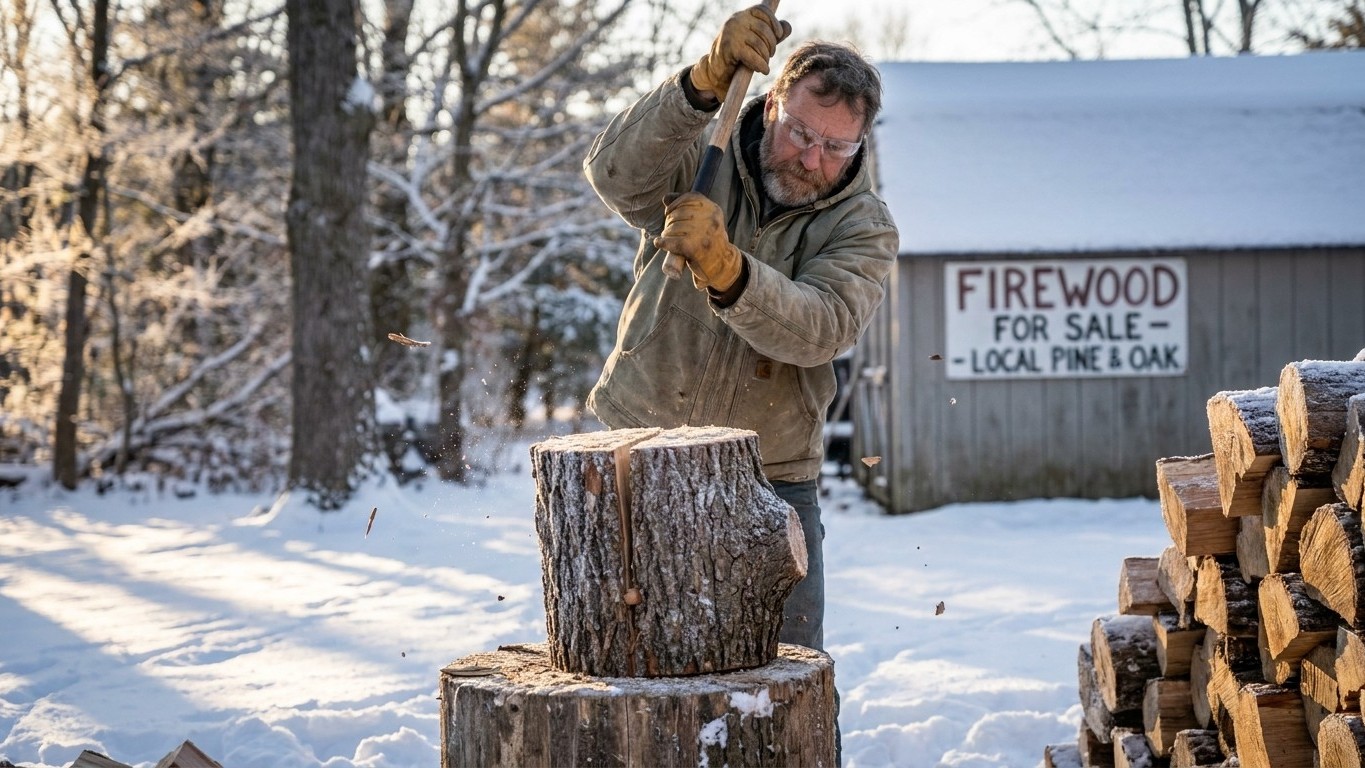

Firewood splits best right after the tree comes down, while the wood is still green, or once winter cold has frozen it solid. Wait too long into a hot, dry summer and even easy species turn stubborn. The technique matters as much as the timing: read the grain at the log’s end, aim for existing cracks, and match your final piece size to your firebox rather than to habit.
Splitting firewood

Wood doesn’t split randomly. It opens along its grain, and that grain is easiest to read at the ends of the round, where the growth rings and any radiating cracks are visible in cross-section. Extension foresters at programs like Penn State Extension and University of Minnesota Extension have long pointed out that a log almost always shows you where it wants to open before you ever swing a maul. Look for a check, a hairline crack running outward from the center, and aim there instead of at the dead middle of the round. Splitting through the center of a round with no visible check means fighting the wood’s structure instead of using it.
Timing changes the physics of the job. Frozen wood splits more easily than wood at room temperature, because the water inside a frozen log is rigid rather than fibrous. Ice doesn’t bend or stretch the way wet wood fiber does, so the same swing that barely dents a round in October can pop it open cleanly in January. This is one reason experienced burners save the toughest rounds for the coldest stretch of the season instead of forcing them in mild weather.
Species that fight back no matter what
Some wood is stringy by nature. Elm is the classic example, along with sycamore and sweetgum. Their fibers interlock instead of running straight, so even a sharp maul and perfect technique can leave you with a round that twists and tears rather than cracking clean. That resistance is a property of the wood itself, not a sign you’re doing something wrong. Knowing which species on your woodpile behave this way saves a lot of frustration, and a lot of wasted swings, before you ever pick up a tool.
Piece size matters just as much as splitting method. Wood cut and split to match the size of your firebox burns evenly. Oversized pieces smolder because the fire can’t reach enough surface area to combust cleanly, which means more smoke and less heat for the same amount of wood. Undersized pieces do the opposite: they catch fast, burn out fast, and leave you feeding the stove every twenty minutes instead of settling in for the evening. Splitting to a habit, always the same size regardless of the round, ignores what your specific stove or fireplace actually needs.
How to do it
- Buck the log to length first. Cut your rounds to the length your firebox takes before you split anything. Splitting first and cutting to length after just means wrestling with pieces that don’t fit.
- Set the round on a low block. Place a short, stable stump or block under the round you’re about to split. A low block keeps your swing short, which means a miss lands harmlessly on the block instead of on your shins or the ground.
- Study the end grain before swinging. Turn the round so you can see the cut face clearly. Look for an existing check or crack radiating from the center outward.
- Aim at the check, not the center. Line up your maul or axe with that crack rather than the geometric middle of the round. You’re following a line the wood has already started, not creating one from scratch.
- Swing through the round, not at it. Follow through as if the target is a few inches past the wood’s surface. A swing that stops at contact wastes energy that should be splitting the fibers apart.
- Reset and rotate for stubborn rounds. If a piece doesn’t open on the first strike, rotate it a quarter turn and try again from a different angle rather than hitting the same spot repeatedly.
- Sort pieces by size as you go. Split each piece down until it matches your firebox dimensions, keeping a few slightly smaller pieces on hand for kindling and quick-starting fires.
- Stack immediately rather than leaving a pile. Wood left in a heap on the ground traps moisture against the bottom layer and slows drying for the whole batch.
What goes wrong
-
The maul bounces off without splitting anything
This usually means you’re striking dead center on a round with no visible check, or hitting a stringy species like elm that resists no matter how hard you swing. Stop fighting the same spot. Rotate the round, look for a crack near the edge instead of the middle, and redirect your next strike there. If the species is simply stringy, accept that some rounds will need several strikes from different angles, or a wedge driven in and worked side to side rather than a single clean blow.
-
The round splits but into oddly uneven chunks
Uneven splits usually trace back to aiming off the grain line rather than following an existing check. Once it’s already happened, don’t try to fix that piece further, just re-sort it by size. Going forward, take an extra second to examine the end grain before each swing instead of swinging from memory or habit.
-
Pieces smolder or burn out too fast once stacked in the stove
This is a sizing problem, not a splitting-technique problem. Oversized pieces choke on their own bulk and smolder; undersized ones flare and vanish. If you’ve already got a pile of mismatched pieces, don’t scrap them, just split the oversized ones down further and set the smallest pieces aside as kindling instead of trying to burn them as primary fuel.
-
A miss lands near your feet or the ground instead of the block
This almost always means the round was set too high, or without a block at all, turning a short recovery swing into a long, uncontrolled one. Once it’s happened, check the block setup before the next round rather than adjusting your stance. A low, stable block under the round is what keeps a miss short and harmless instead of dangerous.
-
Wood that split easily last month suddenly resists this month
Temperature is often the culprit. As frozen wood thaws, the rigid ice inside turns back into flexible, fibrous water, and the same round that popped open cleanly in a cold snap can suddenly feel tough again. If splitting has gotten harder without any change in species, check whether a thaw came through, and consider saving the toughest remaining rounds for the next cold stretch.