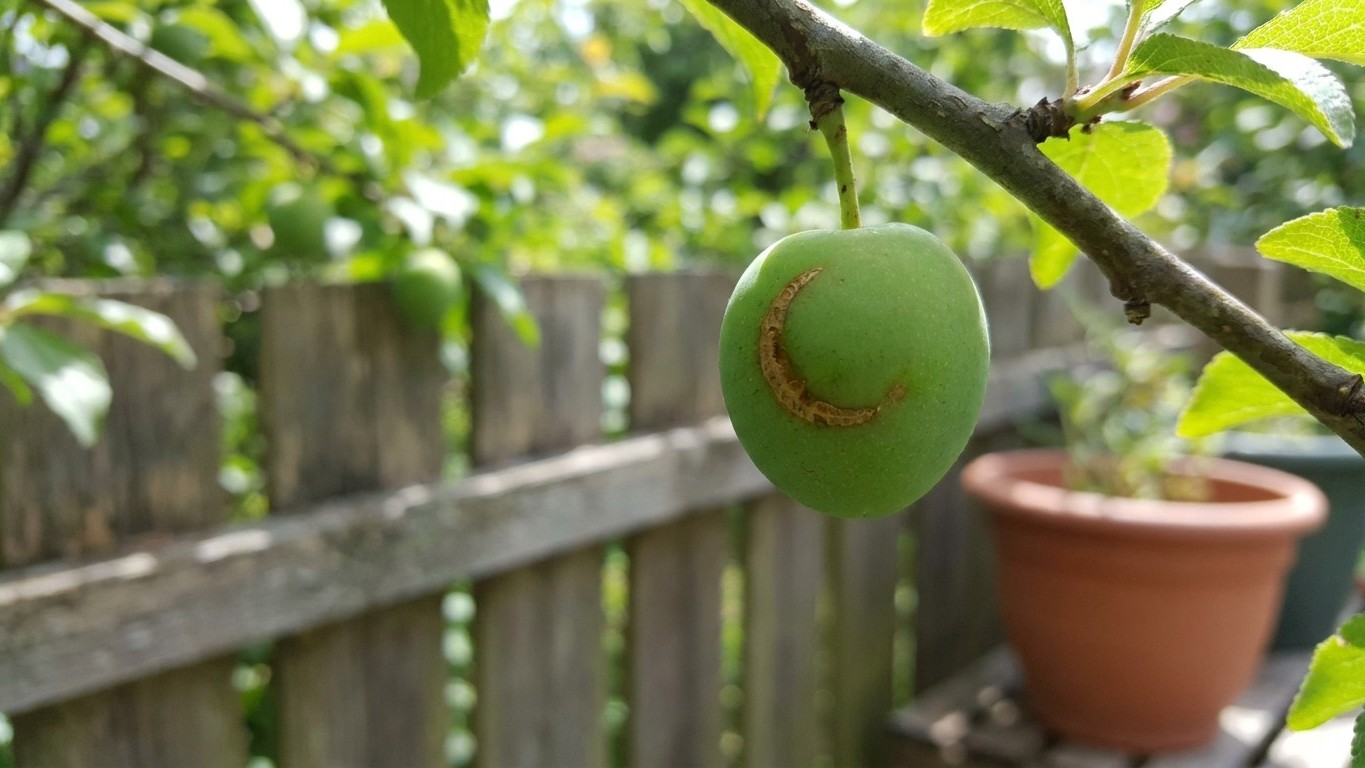

A crescent-shaped scar on a young apple, usually with a small gouge or dimple sitting inside the curve, is the classic sign of plum curculio feeding or egg-laying. The mark shows up early, while the apple is still small and hard, and it does not heal flat: the skin around it stays puckered and often turns corky as the fruit grows. Check the smallest fruit on the tree within the first weeks after petal fall, before you go looking for the beetle itself.
The damage it leaves

The crescent scar
The first thing most growers notice is not the insect but the mark it leaves on the fruit surface. A female plum curculio cuts a small flap into the skin of a young apple, lays an egg underneath it, then slices a curved gouge below the flap so the egg sits in a pocket. That gouge is the crescent-shaped scar the pest is named for: a thin, curved slit with a raised lip, usually less than a quarter inch across, sitting on fruit that is still smaller than a golf ball.
What happens as the fruit grows
Feeding punctures look different from the egg scar. They are small, round, and shallow, more like a pinprick than a cut, and a single apple can carry a dozen of them along with one or two crescent scars. As the apple expands through the season, tissue around both kinds of injury often turns corky, sunken, or dimpled, and the fruit can end up lopsided on one side. Fruit stung early and heavily tends to drop from the tree before it reaches full size, since the growing apple simply cannot expand evenly around the wound. Fruit that stays on the tree carries the scar to harvest, sometimes as a healed, russeted crescent that is still easy to spot when you are sorting the crop.
Making sure it is this one
Cut the fruit open
The surest check is a knife. Slice through a scarred apple at the point of the crescent and look for a narrow curved cavity running just under the skin, sometimes with a small white, legless grub inside with a brown head capsule. That larva feeds only briefly before many stung apples drop, so an empty scar with no grub does not rule the pest out. It only means the egg failed or the larva already left with the fruit.
Tell it apart from other scars
Apple maggot and codling moth leave marks that can be confused with plum curculio at a glance, but the details differ once you cut into the fruit.
| Pest | Surface mark | Inside the fruit |
|---|---|---|
| Plum curculio | Crescent-shaped scar, small round feeding punctures | Short curved cavity near the skin, larva may already be gone |
| Apple maggot | Faint dimpling, no distinct scar | Winding brown trails through the flesh |
| Codling moth | Small entry hole, often with frass stuck to it | Straight tunnel running to the core, frass packed inside |
An adult sighting settles any doubt. Plum curculio adults are mottled gray-brown snout beetles, about a quarter inch long, with four small humps across the back of the wing covers and a curved snout nearly as long as the rest of the body. Jarring a branch over a light-colored sheet or drop cloth in the early morning, while the beetles are still sluggish from the cold, will knock adults down where you can see and count them.
When it attacks
From petal fall to fruit set
Adult plum curculio spend the winter as adults, not eggs or larvae, tucked into leaf litter and brush at the edge of woods or hedgerows near the orchard. They move into apple trees around petal fall, once the blossoms have dropped and the first small fruit is forming, and that migration is what triggers the earliest feeding punctures and egg-laying scars of the season.
A short window, then it closes
Egg-laying continues for as long as the fruit stays soft enough for the female to cut into it, roughly the weeks while the apples are still smaller than a golf ball. Once the flesh firms up, the beetle can no longer cut a workable pocket for an egg, and new scarring drops off sharply even though beetles may still be present. That closing window is why most of the visible crescent damage on a tree traces back to a fairly short stretch right after bloom, not to the whole growing season.
How many generations complete in a year depends heavily on how long the local growing season runs, since a second summer generation needs enough warm weeks left after the first one finishes. That is a climate detail worth checking with a local extension office rather than assuming from a general description, since it changes what you should be watching for later in the season, both for this pest and for the broader run of apple pests that follow similar seasonal patterns.
What to do about it
Find out how many you have before you treat
Jarring branches over a sheet, done a few times a week starting around petal fall, is the standard way to track whether adult numbers are rising on a given tree. Some growers also hang a pyramid-style trap baited with the beetle’s own aggregation scent near the orchard edge as an early-warning tool, since curculio tend to move in from woodland borders rather than appearing evenly across the block.
Reduce the population without a sprayer
Trees at the edge of the orchard, closest to woods or hedgerows, usually take the heaviest hits first, so checking those trees more often catches a buildup early. Shaking or jarring branches to knock adults onto a tarp, then destroying what falls, is slow but genuinely reduces numbers on a small planting where a handful of trees are involved. Picking up and destroying dropped, stung fruit promptly removes larvae before they can finish developing and re-enter the soil as pupae.
Where chemical control fits
Insecticide timing for plum curculio is built around the petal fall window and the weeks right after it, but the specific products registered and legal to use on apples differ by state, so check the label and your local extension service before applying anything. The same sheet-jarring counts that tell you whether the pest is present are also what tell you whether a spray is even warranted, which matters on a home planting where a light infestation may not justify treating at all.
Keeping it out next year
Break the cycle on the ground
Mature larvae leave the fruit and burrow into the soil to pupate, so anything that disturbs that soil layer under and around the tree in the weeks after fruit drop works against them. Raking up and removing dropped fruit, rather than leaving it to rot in place, takes larvae out of the picture before they can complete that step. Shallow cultivation of the soil under the drip line, where fallen fruit tends to concentrate, exposes pupae to weather and predators instead of letting them overwinter undisturbed.
Manage the edge, not just the tree
Because overwintering adults come from leaf litter and brush at the orchard’s border, keeping that edge mowed and cleared of deep leaf litter removes some of the shelter they rely on through winter. Orchards backed up against woods or an old hedgerow tend to see heavier early-season pressure than those with open ground on all sides, which is worth knowing if you are choosing where to plant a new tree. Fruit sanitation matters for more than one pest at a time: cleaning up drops and mummy fruit left on the tree over winter also cuts down on hosts for problems like woolly apple aphid, and a tidy orchard floor generally means fewer overwintering sites for the whole range of insects that trouble apples, including unrelated pests such as Japanese beetles that show up later in summer.
Common questions
Why does my apple have the crescent scar but there’s nothing inside when I cut it open?
Most stung fruit drops before the larva finishes feeding, and a lot of eggs never survive to hatch at all. An empty scar just means the egg or young larva did not make it, not that the identification is wrong.
Does plum curculio only bother apples?
No. It attacks stone fruit as well, including peach, plum, cherry and apricot, which is where the name comes from in the first place. An orchard growing several kinds of fruit can see damage move between them over the course of a season.
Should I destroy fruit that drops early, or is it fine to compost it?
Destroy or remove it from the property if you can, since a home compost pile often does not get hot enough or turn fast enough to reliably kill the larvae inside. Bagging drops for the trash or feeding them to livestock are both more certain than tossing them on a cool compost heap.
Is an apple with the crescent scar safe to eat?
Yes, once you cut away the scarred and corky tissue around the wound. The damage is cosmetic and structural, not a food safety issue, though heavily stung fruit is often better used for sauce or cider than kept whole.