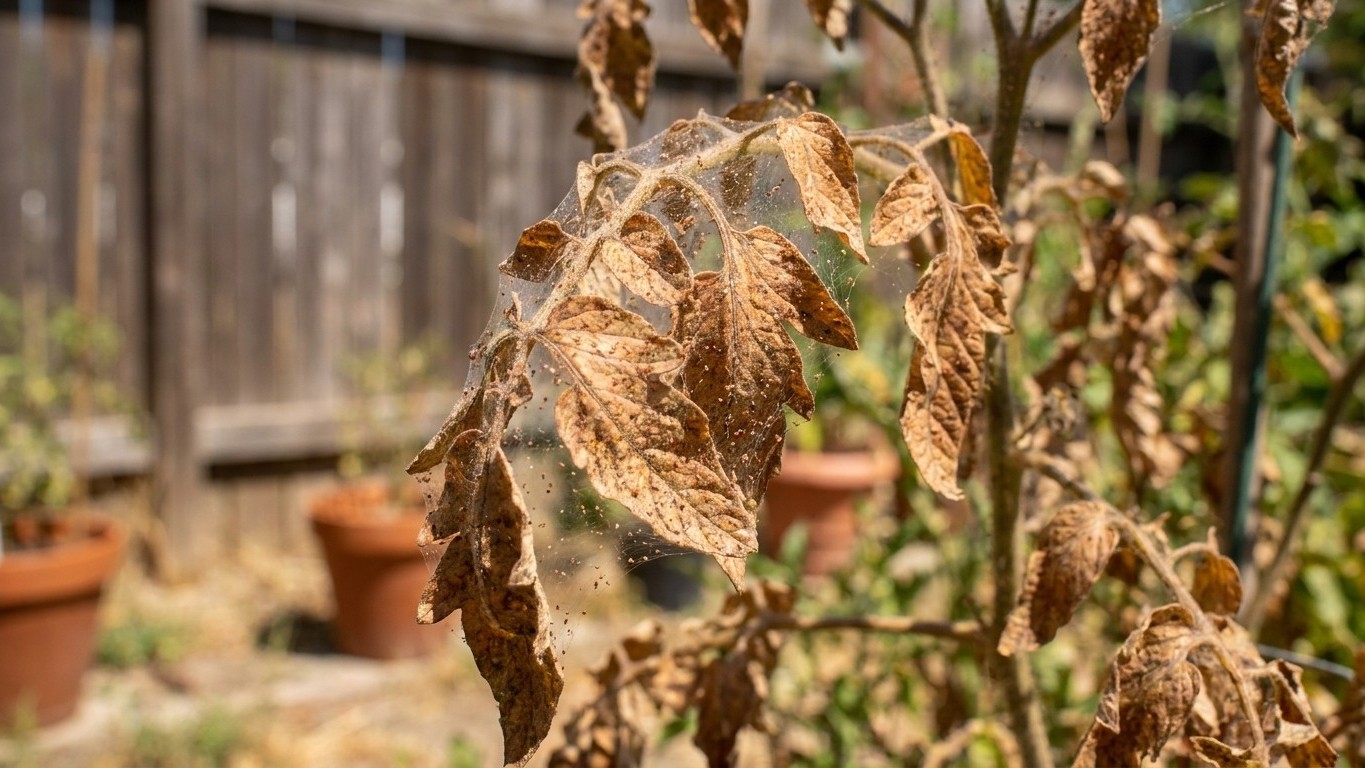

Spider mites show up as a dusty bronze or silvery cast spreading across apple leaves, usually worst on the branches that catch the most sun and dust during a hot dry stretch. No fungus or nutrient problem causes that exact look. Before reaching for anything, hold a sheet of plain white paper under a bronzed branch and give it a sharp tap. If specks smaller than a period start crawling across the paper, that is your answer.
The damage it leaves

On the leaf
The first sign most growers notice is a leaf that looks tired rather than diseased. Feeding starts as tiny pale or yellow specks where a mite has pierced a leaf cell and drawn out the contents. Left alone through a hot week, those specks multiply and run together into a bronze or gray-brown stippling that is visible from several feet away, usually starting on the undersides of leaves low in the canopy or along dusty edges of the orchard.
Heavily fed leaves curl at the edges, feel dry and papery, and drop early. Premature leaf drop by mid to late summer is the real cost of a spider mite outbreak, because it cuts into the sugars the tree needs to store for next year’s bloom, not just this season’s fruit.
On the tree overall
When populations peak, fine silk webbing shows up in the vein axils and along the midrib, easiest to see if you hold a leaf up to backlight. Fruit itself is rarely marked directly, since spider mites feed on leaf tissue rather than fruit skin. What you do see is fruit that sizes up poorly and sunburns once a defoliated branch loses the shade of its own canopy. A tree that has dropped a third of its leaves by August going into a hot dry stretch is carrying a heavier mite load than one that still looks full and green.
Making sure it is this one
The tap test settles most cases in under a minute. Hold a plain white sheet of paper under a bronzed, suspect branch and rap the branch hard against your palm a few times. Spider mites are too small to identify by eye on the leaf itself, but on white paper the moving specks are unmistakable, and a hand lens at ten power will show the oval body and the pair of dark eye spots common to the mites that attack apple.
Webbing is the second confirmation. Fine silk strands in the vein axils, especially where the leaf meets the midrib, do not happen with drought stress or powdery mildew, and they thicken visibly once you know to look for them. Unlike Apple Maggot: Dimpled Skin and Brown Trails Inside, which marks the fruit itself, spider mite damage stays confined to the foliage until the canopy is far gone, so a tree with clean, unmarked apples but bronzed leaves points straight back to mites.
| Cause | Leaf color | Webbing | Confirms with |
|---|---|---|---|
| Spider mites | Bronze to gray-brown stippling | Fine silk in vein axils when severe | Moving specks on white paper after a tap |
| Drought stress | Dull gray-green, curled | None | Soil dry at root depth, whole tree affected evenly |
| Powdery mildew | White-gray felty coating, mostly on new growth | None | Coating rubs off on a finger |
When it attacks
Spider mites overwinter as eggs tucked into bark crevices and around bud scales, well protected through dormancy. Hatching begins as the tree moves through green tip and into pink, and the first generation feeds quietly and low in the canopy through bloom and petal fall, often going unnoticed because populations are still small and leaves are still expanding faster than the damage shows.
The trouble starts once the tree is well into its summer growth and a hot, dry stretch settles in. Spider mites reproduce far faster in heat than the predatory mites and other natural enemies that normally keep them in check, so the balance tips quickly. Several overlapping generations follow one after another through the rest of the growing season, each one adding to the leaf damage left by the one before it, which is why a tree that looked fine in June can be visibly bronzed by August without an obvious single cause.
Cool, wet weather slows the whole cycle down and gives predators time to catch up, which is part of why outbreaks track dry summers so closely rather than any single calendar date.
What to do about it
Water comes first. A tree under drought stress is far more attractive to spider mites and supports faster population growth, so a deep, even watering schedule through a hot spell does more good than most sprays. Relieving drought stress is the single change that most consistently knocks an outbreak back, because it removes the condition mites depend on rather than just killing the mites present that day.
A strong jet of water aimed directly at the undersides of leaves physically knocks mites and their webbing off the tree and buys time without touching the predators that would otherwise help. Repeat every few days during the worst of a hot dry stretch, focusing on the lower, dustier parts of the canopy where populations usually build first.
- Check the driest, dustiest rows first, since mites concentrate there before spreading
- Wash undersides of leaves rather than just the tops of the canopy
- Hold off on broad-spectrum insecticides unless a labeled product from your local extension service specifically targets mites
- Watch nearby trees fighting Japanese Beetles: Leaves Reduced to Lace, since a spray timed for beetles often wipes out the predatory mites holding spider mites in check
Spider mites rarely show up in isolation during a hot summer orchard, so it is worth treating them as one piece of a broader Apple Pests program rather than a single emergency spray. Any miticide beyond water and sanitation should come from a product labeled for apple and mites in your state, since registration and rates differ by location and your local extension service is the right place to check both.
Keeping it out next year
Canopy and airflow
A dense, tall canopy holds dust and heat longer than an open one, and both favor spider mites. Rootstock has a direct hand in this: USU Extension lists MM.111 at 30 to 35 feet and seedling rootstock at 35 to 40 feet at maturity, both of which produce large, dense trees that are hard to hose down completely or scout row by row. Dwarfing rootstocks such as M.9, at 8 to 12 feet per USU, or M.26 and G.11, both 12 to 15 feet, keep the canopy compact enough to inspect the whole tree in a few minutes and to soak every leaf when you need to.
Sanitation and dust
Clearing fallen leaves at the end of the season removes some of the overwintering eggs tucked into bark and debris nearby, though most eggs are laid directly on the tree rather than in the leaf litter. Cutting down on dust around the trees matters more than most gardeners expect, since dusty foliage both attracts mites and interferes with the predators that would otherwise hold them down. A strip of ground cover or mulch under the drip line, instead of bare dusty soil, keeps that dust from settling on the leaves in the first place.
Steady watering through the growing season, rather than letting the tree swing between drought and deep soaking, keeps foliage from ever reaching the stressed state mites exploit. It costs less effort than fighting a bronzed canopy in August.
Common questions
Can spider mites kill an apple tree?
Rarely on their own. A single hot summer of heavy feeding stresses the tree and cuts next year’s bloom, but a mature apple tree usually recovers once cooler, wetter weather returns and predator populations catch up.
Do spider mites spread to other fruit trees or the vegetable garden?
Yes, spider mites are not picky about a single crop and move readily between apple, other fruit trees, and many vegetables, especially during a dry spell when they are actively dispersing on wind and on your clothing after you brush past infested leaves.
Why does the bronzing show up on one side of the tree first?
That side is usually catching more sun, more dust, or more drought stress than the rest of the canopy. Check whether it faces a dry unpaved path, gets less irrigation, or simply gets more direct afternoon heat before assuming the whole tree is equally affected.
Will hosing the tree get rid of spider mites for good?
No, washing knocks numbers down and buys time but does not eliminate an established population by itself. It works best alongside relieving drought stress and cutting dust, repeated through the hot stretch rather than done once and forgotten.