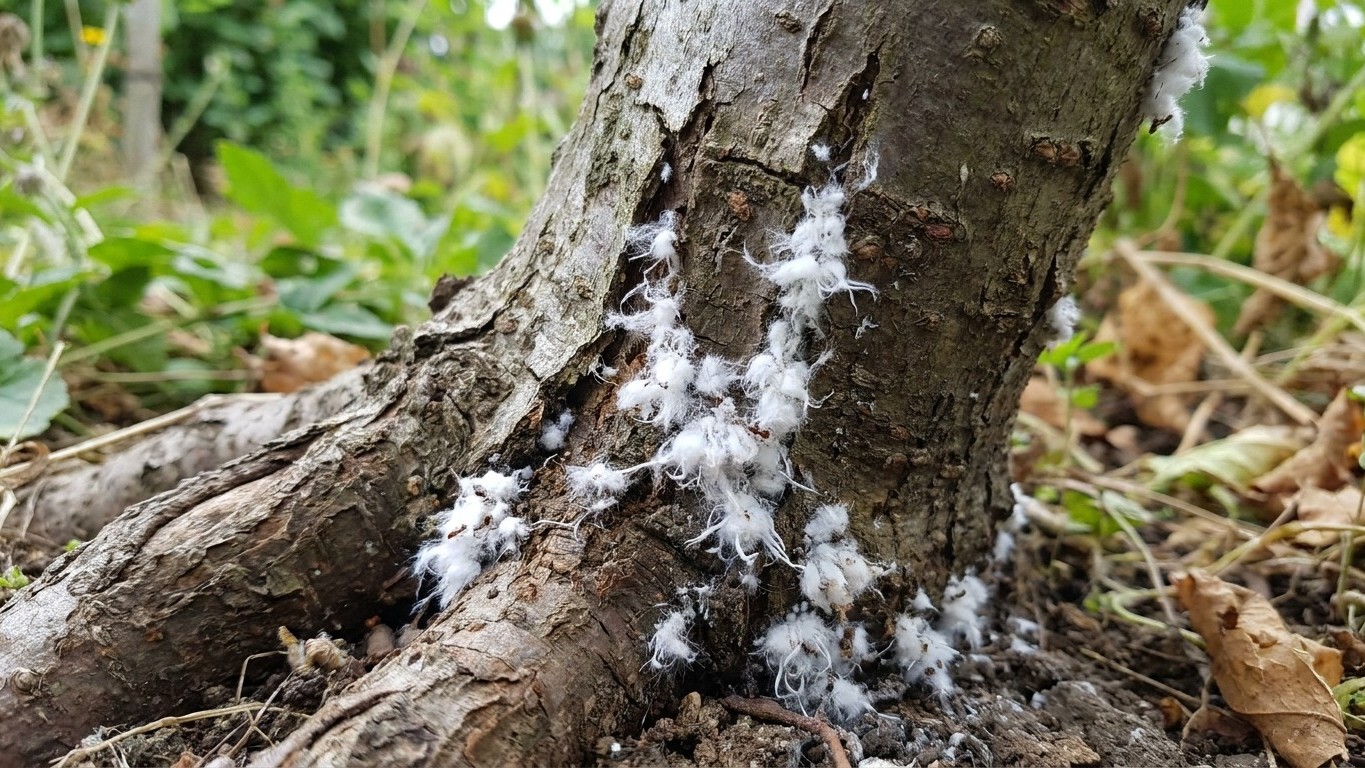

Woolly apple aphid is a small, soft-bodied insect that coats itself in white, cottony wax wherever it feeds, on pruning cuts, bark crevices, and the roots of the tree. The fluff is the giveaway: rub it and you find a cluster of purplish-gray aphids underneath, not a fungus or a scale insect. Check pruning wounds and the base of the trunk first, since colonies start there before they ever reach the roots.
The damage it leaves

The first sign is usually a patch of white, waxy fluff sitting on a pruning cut, a bark crack, or a knot where a branch was removed the year before. It looks like a smear of cotton or mold, and it clings to the wood even in wind and rain because the aphids underneath keep producing it. Wipe a patch away with a finger and you expose a cluster of soft, purplish-gray aphids and a smear of sticky honeydew.
- White, cotton-like tufts on pruning cuts, bark cracks, and sucker growth
- Sticky honeydew and black sooty mold on lower leaves or fruit
- Rough, spongy cankers at old wounds that never smooth over
- Knotty galls along roots, found only by digging near the base
- Thin, pale leaves and short shoots on an otherwise healthy-looking tree
Above ground and below ground
Left alone, the colonies spread along one-year and two-year wood, especially around old pruning wounds, sucker growth at the base of the trunk, and any bark that has been nicked by a mower or a trimmer. On young trees, heavy feeding on the bark raises rough, spongy cankers that never quite heal over, and the wood underneath stays weak at that point for years.
The damage that costs the most is out of sight. Woolly apple aphid feeds on roots as readily as on bark, and root feeding raises knotty, uneven galls that look a little like small potatoes strung along a root. A tree with a heavy gall load takes up less water and less nitrogen, and it shows as thin, pale foliage and short shoot growth even though nothing above ground looks obviously chewed. On a young tree still building its root system, a bad infestation can hold it back for a full season or more.
Honeydew from the colonies drips onto lower leaves and fruit, and a black sooty mold grows on the residue. That mold rubs off and washes off, and it does not damage the fruit the way a scab lesion does, but it marks the skin and it tells you where to go looking for the colony above.
Making sure it is this one
Rub the white fluff between two fingers. If it smears into a waxy, cottony residue and reveals soft aphids with a purplish or maroon body underneath, you have woolly apple aphid. If instead you find a hard, flattened, shell-like bump that does not smear, that is a scale insect, not this aphid, and it needs a different approach entirely.
Ruling out look-alikes
Squeeze one of the aphids and check the color that comes out. Woolly apple aphid stains fingers a dull reddish-purple, which is the fastest field test there is and needs no equipment. Green apple aphid and rosy apple aphid, the two look-alikes most growers confuse it with, are wingless, green or pink, and never produce the white wax coat at all.
If the fluff sits only on new leaf growth at the shoot tips and the leaves are curling tightly around it, look again before you decide. That kind of curling and internal feeding is closer to what Codling Moth: The Grub Inside the Apple leaves inside the fruit itself, so cut open a nearby fruit if you are unsure which pest you are dealing with. Woolly apple aphid stays on the surface of bark and roots. It does not tunnel into the fruit.
Dig gently at the base of a suspect tree and look at the fine roots within the top few inches of soil. Knotty, swollen galls the size of a pea or larger, sometimes with the same white fluff clinging to them underground, confirm root colonization. A tree with cankers above ground but clean roots below has a lighter case and is easier to bring back under control with pruning alone.
When it attacks
Woolly apple aphid does not wait for a calendar date. It overwinters as nymphs tucked into bark crevices, old cankers, and on the roots themselves, protected from cold by the same waxy coating that makes it visible in summer. As soon as the tree breaks dormancy and moves through green tip and pink, those overwintering colonies start feeding again and begin producing the white wax that gives them away.
From bloom through summer
Through bloom and petal fall, colonies build on the bark around pruning wounds and sucker growth, and winged forms appear later in the season to spread the infestation to new wood and to nearby trees. The population above ground and the population on the roots are connected. Aphids move between the two through cracks in the soil and through the base of the trunk, so a colony knocked back on the bark in spring can still be feeding underground all summer.
The insect produces several overlapping generations across a single growing season, with numbers building fastest during the warmest stretch of summer and easing off as growth slows toward the end of the season. Exactly how many generations occur and how fast they build depends on local temperatures, so check with your state extension service for the season length in your own area rather than relying on a fixed count.
Root galls are a longer-term problem than bark colonies. Once a gall forms, it stays on the root even after the aphids feeding on it are gone, and new aphids can reoccupy an old gall the following year. This is why a tree with a bad infestation one season is worth checking again early the next, before growth resumes, rather than assuming last year’s pruning solved it for good.
What to do about it
Start with the colonies you can reach. Prune out infested wood where you find cottony patches on cankers or sucker growth, cutting well back into clean wood, and carry the prunings out of the orchard rather than leaving them in a pile near the trunk. This is the single most useful step for a home orchard, because it removes both the colony and the honeydew that draws ants and sooty mold.
A strong jet of water from a hose knocks the wax coating apart and dislodges a good share of the aphids from bark and low sucker growth, without needing a spray. Repeat it every week or two through the growing season on any spot that keeps coming back. It will not touch the colonies feeding on roots below the soil line, so treat it as a way to manage the visible infestation, not a cure.
Natural predators do most of the work
Lady beetles, lacewing larvae, and several small parasitic wasps feed on woolly apple aphid and usually keep a light infestation from becoming a heavy one on their own. A broad-spectrum insecticide applied for an unrelated problem, such as Spider Mites: Bronzed Leaves in a Hot Dry Summer, can wipe out those predators and let woolly apple aphid flare up afterward, which is one reason to spot-treat a specific problem rather than spraying the whole tree on a routine schedule.
Pesticide registrations and label rates differ by state, and a treatment that is legal and effective in one place may not be labeled for use in another. Take a sample of the white fluff, or a photograph of the root galls, to your state extension service or land-grant university’s plant diagnostic lab, and they can confirm the pest and point you to a currently registered option for your area. This step also belongs alongside your regular walk through Apple Pests, since a colony rarely shows up alone.
Avoid heavy nitrogen fertilizer on a tree that is already carrying an infestation. Lush, soft new growth is exactly what the colonies prefer, and pushing more of it while the aphid population is active tends to make the bark colonies worse before it makes them better.
Keeping it out next year
Sanitation carries more weight than anything you spray. Rake up and remove prunings, sucker growth, and any wood cut out during the season, since wax-covered colonies can survive on cut wood left on the ground and reinfest the same tree the following spring. Clean up around the base of the trunk too. Suckers from the rootstock are a favorite feeding site and the easiest place for the colony to move between roots and bark.
Inspect the base of the trunk and the first few inches of root at the start of the season, before growth resumes, and again in late summer when colonies are easiest to see. Catching a canker or a cluster of fluff early means a small pruning cut instead of removing a whole limb later.
Rootstock and root depth
If you are planting a replacement tree, remember that the rootstock, not the variety, decides how large the tree grows and how close its root system sits to the surface. USU Extension lists mature heights ranging from 8 to 12 feet on M.9 up to 30 to 35 feet on MM.111 and 35 to 40 feet on seedling rootstock, with M.26 and G.11 at 12 to 15 feet, G.30 and M.7 at 18 to 20 feet, and M.106 at 25 to 30 feet in between. A tree on a dwarfing rootstock keeps more of its root system near the surface, which makes it easier to find and prune away root galls by hand when digging at the base, compared with a seedling or MM.111 tree whose roots run deeper and wider.
Keep an eye on ant activity at the base of the trunk too. Ants feed on the honeydew and will actively carry woolly apple aphid colonies to new feeding sites to protect their food source, so a sudden line of ants running up the trunk is often the first clue that a colony has reestablished before the white fluff is easy to spot.
Common questions
Can woolly apple aphid kill my apple tree?
Rarely on its own. It weakens young trees through repeated seasons of root galls and bark cankers, and a young tree already stressed by drought or poor planting can decline faster under a heavy infestation, but a mature, otherwise healthy tree usually tolerates it for years.
Will it spread to my other fruit trees?
Woolly apple aphid feeds mainly on apple and closely related trees such as crabapple and hawthorn. It is not the same insect as the woolly aphids found on beech or other ornamental trees, and it does not typically move onto peach, cherry, or plum in a home orchard.
Is the white fluff harmful to touch?
No. It is wax and honeydew, not a stinging or biting insect, and it washes off skin and clothing with soap and water. Wash your hands afterward mainly to avoid spreading the sticky honeydew and sooty mold to other surfaces.
Is there a rootstock that resists it?
Ask when you buy a replacement tree, and in the meantime, check the root crown of any new tree yearly regardless of rootstock.