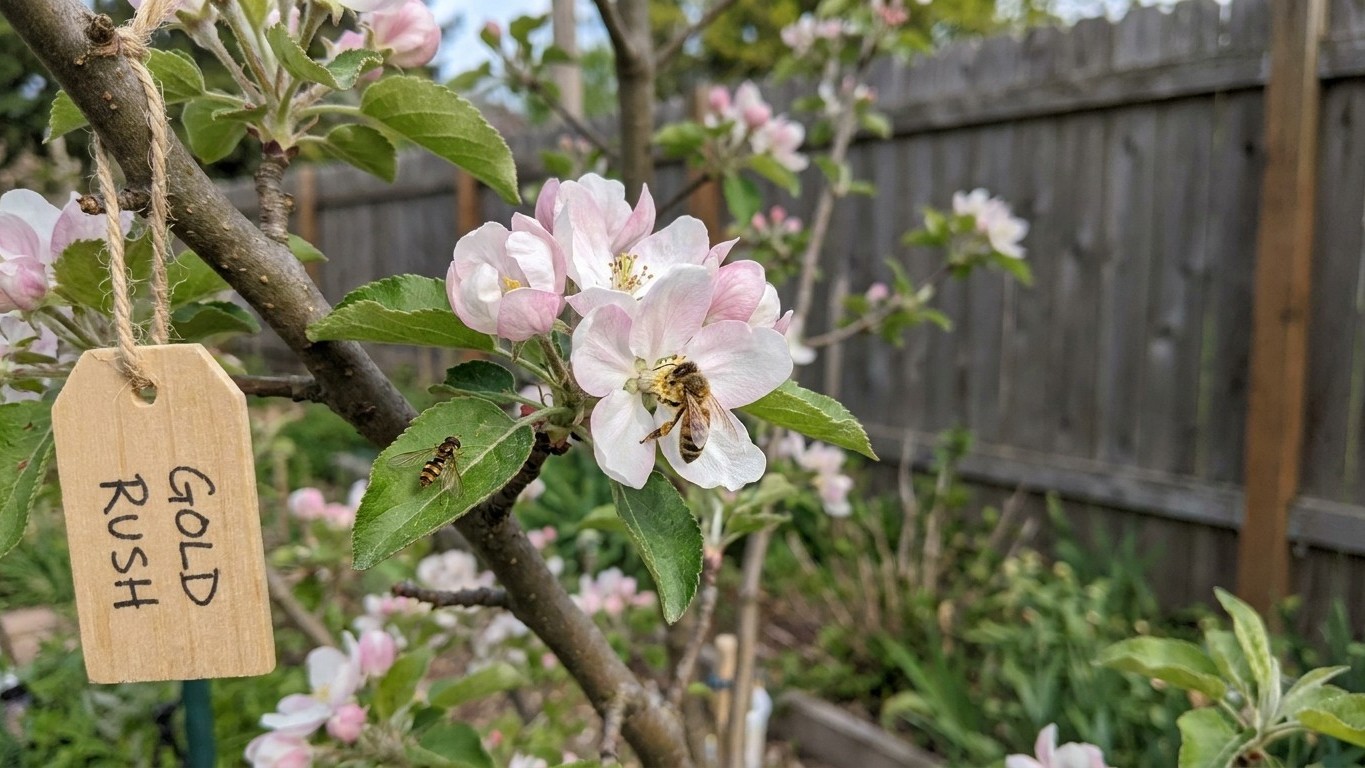

Gold Rush apple trees won’t set fruit alone — you need a second apple tree, blooming in that same mid-season window, growing nearby. The tag says Mid, but no partner list exists for this variety, so you can’t just look one up. Check the bloom-time rating printed on any candidate tree’s own tag before you buy it, and confirm it reads mid-season, not early or late.
The short answer
USU Extension’s variety chart lists Gold Rush’s bloom season as Mid and its hardiness range as zones 4 to 8, but it stops there. No named pollination partner for Gold Rush appears in that source, and rather than paper over that gap with a guess, it is worth stating plainly: if you have seen a list of “Gold Rush partners” somewhere else, it did not come from this reference, and none is invented here.
What you can act on instead is the bloom timing itself. Any apple variety that flowers in the same mid-season window, and that survives the same hardiness zone your Gold Rush tree is planted in, is a mechanically workable candidate. That is the actual test a nursery or extension office runs when someone calls and asks for a recommendation, and it works whether or not the specific variety name shows up on any published list.
On tree count, two trees are usually enough when both have fertile pollen. You need three only when one of the two has sterile pollen, because a sterile-pollen variety can be fertilized and will set fruit, but it cannot send back workable pollen of its own. The extension tables name only four pollen-sterile varieties—Jonagold, Mutsu, Stayman, and Winesap—and Gold Rush is not among them, so before committing to a two-tree planting, ask the nursery whether the specific candidate partner is one of those sterile types, which would call for a third tree instead. If nobody involved can confirm that with certainty, planting a third variety costs little and removes the guesswork entirely.
Why these varieties and not others

Bloom groups are relative, not calendar dates
Two apple varieties pollinate each other only if their flowers are open on the same days, because pollen has to move from one bloom to another while both are still receptive. That mechanism sits underneath everything covered on Apple Pollination generally: bloom overlap, not the variety’s name, is what actually does the work. Extension services sort varieties into bloom groups, early, mid, late, and sometimes finer divisions, to describe that overlap without pinning it to a calendar date. Clemson Cooperative Extension explains bloom grouping as a relative order among varieties, not a fixed date: an early-group tree in a cold spring can still open days later than a mid-group tree in a warmer climate that same year. What holds constant is the order itself. A mid-bloom variety like Gold Rush keeps opening after the early group and before the late group wherever it grows, even though the actual calendar date shifts by climate and by season.
That relative ranking is the entire reason bloom-group matching works as a shortcut. It tells you nothing about the calendar, but it tells you which varieties are likely to be in flower together in your own yard, since weather that delays one mid-bloom tree tends to delay a same-group tree by roughly the same amount.
Being in the same bloom group is necessary, but it is not sufficient, and this is the part people skip. Overlapping bloom does not guarantee fertile pollen: some varieties produce pollen that is sterile or nearly so, and a garden built entirely out of those varieties can flower beautifully together and still set no fruit, because pollen never worked in either direction. Overlapping bloom also says nothing about parentage. Two related varieties can flower at exactly the same time and still fail to pollinate each other if one was bred from the other, since a seedling and its own parent share too much genetic ground for fertilization to take. Gold Rush also carries USU’s rating of moderately resistant to fire blight, which matters when you are choosing a healthy orchard overall, but it has no bearing on whether a candidate partner’s pollen will fertilize it. Resistance and compatibility answer two completely different questions.
What cannot pollinate it
No documented exclusions for this variety
For a lot of well-known apple varieties, extension sources flag at least one specific thing you should not pair it with, usually a sterile-pollen relative in the same bloom group, or a direct parent-and-offspring pairing. If you find a specific exclusion listed by a named extension service elsewhere, treat that source as the one that overrides any other.
What is still worth understanding, so you can recognize a real exclusion when you research a candidate partner yourself, is how the two documented types of failure actually work.
The first is sterile pollen paired with sterile pollen. A sterile-pollen variety can still be fertilized and will still set fruit, but its own flowers cannot fertilize anything else. Plant two sterile-pollen varieties together with no third source in range, and both trees flower right on schedule, both look perfectly pollinated, and neither sets a crop, because there is no fertile pollen anywhere in the pairing. This is the single most common way a two-tree planting fails silently, and it is worth confirming directly with the nursery for any variety under consideration, since ploidy is rarely printed on the plant tag itself.
The second is parentage. A variety bred from another cannot be fertilized by that same parent, no matter how closely their bloom times line up. This is why researching a candidate partner by bloom group alone is not quite enough on its own. Pages like What Pollinates Golden Delicious, and What Cannot and What Pollinates Sweet Sixteen, and What Cannot show what a documented exclusion actually looks like once an extension service has published one, which is useful context even though neither exclusion applies to Gold Rush specifically.
How close the second tree has to be

Pollen moves on bees, not on wind, so distance is really a question of how far a foraging bee is likely to travel between two trees while both are in bloom. The practical rule is that closer is always better: a partner in the same yard beats one two lots over, and one two lots over beats a tree that only exists three streets away, where a bee has to cross traffic, gaps, and competing bloom to reach it.
What else can do the job
The pollen source does not have to be a tree you planted for the purpose. A neighbor’s apple tree counts, and so does an ornamental crabapple in bloom at the same time, since crabapples are cross-compatible with most eating apples and are often planted purely for their flowers. A pollinator branch grafted onto an existing tree also works, and it puts the second variety inside bee range of the first without taking up a separate planting spot. What matters in every case is that the bloom windows actually overlap in your own yard in a given year, not just on paper or on a nursery chart.
What breaks the arrangement is weather, not distance. Cold or wet conditions during bloom keep bees from flying, and bees generally will not forage below a certain temperature or through steady rain. A perfectly matched partner variety, planted right next to a Gold Rush tree, does nothing for the crop if the week both are in flower turns out cold and wet, because the bees are simply not moving pollen that week, regardless of how close the two trees stand. No amount of proximity buys back a bloom week with no bee activity in it, which is one more reason growers who have room plant more than one partner variety with slightly staggered bloom timing rather than relying on a single tree to carry the entire job.
If there is no room for a second tree
Four options for a small garden
A small garden does not have to skip pollination. It has to solve it without a second full-size tree, and there are a few established ways to do that, each with its own cost and its own limits:
- Multi-grafted tree: several varieties grafted onto one trunk, so the tree pollinates itself once every graft is mature enough to flower. Costs more up front and takes a season or two longer for each graft to bloom reliably.
- Pollinator branch: a single graft of a compatible variety added onto your existing Gold Rush tree. Cheaper than a second tree and needs almost no extra ground, but the whole job rests on one branch, so it has to be pruned with some restraint rather than cut back hard every year.
- Columnar variety: a narrow, upright growth habit bred for containers and tight spaces, planted as a genuine second tree rather than a graft. Solves the space problem but not the compatibility one, since the variety still has to match Gold Rush on bloom timing and pollen fertility.
- Flowering crabapple: planted for its bloom rather than its fruit, and often already sold as a compact ornamental. Cheap and easy to fit into a border, but the crabapple itself will not give you apples, only the pollination service.
None of these substitutes for confirming bloom overlap in the first place. A multi-grafted tree carrying the wrong combination of varieties, or a crabapple that finishes flowering before Gold Rush even opens, fails for the same reason a badly chosen second tree fails: the two bloom windows never actually met. Gold Rush itself harvests late September into mid October according to USU, so pairing it with an early or mid-season partner on a multi-grafted tree can also spread the harvest across several weeks instead of dumping everything at once, which is a scheduling perk worth having but not a substitute for checking compatibility first.
Common questions
Is Gold Rush self-pollinating at all?
Nearly all apple varieties crop better with a compatible partner nearby, and Gold Rush is no exception. Plan around a partner variety rather than counting on a single tree to carry a full crop.
Will a wild apple tree down the road pollinate my Gold Rush?
It can contribute if the bloom times happen to overlap and the tree is within normal bee range. The problem is that a wild seedling’s bloom timing is unlabeled and unpredictable from year to year, so it is not something to rely on as your only planned partner.
Does the rootstock affect pollination in any way?
No. Rootstock sets the mature size of the tree, not its bloom timing or its pollen compatibility. A Gold Rush on a dwarfing rootstock and one on a standard rootstock bloom on the same schedule and need the same kind of partner.
Can I just use a crabapple that’s already growing in my yard?
Often, yes, but check its actual bloom timing first, since crabapples span early, mid, and late bloom just like eating apples do. A crabapple that finishes flowering before Gold Rush opens will not help, no matter how close it stands.
What if my second tree keeps blooming about a week later every year?
A consistent lag like that suggests the two varieties sit in different bloom groups rather than the same one, and a short mid-season window in a given year could produce little to no real overlap between them. Adding a pollinator branch timed closer to Gold Rush, or a third variety, is a more reliable fix than hoping the timing closes the gap on its own.