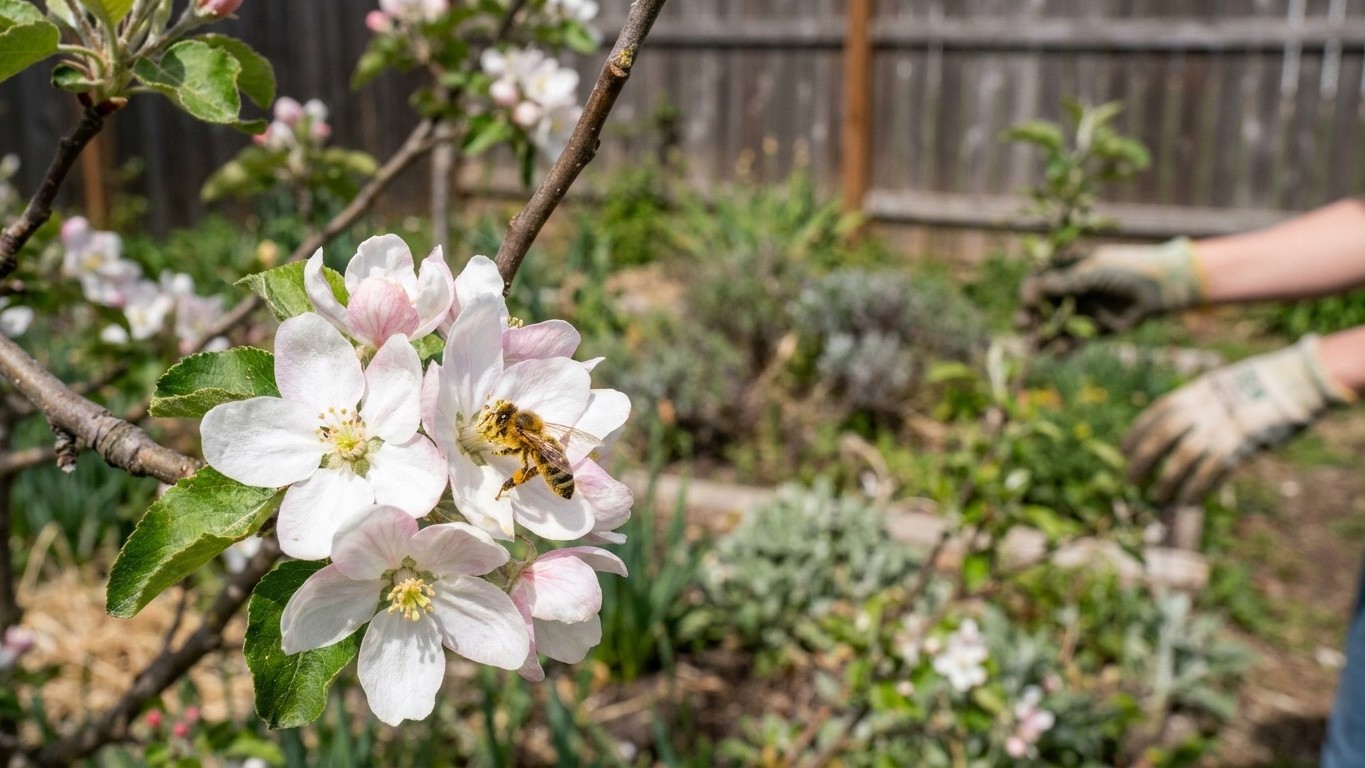

Honeycrisp won’t set fruit on its own pollen alone — it needs a second apple tree, or a crabapple, blooming in that same early window right beside it. Miss the timing and it doesn’t matter how many trees you plant nearby. So before anything else, pick your partner tree first, and check its bloom week against Honeycrisp’s with a local nursery, not a generic list off the internet.
The short answer
USU Extension’s guide, Apple Production for the Utah Home Garden, lists Honeycrisp’s bloom season as early and its hardiness range as zones 3 to 6, but it does not name specific pollination partners for this variety. That gap matters more than it sounds. Plenty of pages online will hand you a tidy list of “Honeycrisp pollinators,” and none of them are sourced to anything you can check.
What you can act on is the mechanism. Honeycrisp is grown as a diploid apple, meaning its pollen is fertile and works in both directions, it can receive pollen from a compatible partner and also supply pollen back. That puts it in the easier category: two trees are enough, one Honeycrisp and one other variety that blooms in the same early window, as long as neither is a triploid with sterile pollen. Triploid varieties, Jonagold and Winesap among them, need a third tree in the mix because their own pollen cannot do the return job.
Since USU’s source doesn’t confirm a specific match for Honeycrisp, the safest move is practical rather than list-driven. Plant, or find within bee range, any early-blooming apple variety hardy to the same zone range, or an ornamental crabapple flowering at the same time, and let bloom overlap do the work rather than a name on a chart. Bloom timing decides compatibility here, not the variety’s marketing name.
Why these varieties and not others

Two apple varieties can pollinate each other only if their flowers are open on the same days. Extension services group varieties by bloom timing into rough categories, early, mid, and late season, and Clemson Cooperative Extension explains that this bloom group is a relative order, not a calendar date. Early-blooming varieties open before mid-season ones in every climate where apples grow, but the actual date shifts by weeks depending on the winter and the region. A grower in a cold valley and a grower two counties over will see different bloom dates on the same tree in the same spring, yet the order between an early bloomer and a late one stays fixed.
This is why the USU figure that matters for Honeycrisp is qualitative: early bloom season, not a date. Any variety that other extension services also class as early or mid-season is a candidate on timing grounds. That’s the whole reason the general overview on apple pollination talks about matching bloom groups rather than matching names. It’s a shortcut for timing, nothing more.
Two things a matching bloom group does not guarantee. First, fertile pollen. A triploid variety can flower at exactly the right time and still contribute nothing, because its pollen is sterile. Bloom group tells you the flowers are open together, not that the pollen inside them works. Second, a shared bloom group says nothing about parentage. Two varieties can bloom in the same window and still be parent and offspring, or share a parent, and breeding lines occasionally run into the separate problem of a seedling being unable to fertilize its own parent tree. Bloom group is a timing filter only. It screens out varieties that flower weeks apart, but it does not screen in a guaranteed match.
This is the same logic that applies to varieties like Idared, whose own bloom-group placement and pollen compatibility are covered on our Idared pollination page, where the constraints happen to run differently.
What cannot pollinate it
What can be said, based on how pollen works generally, is where the failures usually come from, and a grower can check any candidate partner against these two traps before planting.
The sterile-pollen trap
Triploid varieties, Jonagold, Winesap, and Stayman among the commonly grown ones, carry an extra set of chromosomes and produce pollen that is essentially sterile. A triploid can still receive pollen and set its own fruit, but it cannot supply usable pollen back to a neighboring tree. Plant only Honeycrisp and a triploid together and the Honeycrisp side may still set fruit, since Honeycrisp’s own pollen is fertile, but the triploid gets nothing useful from that pairing and will need its own separate pollinizer to fruit well. A triploid variety planted alone with Honeycrisp fixes only half the orchard.
The parentage trap
The second failure mode is genetic rather than about timing: a variety bred directly from another cannot fertilize that parent tree, even if both bloom in the same week. This shows up in named breeding lines where the parentage is published and well known. Anyone planting a specific pairing on the strength of parentage alone should confirm it with a nursery catalogue or a local extension office rather than a general rule of thumb.
How close the second tree has to be

Pollen moves on bees, not on wind, so distance is a practical question about how far a foraging bee will travel between flowers, not a fixed number written on a chart. Closer is always better. A partner tree in the same garden bed, close enough that a bee visiting one can drift to the other in the same trip, works better than one across the property line, and a partner two properties away is functionally useless even if it is technically the right variety.
The partner tree does not have to be a second Honeycrisp-compatible apple you planted on purpose. A neighbor’s apple tree flowering at the same time counts, if bees travel between the two yards. An ornamental crabapple in bloom during the same window counts too, and many gardeners use one specifically because crabapples are compact and flower heavily. A pollinizer branch grafted onto the trunk of an established tree also works, and it solves the space problem without adding a second trunk to the yard, a fix covered in more detail below.
What defeats all of these options at once is weather, not distance. Cold or wet conditions during the bloom window keep bees from flying, and when that happens it does not matter how close the partner tree is or how well the bloom groups line up. No amount of extra partner trees compensates for a stretch of bad bloom-week weather. That risk is one more reason to plant the partner as close as the layout allows. A short, dry flight between two trees a few feet apart still has a chance in marginal weather, a flight across a windbreak or a busy road does not.
If there is no room for a second tree
A small yard doesn’t rule out a second bloom source, it just changes the form it takes.
- Multi-grafted tree: several varieties grafted onto one trunk, so one tree in the ground still supplies overlapping bloom. It takes upkeep, each variety on the trunk grows at its own rate and needs separate pruning attention, but it solves the space problem completely.
- Pollinizer branch graft: a single scion of a compatible, early-blooming variety grafted onto an existing Honeycrisp. Cheaper and faster than a second tree, but it only supplies pollen from the grafted branch itself, so it needs to establish and bloom reliably before it does any good.
- Columnar variety: a narrow, upright-growing form that fits where a full-size tree won’t. It adds bloom in a tight footprint, but a columnar tree’s own fruiting habit is limited, so it works best as a pollen source rather than a main crop tree.
- Flowering crabapple: an ornamental tree bred for heavy bloom rather than fruit. It takes almost no orchard management, but it earns its place only if its bloom window actually overlaps Honeycrisp’s, which should be checked before planting rather than assumed.
None of these fixes the core requirement, they only change where the second bloom source physically sits. A grower choosing between them is really choosing how much grafting or pruning work they want to take on, not whether a partner is needed at all. The same trade-off comes up for other early bloomers, including Yellow Transparent, where a small yard faces the identical space problem with a different bloom window to match.
Common questions
Can I skip a second tree if my Honeycrisp already sets some fruit?
A light fruit set from one tree is common but not the same as a full crop. Most apple varieties, Honeycrisp included, carry self-incompatibility genes that block a flower’s own pollen, or pollen from another tree of the identical variety, from fertilizing it well, so a lone Honeycrisp or two Honeycrisps together will always underperform a Honeycrisp paired with a genuinely different variety.
Does a crabapple growing wild nearby count as a real pollinator?
It can, if its bloom overlaps Honeycrisp’s early window and bees move between the two trees. Ornamental and wild crabapples are not sorted into the same named bloom-group charts as orchard varieties, so the only way to know is to watch both trees during bloom for a season and see whether the flowering dates actually line up.
How far away can the pollinator tree be and still work?
There’s no fixed distance, because the job depends on bee traffic rather than a measured radius. A partner in the same yard is reliable, a partner several properties away is not, and anything in between depends on how many pollinators are working the area that spring.
Can two Honeycrisp trees pollinate each other?
No. Two trees of the same variety carry the same pollen, and self-incompatibility genes generally block that pairing regardless of how many trunks are in the ground. The second tree needs to be a genuinely different variety, not another Honeycrisp.
What if my only nearby apple tree blooms weeks earlier or later than Honeycrisp?
A large gap in bloom timing means little or no useful overlap, and that pairing likely will not help fruit set no matter how close the trees stand. The fix is a variety USU or another regional extension service classes in the same early bloom window as Honeycrisp, not a nearby tree of any kind.