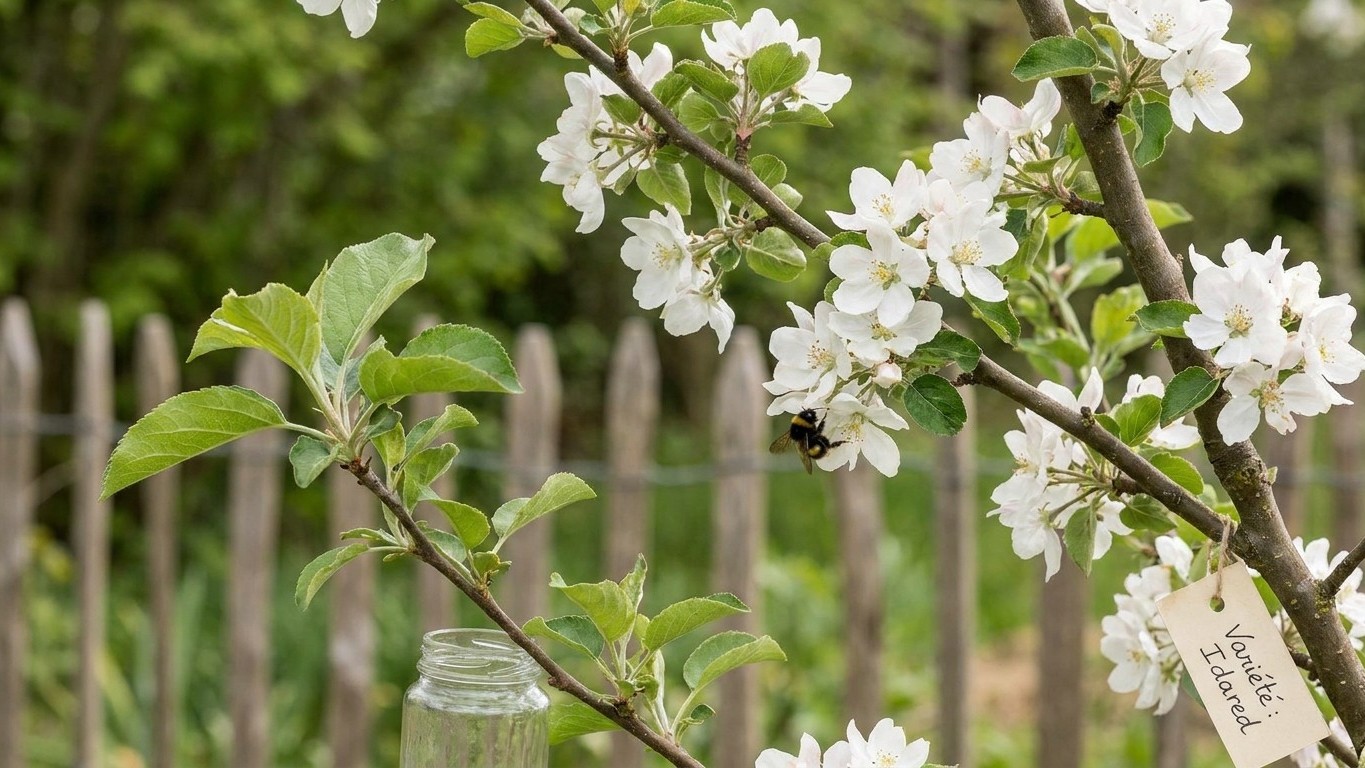

Idared won’t set a full crop alone — it needs a second apple tree, a different variety, blooming at the same time. That’s the answer, and the part worth sitting with is “at the same time”: Idared opens its flowers early in the season, so a late bloomer nearby does nothing for it no matter how close the trees stand. Before you plant or graft anything as its partner, find out when that candidate tree actually blooms in your area and whether its pollen is fertile — not just whether it’s labeled an early apple on a tag.
The short answer
USU Extension’s guide is the source for the other figures used here, and it does not publish a list of compatible pollinator varieties for Idared by name. What it does confirm is that Idared blooms Early and is hardy in USDA zones 4-6. That narrows the search without settling it: a workable partner has to open its blossoms on roughly the same schedule as Idared, not simply grow well in the same climate zone.
Two trees or three?
Nearly all apple varieties crop better with a compatible partner nearby, and Idared is no exception even without a name-matched list in this source. The rule that applies to every apple pairing, Idared included, is that two trees are enough if both carry fertile pollen. If one of the two turns out to have sterile pollen, a two-tree planting sets little or no fruit on either side, because the sterile tree can receive pollen but never send any back to its partner. In that case the planting needs a third tree, one with fertile pollen and an overlapping bloom window, to carry pollen to both of the others.
Extension variety tables (USU Extension, Apple Production for the Utah Home Garden; Clemson Cooperative Extension HGIC 1350) name the pollen-sterile apple varieties—Jonagold, Mutsu, Stayman, and Winesap—and Idared is not among them. Before committing to a two-tree planting, check the fertility status of whatever variety you are considering as a partner, either with your extension office or on the nursery’s variety description. Treat “early bloom, zones 4-6” as the starting filter, not the final answer.
Why these varieties and not others

Bloom timing is the mechanism, not a rule someone made up for convenience. A honeybee or orchard mason bee moving from flower to flower only spreads pollen between blossoms that are open at the same time, so two apple varieties can pollinate each other only if their bloom windows overlap enough for bees to carry pollen between them in a single working day. Extension services sort varieties into early, mid-season and late bloom groups to make that overlap easy to check without tracking exact dates for every county.
What “early” means across climates
Clemson Cooperative Extension explains this grouping as a relative order rather than a fixed date: the actual day a variety opens its blossoms shifts with the weather in a given year and the climate of a given place, but an early bloomer stays ahead of a mid-season bloomer and a mid-season bloomer stays ahead of a late one, wherever it is planted. USU lists Idared as an Early bloomer, so the search for a partner should start among other early bloomers, with the understanding that “early” describes Idared’s order relative to other apples, not a specific date on any one calendar.
Matching bloom group is necessary, but it is not sufficient on its own. Overlapping bloom tells you the bees have a chance to carry pollen between two trees. It does not tell you the pollen will actually work once it arrives. A variety in the same bloom group can still have sterile pollen, meaning it accepts pollen from others but produces none that can fertilize a partner in return. Overlapping bloom also says nothing about parentage: if one variety was bred from the other, the seedling cannot be fertilized by its own parent even though the two might flower in the same week. Bloom group narrows the list of candidates worth checking. It does not clear any single variety for planting on its own.
If you are new to how apple pollination actually works, the primer at Apple Pollination walks through bloom groups, pollen fertility, and the role bees play in carrying pollen between trees, before you get into the specifics of any one variety.
What cannot pollinate it
This is where a partner list would earn its keep, and it is exactly where USU’s guide stays silent for Idared: no sterile-pollen exclusion and no parentage exclusion is published for this variety in the source used here. That gap matters more than it sounds, because the two most common ways a pairing fails are both things a bloom-time match will never reveal on its own.
Two exclusions that a bloom match won’t reveal
- Two sterile-pollen varieties planted together: bloom overlaps, bees visit both, and neither tree ever receives usable pollen, because sterile pollen only receives, it never sends.
- A variety paired with its own parent: the two may flower in the same week, but a seedling cannot be fertilized by the tree it was bred from.
- A variety whose bloom window does not actually reach Idared’s, despite both being labeled “early” by a catalogue using a different reference scale.
A grower who plants Idared next to a single other tree without checking that tree’s pollen fertility takes on the same risk as a grower who unknowingly pairs two sterile varieties, just without a specific name attached to the mistake.
One figure worth carrying into that check is fire blight risk. USU rates Idared as Very Susceptible to fire blight, and fire blight bacteria travel on the same bees and the same bloom-time traffic that carries pollen. A heavy bloom overlap with a second tree helps pollination, but if that second tree is also carrying fire blight, the same visits that set Idared’s fruit can also move the disease into its blossoms. Ask your local extension office both questions together: pollen compatibility and fire blight status of whatever variety you are about to plant nearby.
How close the second tree has to be

Pollen for apples moves on insects, mostly honeybees and orchard mason bees, not on wind. That makes distance a practical question about how far a foraging bee is likely to travel between two trees while still carrying a useful pollen load, not a fixed number of feet on a tape measure. The general guidance from extension programs is that closer is always better, and that the same garden beats the same street, which in turn beats a partner several properties away.
The second tree does not have to be one you planted yourself. A neighbor’s apple tree in bloom at the same time counts, and so does an ornamental crabapple, provided it flowers on the same schedule as Idared. A grafted branch of a compatible variety added into an existing tree’s canopy also works, since it puts a second bloom source close enough for the bees already working the main tree to reach it in a single trip.
What stops the job even with a partner in place
Weather during bloom matters more than distance once a partner tree is close enough. Cold or wet conditions while Idared is in flower keep bees from flying, and a partner planted right next to Idared does no good if no bee ever visits it during the narrow window both trees are open. If bloom coincides with a cold snap or several days of rain, growers sometimes see poor fruit set even with a well-matched partner a few feet away, simply because the insects that would have carried pollen never left their hives. No amount of proximity, and no number of partner trees, compensates for bad weather during bloom.
If there is no room for a second tree
A small garden does not have to give up on pollination. A multi-grafted tree, one trunk carrying several varieties on different branches, puts a compatible bloom source inside the same canopy as Idared, at the cost of more careful pruning to keep each variety’s wood from shading out the others.
Grafting a single pollinator branch onto an existing Idared tree solves the same problem with less structural complexity: one scion, matched for compatible bloom timing, added to a tree you already have. It takes a season or two for that branch to grow enough flowering wood to matter, so it is not a fix for the current year’s crop.
A columnar apple, planted as a second tree in a footprint far narrower than a standard tree’s canopy, is worth considering purely for space. It still has to clear the same bloom-timing and pollen-fertility checks as any other candidate. Narrow habit has nothing to do with whether its pollen will actually work on Idared.
An ornamental crabapple that flowers on the same schedule is often the easiest fix in a tight garden, since many crabapples bloom heavily and take up far less room than a second full-size apple tree. It solves the pollination gap. It does not solve fruit production on the crabapple’s side, since most ornamental crabapples are grown for bloom rather than for fruit.
If you already grow a tree of a different variety nearby, such as a Jonagold or a Zestar, check that variety’s own bloom timing and pollen fertility against Idared’s before assuming it is already doing the job.
Common questions
Can I plant two Idared trees together for pollination?
No. Two trees of the same variety share the same bloom timing and the same pollen, and an apple cannot fertilize a blossom on another tree of its own variety. You need a genetically different variety with an overlapping bloom window.
Does a crabapple count as a real pollinator or just decoration?
A crabapple counts as a real pollinator as long as it flowers at the same time as Idared. Bees do not distinguish between an apple grown for fruit and one grown for bloom, only between compatible pollen and incompatible pollen.
What if my Idared blooms but sets almost no fruit?
Check three things in order: whether a compatible variety was actually in bloom at the same time, whether bees were active during that window, and whether a late frost damaged the open blossoms before bees ever reached them.
Is Idared self-fertile enough to skip a second tree?
USU’s guide does not list Idared as self-fertile, and treating any apple as reliably self-fertile on its own is a common mistake. Plan for a second, compatible tree rather than counting on Idared to set a full crop alone.
How do I find out if a variety I already have is compatible?
Compare its published bloom season against Idared’s Early rating from USU, and ask your local extension office whether that variety’s pollen is fertile. Both pieces of information matter, and neither one alone is enough to confirm a working pair.