
USU Extension’s guide to home orchard apples does not publish a named pollen partner for Jonamac. What it does give is Jonamac’s bloom season, listed as Mid, and that figure is what actually decides which second tree will work. Check any candidate variety’s own bloom season listing against that mid-season window before you buy it, and plant it as close to Jonamac as your garden allows.
The short answer
Jonamac’s bloom season is listed simply as Mid, and that single word is the whole answer to what pollinates it, since no named partner variety exists on record. Any apple flowering in that same mid-season window is a workable match; anything blooming notably earlier or later has already finished, or hasn’t started, when Jonamac’s flowers open. Pull that candidate variety’s own bloom listing and check it against Mid before you buy.
Any apple variety flowering in that same mid-season window is a mechanical candidate for pollinating Jonamac, whatever week that lands on where you garden. A variety that blooms notably earlier or later will have finished flowering, or not yet started, by the time Jonamac’s blossoms are open for bees. Timing decides the match, not the variety’s name or reputation.
Tree count: two or three
As a default, plant at least two trees of different varieties, since Jonamac needs pollen from a genetically different apple to set a reliable crop, the same rule that holds for nearly all apple varieties. If the second tree you choose turns out to have sterile pollen, a trait some varieties carry, you need a third tree in the mix, because a sterile-pollen variety accepts pollen but cannot supply any back. USU’s guide does not state Jonamac’s own pollen fertility, so treat any partner you plant as unconfirmed until you’ve checked that variety’s own catalogue listing. If you haven’t yet worked through the basics of why apples need a partner at all, that groundwork is covered in our guide to Apple Pollination.
Why these varieties and not others

Bloom group is not a calendar date. It is an order. Clemson Cooperative Extension describes apple bloom groups as a relative ranking: varieties assigned to the same group flower together relative to each other, but the actual calendar date shifts every year and every region. Jonamac’s mid bloom season, per USU, places it in the middle of that ranking. It does not mean Jonamac opens on a fixed day. A partner variety needs to share that same relative position, not the same date on a wall calendar.
What “same bloom group” does and doesn’t promise
Two varieties sharing a bloom group promises overlap in flowering time. Nothing more. It does not promise fertile pollen from either side, and it does not promise the two trees are genetically distinct enough to fertilize each other. A variety bred as a close relative of another can carry pollen too similar to do the job, even with perfect bloom overlap, which is why parentage matters just as much as timing.
This is also why a nursery tag reading “self-fertile” or “needs a pollinator” is not enough information by itself. Two trees can flower in exactly the same week and still fail to set fruit together, if one carries sterile pollen or if the two share a parent-offspring relationship that blocks fertilization between them. Bloom group tells you the bees will find open flowers on both trees at once. It says nothing about whether the pollen those bees are carrying will do anything once it lands.
Growers working out the same question for Jonathan run into an identical version of it, since bloom group and pollen fertility interact the same way across varieties. The fuller mechanics for that pairing are laid out in What Pollinates Jonathon, and What Cannot. The underlying rule does not change from one apple to the next. Overlapping bloom is the entry ticket, not the guarantee.
What cannot pollinate it
Our sources do not name a specific variety that shares Jonamac’s bloom group and carries sterile pollen, and they do not document any parentage relationship that would rule out a specific partner. That gap matters. We are not going to guess at an exclusion USU has not published, because a wrong guess here costs a grower a wasted planting and a season of no fruit.
What we can lay out is how these two kinds of exclusion actually work, so you can check any candidate variety against them yourself.
Sterile pollen exclusion
Some apple varieties are triploid, meaning they carry an extra set of chromosomes, and triploid varieties produce pollen that cannot fertilize another tree, even though the tree itself can be fertilized normally by something else. Jonagold, Stayman, and Bramley’s Seedling are commonly cited triploid varieties for this reason. Plant two triploid varieties together with nothing else nearby in bloom, and neither one sets fruit, because neither can supply working pollen to the other. The extension tables list only four pollen-sterile apple varieties—Jonagold, Mutsu, Stayman, and Winesap—and Jonamac is not among them, so confirm the pollen status of any second tree you choose before relying on it as Jonamac’s only partner.
Parentage exclusion
A variety bred from another cannot be fertilized by its own parent, or by a close sibling sharing most of the same genetics, even when both flower at the same time. This exclusion has nothing to do with bloom timing and everything to do with genetic similarity. No parentage record for Jonamac appears in the USU guide used here, so we cannot flag a specific parent or sibling variety to avoid. If you know Jonamac’s breeding history from another source, treat any variety bred directly from it, or that it was bred from, as a pairing worth double-checking rather than assuming.
| Exclusion type | Why it blocks fruit set | How to check before buying |
|---|---|---|
| Bloom mismatch | flowers open weeks apart, so bees never carry pollen between them | compare each variety’s own published bloom season |
| Sterile pollen | the tree can be fertilized but produces no pollen that works | look for “triploid” or “sterile pollen” on the variety’s catalogue listing |
| Parentage | parent and offspring, or close siblings, share too much genetic material to fertilize each other | ask the nursery for the variety’s breeding record |
Anyone offering a firm yes or no on a specific pairing beyond what’s listed above is going further than the record actually supports.
How close the second tree has to be

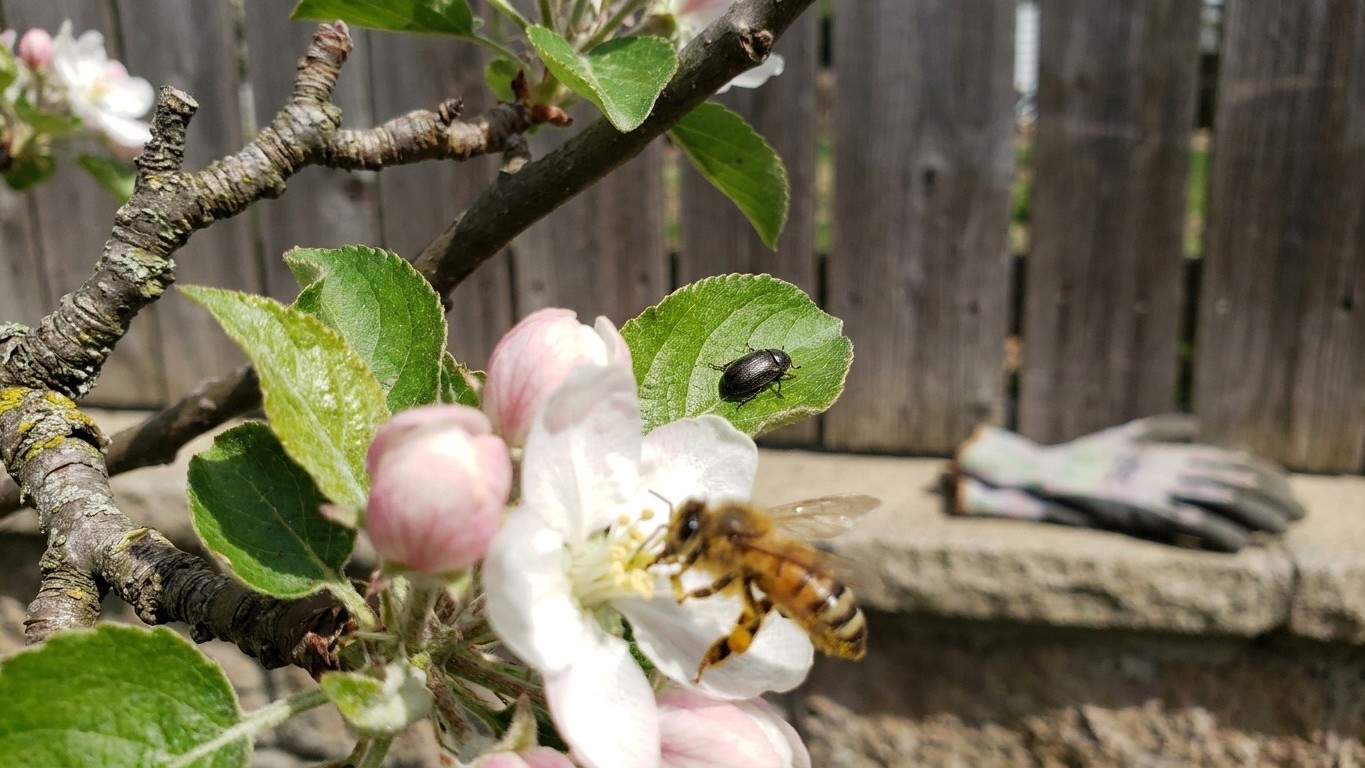
Pollen moves on bees, not on wind, so distance is a question about where bees actually travel, not about line of sight or the direction the wind blows. The closer the second tree, the more reliable the cross-pollination, and a partner planted in the same garden bed beats one two properties over, even if both fall technically within a honeybee’s flying range.
- A neighbor’s apple or crabapple tree, close enough that bees crossing the fence line during normal foraging runs pick up both
- An ornamental crabapple planted in your own yard for flowers rather than fruit, as long as it opens in the same window as Jonamac
- A single grafted branch of a compatible variety added onto Jonamac’s own trunk, which removes the distance question entirely
Any of these needs to survive the same climate Jonamac does. USU lists Jonamac as hardy across zones 4 through 8, so a crabapple or apple partner rated outside that range for your own local zone is a poor bet regardless of how well its bloom timing lines up on paper.
What weather can undo
None of this matters if the bees aren’t flying. Cold, wet, or windy weather during the bloom window keeps bees in the hive, and no amount of partner planning fixes a season where pollinators simply didn’t move between trees. That is a weather problem, not a variety problem, and it is why even a well-paired orchard has a light year now and then.
If there is no room for a second tree
A small garden still has four practical routes to a second pollen source, and each one trades effort for space differently.
Multi-grafted trees

A single trunk carrying three or four grafted varieties, sold by some nurseries as a combination or “family” tree, puts several bloom-time partners on one root system. It solves the space problem completely but costs more upfront and needs careful pruning every year to stop the strongest variety from shading out the others.
A grafted pollinator branch

Grafting one compatible branch onto an existing Jonamac tree is cheaper than buying a whole second tree and takes up no extra ground at all. It means learning a graft technique, and the graft has to take and grow enough to flower, which for many grafts takes at least a couple of seasons before it contributes anything.
Columnar varieties

Columnar apple trees grow narrow and upright, so two of them fit in the space one standard tree would take. They still need a compatible partner blooming at the same time as Jonamac. A columnar habit solves the width problem, not the pollination problem, and the variety planted still has to be checked against Jonamac’s mid bloom window like any other candidate.
An ornamental crabapple

A flowering crabapple chosen for bloom timing rather than fruit takes up space you might already be giving to an ornamental anyway, and many crabapple varieties bloom heavily enough to cover a nearby apple tree’s whole pollination need. It gives you no crabapple fruit worth eating in most cases, though that’s rarely the point of planting one. Growers weighing whether a low-chill variety like Anna could fill this same role instead face a different set of climate tradeoffs, covered separately in What Pollinates Anna, and What Cannot.
Common questions
Can I use a crabapple already in my yard instead of buying a second apple tree?
Yes, as long as it flowers in the same mid-season window Jonamac does. Crabapples count as apples for pollination purposes, and many bloom heavily enough to cover a nearby apple tree’s needs on their own.
Will two Jonamac trees pollinate each other?
No. Two trees of the same variety are genetically identical clones, so neither one supplies the genetically different pollen Jonamac needs to set a reliable crop. You need a second, different variety in the mix.
Does the exact distance in feet between the two trees matter?
Closer is always better, and a partner in the same garden is more reliable than one several properties away, even within a bee’s normal flying range.
My Jonamac bloomed heavily but set almost no fruit last year. What happened?
Check three things before assuming a pollination failure. Cold or wet weather during bloom keeps bees from moving between trees, a partner variety with sterile pollen can’t return the favor even with heavy bloom, and fire blight, to which USU rates Jonamac moderately susceptible, can damage or kill flower clusters outright and look like a pollination problem from a distance.
How do I know exactly when Jonamac is blooming in my own yard?
Watch the tree itself rather than relying on a catalogue date. USU lists Jonamac’s bloom season as Mid, which tells you its relative position among varieties, but the actual calendar week it opens shifts with your local spring, so a quick check of the buds each year beats guessing from a listing alone.