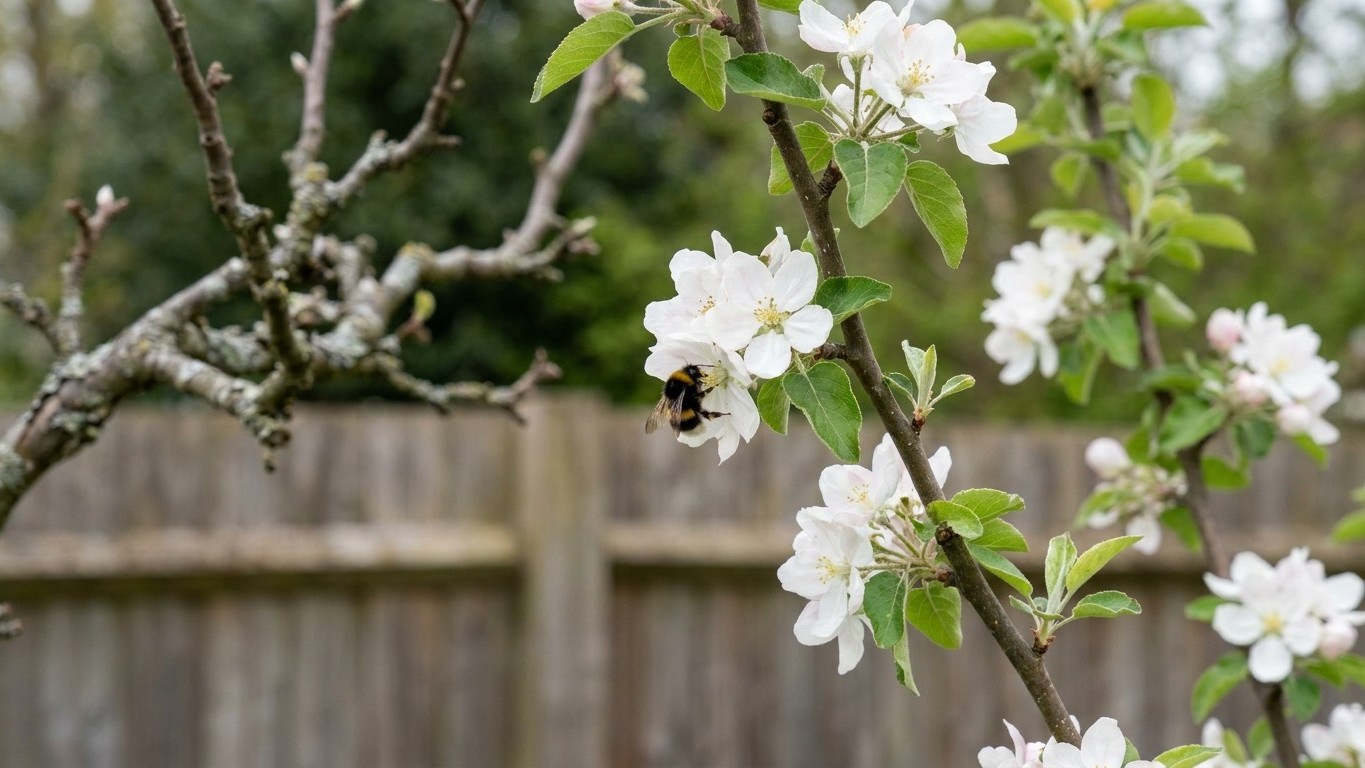

Your Jonagold won’t set fruit on its own, and the tree next to it won’t fix that unless it’s the right one — Arkansas Black, Ozark Gold, Priscilla, or Rome Beauty will do the job, but a Stayman or a Golden Delicious sitting in that same spot won’t, no matter how nicely they bloom together. Walk the yard and check what’s already flowering near it before you plant anything new.
The short answer
The named varieties that will pollinate Jonagold are Arkansas Black, Ozark Gold, Priscilla, and Rome Beauty. Plant any one of these close enough for bees to move between the two trees and the Jonagold will set a full crop.
That covers only one direction. Jonagold’s pollen is sterile, a point Clemson, UGA, and USU all confirm. A sterile variety takes pollen from a neighbor but produces none the neighbor can use in return. Plant only a Jonagold and an Arkansas Black side by side, and the Arkansas Black gets nothing back from its neighbor. It will crop light unless something else nearby pollinates it too.
Three trees, not two
That is why a Jonagold planting needs three varieties, not two: the Jonagold, a pollinizer for it from the list above, and a third variety that in turn pollinates that pollinizer. In a lot of home orchards the third tree already exists, a neighbor’s apple or an ornamental crabapple blooming in the same window, and the grower never notices the gap until the pollinizer itself starts cropping light. USU Extension puts Jonagold’s bloom season as Mid, hardy in zones 4 to 8, with harvest running late September to mid October, useful context when choosing a third variety that flowers at the same time and ripens on a schedule you can manage.
Why these varieties and not others

Two apple varieties pollinate each other only if their bloom overlaps enough for the same bees to visit both trees on the same days. For the mechanics behind why any two varieties need that overlap at all, the general guide to apple pollination covers the basics. Clemson Cooperative Extension groups apple varieties into relative bloom sequences for exactly this reason, and Jonagold sits in bloom group C, a mid-season group.
That grouping is relative, not a calendar date. In a cooler region the whole sequence shifts later in the year, in a warmer one it shifts earlier, but Jonagold still opens after the early-group varieties and before the late-group ones wherever it grows. A variety pollinates Jonagold only if it falls in the same group, or close enough to it, in your own climate.
What overlapping bloom does not guarantee
Matching bloom groups tells you the two trees will have open flowers at the same time. It tells you nothing about whether the pollen actually works. Two problems can undo an otherwise well-timed pairing. The first is sterile pollen: some varieties, Jonagold included, produce pollen that cannot fertilize anything, even a partner blooming in perfect sync. The second is parentage: a variety bred from another cannot be fertilized by that same parent, no matter how well the bloom windows line up. Both problems are invisible from the calendar alone, which is why the list of confirmed partners matters more than the bloom group by itself.
This is also why a compatibility list has to be checked against a named source rather than assumed from bloom timing. Arkansas Black, Ozark Gold, Priscilla, and Rome Beauty were confirmed as effective pollinizers for Jonagold by Clemson HGIC and UGA. Plenty of other varieties share Jonagold’s bloom window without ever having been tested for the pairing, so absence from that list is not the same as a proven failure.
What cannot pollinate it
One variety in particular makes an easy trap. Stayman flowers at the same time as Jonagold, but Stayman’s pollen is sterile in the same way Jonagold’s is. Plant only these two together and both trees bloom right on schedule, bees work both, and neither sets a crop, because neither tree has usable pollen to offer. It is the clearest case of overlapping bloom meaning nothing on its own.
Golden Delicious, and why parentage matters
Golden Delicious cannot pollinate Jonagold either, for a different reason. Jonagold was bred from Golden Delicious, and a variety cannot be fertilized by its own parent. The genetics that make Jonagold what it is came partly from that Golden Delicious lineage, and pollen from the parent does not carry anything new enough to complete fertilization in the offspring it helped create. A Golden Delicious in the yard is a fine apple on its own terms, and it pollinates plenty of other varieties, but it will not do this particular job.
Beyond Stayman and Golden Delicious, published compatibility data runs out. That does not mean every other variety fails. It means the pairing has not been tested and confirmed by an extension source. A grower who wants a documented result should choose from the confirmed list: Arkansas Black, Ozark Gold, Priscilla, or Rome Beauty. Anything outside that list is a gamble, not a known failure, worth treating that way when there is room for only one more tree.
- Stayman: blooms at the same time as Jonagold, but its pollen is sterile too, so the pair sets no fruit.
- Golden Delicious: a parent variety of Jonagold, and a parent cannot fertilize its own offspring.
- Any other variety: not confirmed either way by a named extension source.
How close the second tree has to be

Bees carry apple pollen from tree to tree. Wind does not move it in any useful amount. That makes distance a practical question about bee travel, not a matter of prevailing wind direction: the closer the pollinizer tree stands, the more of its pollen actually reaches the Jonagold’s flowers on a given morning. Same garden works better than same street, and same street works better than several blocks away.
What else can do the job
The pollinizer does not have to be a tree planted on purpose for this. A neighbor’s apple tree blooming in the same window counts, provided bees regularly cross the distance between the two properties. If that neighboring tree happens to be a Jonamac or a Jerseymac rather than one of the four confirmed partners, check what pollinates Jonamac, and what cannot or what pollinates Jerseymac, and what cannot before counting on it, since a shared fence line does not guarantee a shared bloom window or usable pollen.
An ornamental crabapple flowering at the same time works too. Many crabapples are grown as pollinizers precisely because they bloom heavily and over a longer stretch than most apple varieties, which widens the window in which their pollen is available. A grafted branch of a compatible variety onto the Jonagold itself also works, and puts the pollen source close enough that distance stops being a question at all.
None of that helps if the weather during bloom keeps bees from flying. Cold or wet weather during bloom is the one thing no partner variety, however well matched, can compensate for. Bees fly reluctantly in cold conditions and not at all in steady rain, and a bloom week lost to weather can undo an otherwise well-planned pairing regardless of how close the trees are planted. That is a season to accept and plan around, not a compatibility problem to fix with a different variety.
If there is no room for a second tree
A small yard with space for exactly one apple tree still has a few real options, none of them free of tradeoffs.
Options for a single-tree yard
| Option | What it solves | What it does not solve |
|---|---|---|
| Multi-grafted tree | Several compatible varieties on one trunk, bee travel distance nearly zero | Each variety on the graft still needs its own bloom timing checked |
| Pollinizer branch grafted onto the Jonagold | Adds a compatible variety without planting a second full tree | Takes a season or two to grow enough flowering wood to matter |
| Columnar variety planted alongside | Fits a compatible partner into a narrow strip of ground | Still a second tree to buy, plant, and maintain |
| Flowering crabapple nearby | Supplies pollen if it blooms in the same window | Does not guarantee overlap every year, and does nothing for a sterile pairing like Stayman |
A multi-grafted tree carrying Jonagold alongside one of its confirmed partners solves the distance problem completely, since the varieties share a root system and the flowers open inches apart. It costs more up front and needs a grower comfortable pruning each variety on the graft separately, since they rarely grow at the same rate. A pollinizer branch grafted onto an already-established tree is cheaper but slower, and it will not carry enough bloom to matter for a couple of seasons. A columnar variety takes less ground space than a full second tree, but it is still a second tree, with its own planting hole and its own care. None of these substitutes for checking that the second variety chosen is one of the confirmed partners, since a beautifully solved space problem still produces no fruit if that second variety turns out to be Stayman or Golden Delicious.
Common questions
Will planting two Jonagold trees next to each other help pollination?
No. Both trees carry sterile pollen, confirmed by Clemson, UGA, and USU Extension, so two Jonagolds together set no fruit no matter how close they stand. Nursery tags rarely mention pollen sterility, which is why this mistake is common. You need a separate confirmed variety, and since Jonagold cannot return the favor, a third tree to pollinate that one in turn.
Can a flowering crabapple really substitute for a full apple tree partner?
Yes, as long as it blooms in the same window as Jonagold. The crabapple does not need to produce edible fruit to do the job, it only needs open flowers and pollen bees will carry, and ornamental varieties are commonly planted for exactly this reason.
How do I confirm my two trees are actually blooming at the same time?
Watch both trees during bloom for a season rather than trusting a printed date. Bloom group C describes a relative sequence, per Clemson Cooperative Extension, and the local calendar shifts with climate, so the only reliable check in your own yard is the flowers themselves.
Does rootstock affect pollination compatibility?
No. Rootstock controls the mature size of the tree, not whether the variety grafted onto it can pollinate Jonagold. Choosing a rootstock is a spacing decision, and worth discussing with a local nursery or extension office separately from the pollination question.
Should I worry about fire blight when choosing a pollinizer tree for Jonagold?
It is worth knowing before deciding what stands next to it. USU Extension rates Jonagold as moderately susceptible to fire blight, so a bloom-time infection in a wet spring can damage flowers on both trees, on top of whatever weather is already keeping bees away that week.