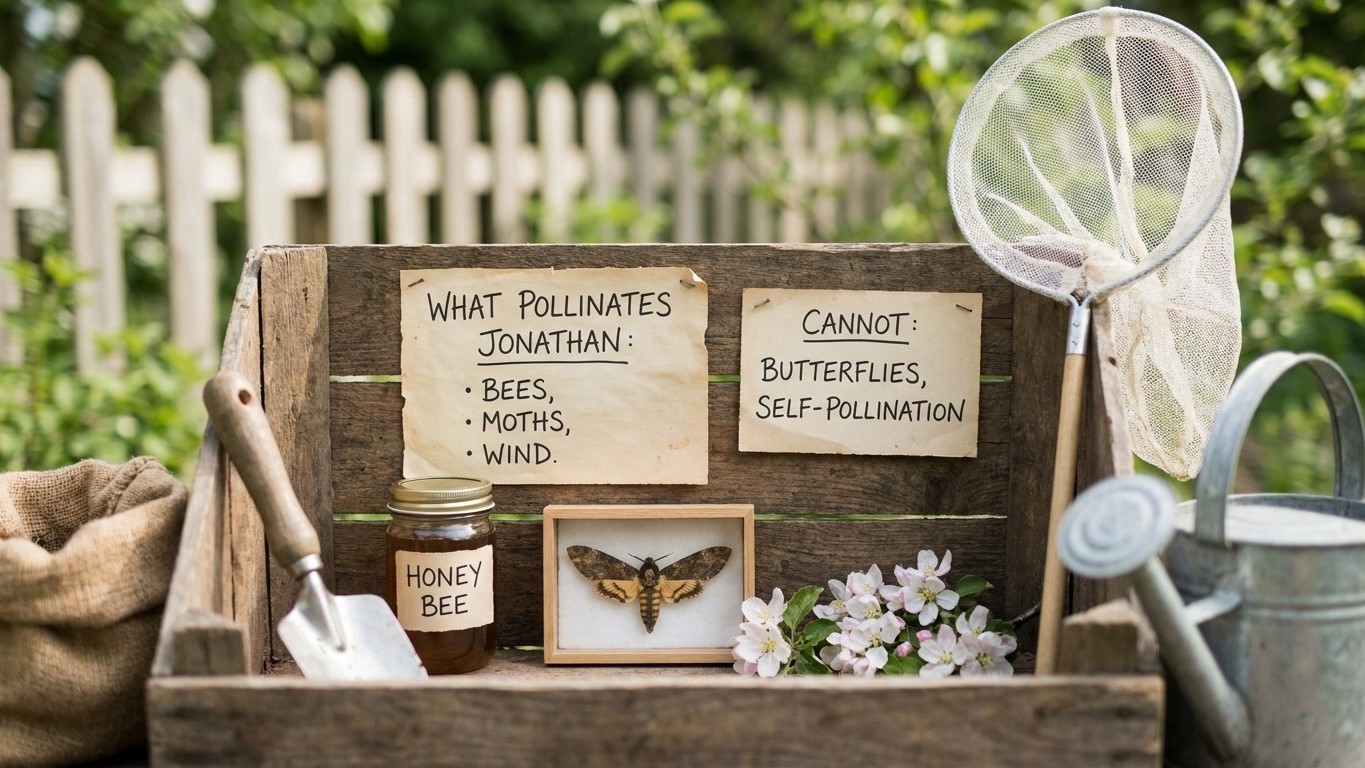

What actually pollinates Jonathon? Nobody documents a confirmed partner variety for it, and that’s the honest, if unsatisfying, truth. What is known is that Jonathon blooms mid-season and grows in zones 4 to 8, which narrows the search even without a name to point to. So the move is this: walk your yard, pick a second apple tree that flowers in that same mid-season stretch and also thrives in zones 4 to 8, and check that with the nursery before you plant it — not a guess, a match.
The short answer
USU Extension’s guide covers Jonathon’s bloom timing, hardiness range, and disease susceptibility, but it does not publish a pollination partner list for this variety.
What USU does confirm
The figures that are documented are still useful. USU Extension puts Jonathon’s bloom season at Mid, its hardiness range at zones 4 to 8, and its harvest window at mid September to mid October. Any partner tree needs to fall within that same hardiness range to survive the same site, and it needs to flower during the same mid-season stretch so bees can move pollen between the two while both are open.
USU Extension also lists Jonathon as susceptible to fire blight. That matters when choosing a partner too: planting two fire-blight-susceptible varieties side by side does not raise the risk on its own, but it means neither tree offers any buffer if the disease turns up in a wet spring.
How many trees to plant
Most apple varieties carry fertile pollen and need only two compatible trees to set a full crop, one pollinating the other and vice versa. A smaller number of varieties produce pollen that cannot fertilize anything, so a garden planted with one of those and just one partner gets fruit on the partner but none on the sterile tree, or none anywhere if both happen to be sterile. USU’s guide does not state whether Jonathon’s own pollen is fertile or sterile, so the safer plan is to treat it as needing a genuinely compatible second tree, and to keep a third variety in reserve if the first pairing does not perform after a season or two.
Why these varieties and not others

Pollination compatibility comes down to timing, not taste or color. Two apple trees can only pollinate each other if their flowers are open on the same days, so bees can carry pollen from one to the other while both are receptive. That timing is described with a bloom group system, a way of ranking varieties by how early or late they flower relative to each other in a given season, according to Clemson Cooperative Extension.
What a bloom group actually means
A bloom group is a relative order, not a calendar date. In a warm spring the whole sequence shifts earlier, in a cold one it shifts later, but an early-group variety still opens ahead of a late-group variety wherever you garden. USU Extension places Jonathon’s bloom season at Mid, which means the varieties most likely to overlap with it are others also rated early-to-mid or mid on that same relative scale, not any specific names USU attaches to Jonathon itself.
This is also why a page like our guide to What Pollinates Lodi, and What Cannot can name confirmed partners for that variety while this page cannot for Jonathon. The documentation exists for some varieties and not for others, and printing a name without it would be a guess dressed up as fact.
What overlapping bloom does not guarantee
Two trees flowering together is necessary but not sufficient. Overlapping bloom does not tell you whether a variety’s pollen is fertile, and it says nothing about parentage. A seedling apple cannot be fertilized by pollen from its own parent tree even if both are in the same bloom group and flowering on the same day, because the genetic overlap is too close for fertilization to succeed. None of this is a strike against Jonathon specifically. It is simply why a shared bloom window is the start of a compatibility check, not the end of one.
What cannot pollinate it
USU Extension’s guide does not name a pollen-sterile partner in Jonathon’s bloom group, and it does not list a parentage exclusion either. The two ways a pairing can fail elsewhere are worth understanding, so a grower knows the right question to ask a nursery.
Sterile pollen
Some apple varieties carry pollen that cannot fertilize any other tree, a trait usually caused by having three sets of chromosomes instead of the usual two. ‘Jonagold’, ‘Baldwin’, and ‘Bramley’s Seedling’ are commonly cited examples of this kind of variety, regardless of climate or state. A garden planted with one of those and nothing but another sterile-pollen variety sets little or no fruit on either tree, because sterile pollen only works one way. The tree can receive pollen and be fertilized, but it cannot supply pollen back. The extension tables name only four pollen-sterile varieties—Jonagold, Mutsu, Stayman, and Winesap—and Jonathon is not among them, so a grower should instead confirm the fertility of whatever partner variety is chosen alongside it.
Parentage
The second failure mode is genetic closeness. A variety bred from a particular parent cannot be reliably fertilized by that same parent, even with overlapping bloom, because the pollen and the flower are too closely related to set fruit. USU’s guide does not list a parent variety for Jonathon or state a parentage exclusion, so there is no documented cross to avoid here. Where a page does have that information, it is worth checking. Our guide to What Pollinates Mollie’s Delicious, and What Cannot covers a variety with more specific documented exclusions, and it is a useful comparison for what a fuller record looks like next to Jonathon’s.
How close the second tree has to be

Pollen moves on bees and other pollinating insects, not on the wind, so distance matters more than it does for wind-pollinated crops like corn. The closer the two trees are, the more reliably bees move between them in a single foraging trip, which is what actually carries pollen from one flower to another before it drops.
What counts as close enough
Same garden beats same street. A bee working a mid-season bloom tends to visit the nearest open flowers first, so a partner tree planted within the same yard gets worked far more thoroughly than one two properties away, even if both sit within flying range on paper. This is also why a neighbor’s apple tree, an ornamental crabapple flowering at the same time, or even a single grafted branch of a different variety on the same trunk can all do the job, as long as the bloom overlaps and a bee can reach both on one visit.
What stops it working
Weather during the bloom window matters more than distance once a partner tree is in place. Cold or wet conditions keep bees from flying at all, and a pairing that would otherwise work sets little fruit simply because no insect moved between the flowers while they were open. No partner tree, however well chosen, compensates for a stretch of poor pollinating weather during that mid-season bloom. It is worth reading the general rules in our Apple Pollination guide for what else affects fruit set beyond the partner variety itself.
If there is no room for a second tree
A small garden does not rule out a second variety, it just changes the shape of the solution. Four options cover most situations, and each solves the space problem without solving every problem at once.
- Multi-grafted tree: several varieties grafted onto one trunk, so one tree functions as its own pollination pair. Takes the most care to buy correctly, and the varieties still need a compatible bloom window.
- Pollinator branch: a single graft of a different variety added onto an existing mature tree. Cheaper than a whole new tree and grows in the space of one limb, but takes a couple of seasons to flower reliably.
- Columnar variety: a narrow, upright-growing tree bred to take up very little width. Solves the space problem well but still needs a compatible partner nearby, it does not pollinate itself.
- Ornamental crabapple: many flower at the same mid-season timing as apple varieties and produce abundant pollen. Solves pollination without producing an eating crop of its own, and works only if its bloom genuinely overlaps.
Whichever option is chosen, the bloom timing and hardiness range still need checking against USU Extension’s Mid and zone 4-8 figures for Jonathon, because a well-solved space problem paired with the wrong bloom window still sets no fruit.
Common questions
Can a Jonathon apple tree pollinate itself?
Nearly all apple varieties, Jonathon included, crop better with a compatible partner nearby. A lone tree may set some fruit in a good year, but the set tends to be light and unreliable compared with a garden that has a second flowering apple or crabapple close by.
My Jonathon tree bloomed heavily but set almost no fruit. Why?
The most common causes are a missing or poorly timed partner, and cold or wet weather during the bloom window that kept bees from flying. Check both before assuming the tree itself is the problem, since a healthy tree with no partner and a healthy tree with the wrong weather look identical from the ground.
Does the second tree have to be another apple variety, or will a crabapple work?
An ornamental crabapple can pollinate an apple tree as long as the two are flowering at the same time. The crabapple does not need to be edible or a named fruiting cultivar. What matters is bloom overlap and enough bees moving between the two, not the crabapple’s own fruit quality.
Is “Jonathon” the same apple as “Jonathan”?
Spelling varies between nurseries and catalogs, and the two names sometimes refer to the same cultivar or to closely related ones sold under slightly different labels. Check the tag or the seller’s own description before assuming, since a mismatch in spelling can mean a genuinely different tree with different bloom timing.
How do I find out if Jonathon’s pollen is fertile or sterile?
Ask the nursery selling the tree, since sterile-pollen varieties are usually flagged as triploid on catalog descriptions. If that information is not offered, watching whether a single well-matched partner sets fruit on both trees over a couple of seasons is the practical way to find out at home.