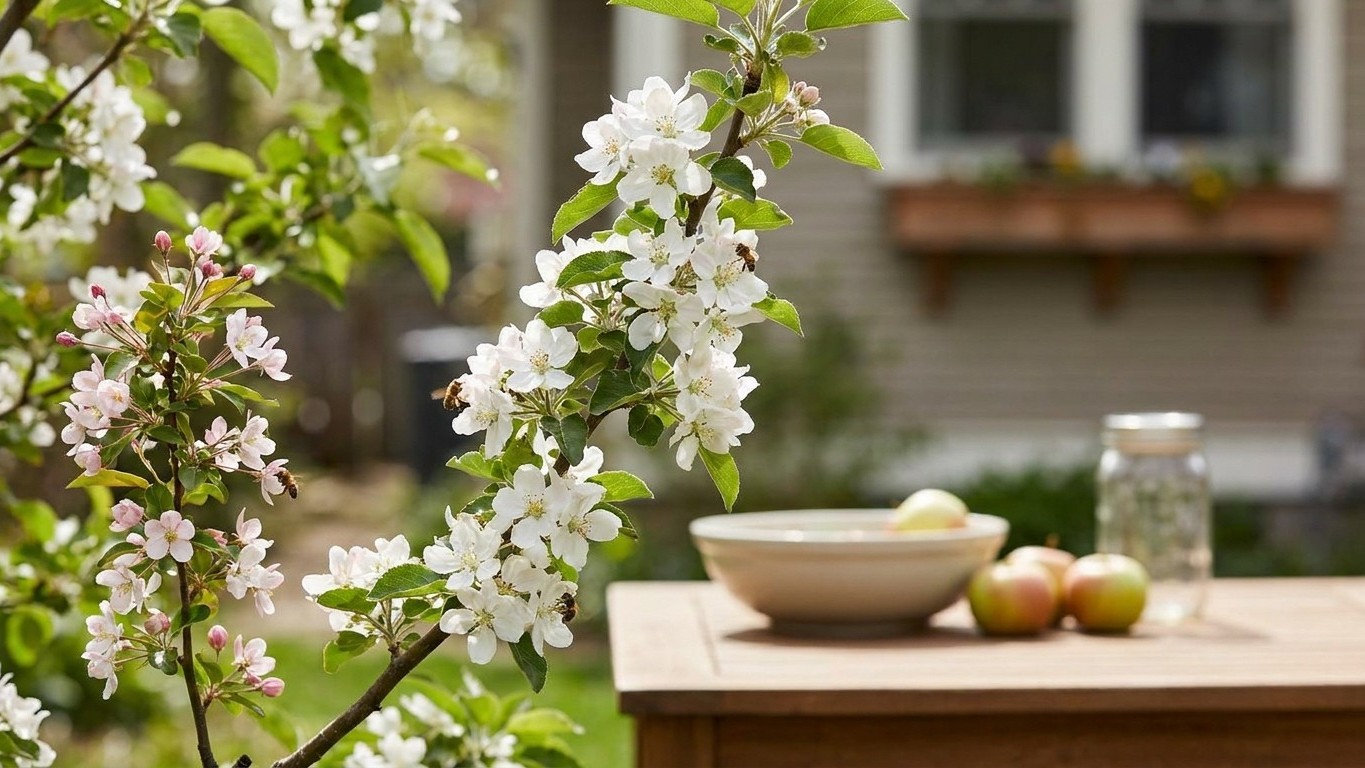

McIntosh needs a second apple tree flowering at the same time to set a full crop, but USU Extension’s fact sheet on apple production for the Utah home garden does not publish a specific list of compatible partner varieties for this cultivar. What USU does give is McIntosh’s bloom classification, Early to Mid, the same scale used to sort every other apple in the orchard. Check any candidate partner tree’s own bloom classification against that Early to Mid window before you buy it, because a partner blooming weeks off does the tree no good at all.
The short answer
No published partner list, but a known bloom window
McIntosh needs another apple tree blooming nearby at the same time, or it won’t set much fruit. What it doesn’t need is anything exotic — just a variety flowering in that same early-to-mid window, whatever else is already growing in the yard or the neighbor’s yard next door. Before you plant a second tree for this job, check its bloom classification against McIntosh’s Early to Mid timing; a tree that flowers weeks apart, even a good apple otherwise, does nothing for you. McIntosh can also pollinate itself back, so once you’ve matched the timing, two trees is all it takes.
A compatible partner is any apple variety that flowers in that same Early to Mid window, wherever you garden. The classification is relative to your own climate rather than tied to a fixed calendar date, so the rule holds whether your local bloom happens early in spring or later in the season. If another apple in the neighborhood already flowers at the same time as your McIntosh, in most years it can move pollen back and forth without you doing anything else.
McIntosh is a diploid variety, meaning its own pollen is fertile. That matters for the tree count: a diploid needs just two trees total, the McIntosh and one compatible partner, to cross-pollinate each other. Varieties with sterile pollen, called triploids, cannot return the favor, so a garden built around a triploid needs three trees, two fertile diploids flowering with the triploid and with each other. McIntosh doesn’t carry that complication itself, but if the partner you’re considering turns out to be a triploid, you’re back to needing a third tree to close the loop.
If you’re deciding whether Mutsu or Akane could serve as that partner, check their own bloom classification and pollen fertility first, since each has its own compatibility question worth working through on its own terms: see What Pollinates Mutsu, and What Cannot and What Pollinates Akane, and What Cannot for those specifics.
Why these varieties and not others

Bloom groups sort timing, not compatibility
For how bloom groups work across apples generally, see Apple Pollination. Apple varieties are sorted by when their flowers open relative to each other, a system Clemson Cooperative Extension describes as bloom grouping. Two trees in the same group open, peak, and finish blooming close enough together that bees can carry pollen from one to the other while both still have receptive flowers. McIntosh’s group, Early to Mid, is a relative ranking rather than a fixed date. In a cold spring the whole sequence shifts later. In a warm one it shifts earlier. What doesn’t change is the order: an Early to Mid variety blooms ahead of a Late variety in the same year, on the same property, and the order does not move even when the calendar dates do.
What overlapping bloom does not guarantee
Bloom overlap only answers the timing half of the question. It says nothing about whether the pollen itself is fertile, and it says nothing about the two trees’ parentage. A tree flowering at exactly the right moment can still be useless as a partner if its pollen is sterile, which is true of every triploid variety regardless of how well its flowers line up with McIntosh’s. And sharing a bloom group carries no implication of parentage one way or the other. Two varieties can be bred a century and a continent apart and still land in the same bloom group by coincidence of biology. A parent and its own offspring can just as easily bloom close together and still fail to cross-pollinate, for genetic reasons that have nothing to do with timing at all.
This is why a bloom group is a starting filter, not a final answer. It narrows a nursery catalog down to the varieties worth checking further, the same way a days-to-maturity figure narrows a seed catalog before you check anything else about a tomato variety. For McIntosh specifically, USU’s fact sheet stops at the bloom classification and does not carry the search further into named partners, pollen fertility, or parentage. A grower who wants that next layer of detail has to look it up variety by variety, which is exactly what the next section walks through for the specific traps to check.
What cannot pollinate it
No documented exclusion for this variety, but two categories still apply
No specific triploid partner or parentage exclusion is named for McIntosh. A grower considering a specific pairing not covered above should confirm it with a nursery or extension office before relying on it for a crop.
Two general categories are still worth checking against whatever partner you’re weighing, because they apply to McIntosh the same way they apply to every other apple variety.
Triploid varieties
A triploid apple carries an extra set of chromosomes, and its pollen is essentially sterile. It can still be pollinated by a diploid neighbor and will set fruit normally itself, but it cannot return the service. Jonagold, Baldwin, and Bramley’s Seedling are commonly cited triploids. Plant one of these next to a single McIntosh and nothing else, and the McIntosh has no functioning partner at all, because a triploid contributes nothing back to the pairing.
Self-pollination and shared parentage
McIntosh cannot pollinate itself, which is true of nearly all apple varieties and is the whole reason a second tree is needed in the first place. A closer trap is parentage: a seedling variety generally cannot be fertilized by its own parent tree, because the genetic overlap that made the breeding possible in the first place also blocks the pollen from working properly between the two. McIntosh is a documented parent of several later dessert varieties, including Cortland and Empire. Parentage alone does not guarantee incompatibility, but it is the specific case worth checking before you rely on either of those trees as your McIntosh’s only partner, since USU’s source does not extend its guidance that far.
How close the second tree has to be

Distance is a bee problem, not a wind problem
Apple pollen does not travel on the wind in any useful amount. It moves on bees, mostly honeybees and mason bees working flower to flower, which makes the practical question one of bee traffic rather than distance measured in feet. The closer the second tree, the more reliably a bee working one moves straight to the other before it visits something else entirely. Same yard beats same street, and same street beats a tree three properties over that the local bee population may rarely reach in useful numbers.
The second tree does not have to be a full-size McIntosh partner planted on purpose. Any of the following can do the job, provided it blooms in the same Early to Mid window and carries fertile pollen:
- A neighbor’s apple tree, if it’s close enough for bees to cross the property line, which they do routinely
- An ornamental crabapple in flower at the same time, since many crabapples are strong pollen sources for apples generally
- A pollinator branch grafted onto an existing tree, effectively smuggling a second variety’s flowers onto the same trunk
None of that helps if the weather itself keeps bees grounded. Cold, wet, or windy weather during bloom shuts down bee flight almost entirely, and no partner variety, however well matched, compensates for a week of bees staying in the hive. A perfectly timed pairing can still set a light crop in a bad bloom week for exactly that reason, and there is no substitute for the pollinator being active while the flowers are actually open.
If there is no room for a second tree
Four ways to get a second variety into one space
A small yard doesn’t have to mean one variety and a light crop. Several grafting and nursery options put a second bloom source into the same footprint as a single tree, though each comes with its own limits.
| Option | Effort | What it doesn’t solve |
|---|---|---|
| Multi-grafted tree (several varieties on one trunk) | Buy once, no grafting skill needed | Still needs the varieties on it to share a bloom window with McIntosh |
| Pollinator branch grafted onto an existing McIntosh | Requires grafting skill or a hired hand, done once | Doesn’t add a full tree’s worth of flowers, so timing still has to line up |
| Columnar apple variety planted alongside | Low effort, minimal space | Still a separate tree needing its own bloom-window check |
| Ornamental crabapple planted nearby | Low effort, widely available at nurseries | Only works if its bloom happens to overlap McIntosh’s Early to Mid window |
Whatever you add still has to bloom inside McIntosh’s Early to Mid window and carry fertile pollen, or it’s decoration rather than a pollinator. A multi-grafted tree is the closest thing to a guarantee, since a reputable nursery usually selects varieties that flower together on purpose, but it costs more up front than a single tree and limits you to whatever combination that nursery chose.
Common questions
Can I grow just one McIntosh tree and still get apples?
You might get a light, unreliable set if a stray pollinator variety happens to be blooming nearby, but nearly all varieties crop better with a compatible partner. Don’t plan a harvest around a single tree without one.
Will a random apple tree down the road pollinate my McIntosh?
It can, if it’s close enough for bees to reach reliably and its bloom overlaps McIntosh’s Early to Mid window. The catch is you usually don’t know that tree’s variety or whether its pollen is fertile, so it’s a bonus rather than something to plan around.
Can McIntosh pollinate other apple varieties, or only receive pollen?
Since McIntosh is a diploid with fertile pollen, it can pollinate other varieties that share its Early to Mid bloom window, not just be pollinated by them. Check the partner variety’s own bloom classification and ploidy before assuming the match works both ways.
My other apple tree blooms weeks before or after my McIntosh. What now?
A mismatched bloom window means that tree isn’t functioning as a McIntosh partner, whatever else it’s good for. You’d need a third tree in the Early to Mid window, or a grafted pollinator branch, to actually cover McIntosh.
Where do I find the actual bloom dates for my area, not just “Early to Mid”?
Your state or county extension office is the right place to ask, since bloom timing shifts from one climate to the next even though the Early to Mid ranking itself doesn’t change. Local orchard records or a nearby nursery can also tell you what’s actually flowering and when in a typical year near you.