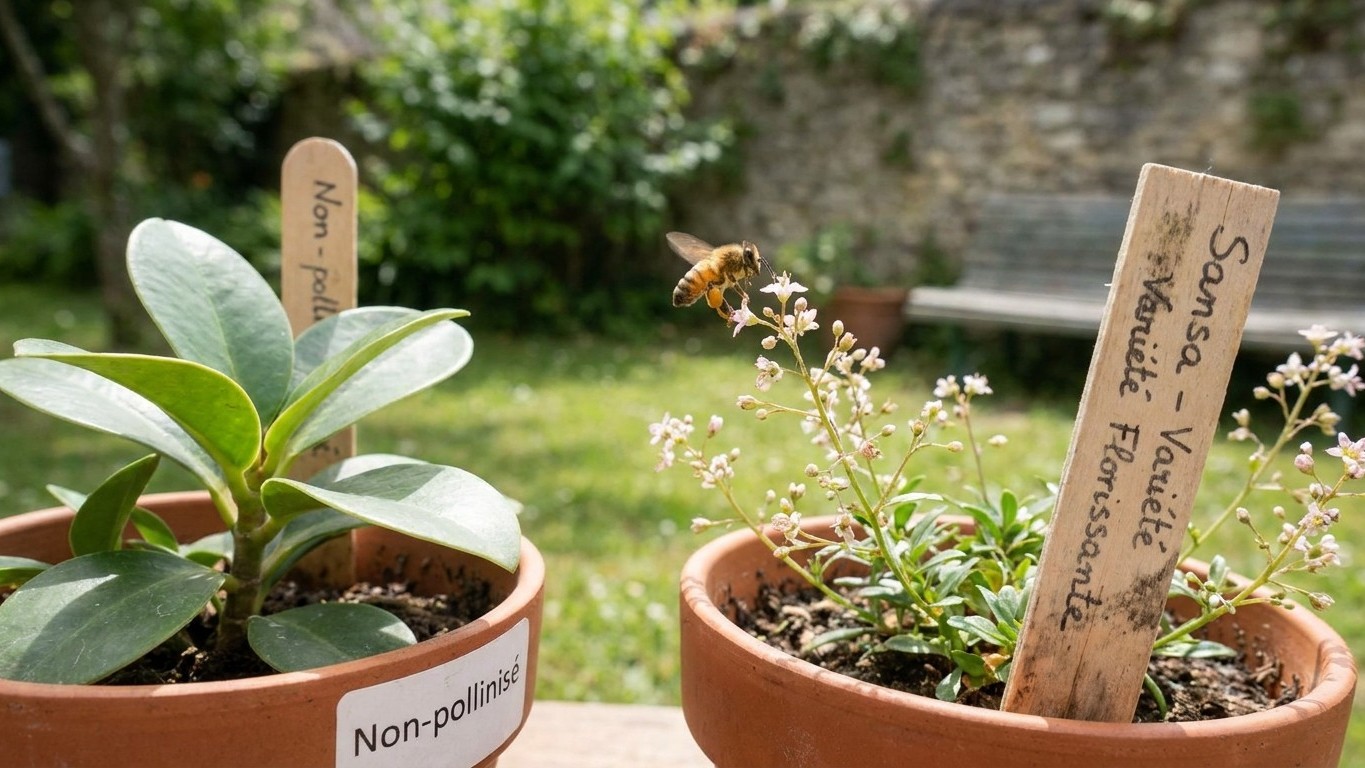

Sansa’s pollination partners aren’t named anywhere in the documentation, and no supplier list fills that gap either. What you do get is bloom timing: Sansa flowers Mid season, so any variety also listed as Mid works as a candidate partner. Two trees usually suffice, since most diploid apples carry fertile pollen and pollinate each other. But if your chosen partner turns out triploid, its pollen is sterile, and you’ll need a third tree before anything sets fruit.
The short answer
Sansa’s pollination partners are not documented in USU Extension’s guide. What USU Extension does give you is the bloom timing to work from: Sansa flowers in the Mid season, so a workable partner is any apple variety whose own catalog listing also places it in the Mid bloom window. That is the search you actually need to run, not a hunt for one specific cultivar name.
Once you have a candidate, the tree count depends on how that candidate’s pollen behaves. Most diploid apple varieties carry fertile pollen and can pollinate a partner back, so two trees, Sansa plus the Mid-blooming variety you chose, is usually enough. But some apples are triploid and produce sterile pollen. A triploid can receive pollen and set fruit, but it cannot return the favor, so if your second tree turns out to be one of those, you need a third tree in the mix, a second Mid-blooming variety with fertile pollen, or nothing sets fruit on either of the first two.
This is the one detail worth checking before you dig a hole: look up whether the specific variety you are considering as Sansa’s partner is listed as diploid or triploid by its supplier. That single fact decides whether you are planting two trees or three.
Why these varieties and not others

What a bloom group actually means
Two apple varieties pollinate each other only if their flowers are open on the same days, because pollen moves tree to tree on the bodies of foraging bees, not through the air on its own. Clemson Cooperative Extension groups apple varieties by bloom timing, early, mid, and late, so that a grower can match two varieties without having to track exact calendar dates. Sansa sits in USU Extension’s Mid category, so any other Mid-season variety is a candidate on timing alone.
The important qualifier is that a bloom group is a relative order, not a fixed date. A cold spring pushes every variety’s bloom later across the board, a warm one pulls it earlier, and a tree on a south-facing slope opens ahead of the identical variety in a low, shaded corner of the same yard. What stays constant year to year is the sequence: early varieties bloom before mid varieties, which bloom before late varieties, in that order, in a given location. That is why the group label is useful at all, and it is also why you should not expect Sansa and its partner to open on the same calendar day every year, only in the same rough window relative to each other.
What a shared bloom group does not guarantee is fertile pollen. Two Mid-season varieties can flower together and still fail to set fruit on each other if one of them is a sterile triploid. Bloom timing and pollen fertility are two separate facts about a variety, and a nursery tag that only tells you the bloom group has told you half the story. The other thing a shared bloom group does not tell you is parentage. Two varieties in the same bloom window can be entirely unrelated seedlings, or one can be a direct offspring of the other, and that second case matters more than most gardeners expect, which the next section covers directly.
What cannot pollinate it
What we know, and what we don’t
USU Extension’s guide does not name a sterile-pollen variety in Sansa’s bloom group, and it does not state a parentage exclusion for Sansa either. If you find a compatibility chart elsewhere naming a specific exclusion for Sansa, treat it as a separate claim to verify against its own source, not something confirmed here.
What is true across apples generally, and worth knowing while you shop for a partner, is that some varieties are triploid and carry sterile pollen. A triploid can be pollinated and will fruit normally with the right partner nearby, but its own pollen cannot fertilize anything else, including Sansa. Well-known triploid apples in commerce include:
- ‘Jonagold’
- ‘Baldwin’
- “Bramley’s Seedling”
Plant only one of these alongside Sansa and you have solved nothing: the triploid needs its own second pollinator, and Sansa still has no fertile pollen source in the garden. This is the trap that catches gardeners who pick a partner on bloom timing alone and never check whether it is diploid or triploid.
The other exclusion worth knowing about, in general terms, is parentage. A variety bred as a direct seedling of another cannot be reliably fertilized by that same parent, even when the two overlap in bloom. USU Extension’s guide does not state that Sansa has this kind of parent-offspring relationship with any other named variety, so there is no specific pair to warn you away from here. If you are choosing between two candidates and are not sure whether one is a known seedling of the other, that is worth a direct question to the nursery before you plant both.
How close the second tree has to be

Pollen for apples travels on bees, not on wind, which turns “how far” into a practical foraging question rather than a distance measured in feet on a map. The closer the two trees, the more consistently a bee moves between them on a single trip, and a partner planted in the same garden bed does the job far more reliably than one three properties over. If you are choosing where to put a new tree, put it as near to the Sansa as your spacing and sunlight allow.
What else can carry the job
A dedicated second tree in your own yard is not the only path to pollination. A neighbor’s apple tree can do the work if it blooms in the same Mid window and a bee route runs between the two properties. An ornamental crabapple flowering at the same time works just as well as a full-size eating apple, since bees do not distinguish between them, and many gardeners use a crabapple specifically because it takes up far less space. A single pollinator branch grafted onto an existing tree, discussed further below, also puts a second variety’s flowers within a few feet of Sansa’s own.
What stops all of this cold is weather during bloom, not distance. Cold, wind, or heavy rain during the bloom window keeps bees in their hives and off the flowers, and no partner variety compensates for a bloom week that bees simply did not fly. This is outside a gardener’s control, and it is one reason fruit set varies year to year even in an orchard with well-matched partners already in place. Reviewing the basics of apple pollination is worth doing before you plant anything, since the weather risk applies regardless of which varieties you choose.
If there is no room for a second tree
A small garden does not rule out a partner, it just changes what form that partner takes. The four practical options trade off differently on effort and on what they leave unsolved.
| Option | Effort | What it does not solve |
|---|---|---|
| Multi-grafted tree (several varieties on one trunk) | Buy once, no grafting skill needed | Branches still need to bloom at the same time as Sansa |
| Pollinator branch grafted onto the existing tree | Requires basic grafting or a grafted scion bought pre-made | One branch is a small pollen source, weather-dependent like any other |
| Columnar apple variety planted alongside | Low space cost, easy to plant | Still needs a Mid-season bloom match, same as any variety |
| Ornamental crabapple in the same bed | Widely available, minimal care | Only works if it flowers in Sansa’s Mid window |
A multi-grafted tree puts two or three varieties on one root system, which suits a garden with room for only one planting hole. It still depends on the grafted varieties actually flowering together, so check the bloom timing of each named variety on the tree before you buy rather than assuming the nursery matched them for you.
Grafting a single pollinator branch onto Sansa itself, or onto a neighboring tree, is the lowest-space option of all, but it is also the smallest pollen source in the garden and the most exposed to a single bad bloom week. A columnar variety takes up barely more room than a fence post and can be tucked into a bed that has no space for a full tree, though it is still bound by the same Mid-season bloom requirement as any other candidate. A flowering crabapple solves the space problem outright and adds an ornamental tree to the garden besides, provided its bloom happens to line up with Sansa’s, which is worth checking with the supplier rather than assuming.
None of these four options changes the fire blight picture for the garden. USU Extension lists Sansa as susceptible to fire blight, and that risk travels through the same bloom period a pollinator partner needs, since the bacteria spread on the same pollinating insects. Planting a second tree close by does not raise that risk on its own, but it is a reason to keep an eye on blossom health across every tree in the group each spring, not just the one you planted for fruit.
Common questions
Can two Sansa trees pollinate each other?
Not reliably. Nearly all apple varieties crop better with a genuinely different variety nearby rather than another tree of the same kind, because two trees of one variety share identical bloom timing but not the genetic difference that improves fruit set. Plant a second, different variety rather than a second Sansa.
Will a crabapple actually pollinate my Sansa tree?
Yes, if its bloom overlaps Sansa’s Mid-season window. Ornamental crabapples are a common small-space pollinator for exactly this reason, but check the specific crabapple’s bloom timing with the supplier rather than assuming every crabapple flowers at the same time.
How do I find out what bloom group my other apple tree is in?
Check the variety’s own nursery tag or catalog listing, which usually states early, mid, or late bloom directly. Remember that this label is a relative order, so a mid-season variety in a warm spring can still open before an early-season variety did the previous cold spring.
Does hardiness zone matter when I’m picking a pollinator?
It matters for whether the partner survives your winters, separately from whether it can pollinate Sansa. USU Extension lists Sansa as suited to zones 5 through 7, so a partner rated well outside that range may struggle in the same spot even if its bloom timing matches perfectly.
Does Sansa’s fire blight susceptibility change which partner I should choose?
Not directly. USU Extension lists Sansa as susceptible to fire blight, but that susceptibility is about the tree’s own resistance, not about which varieties can fertilize it. It is a reason to watch blossom health on every tree in a mixed planting each spring, since the bacteria that cause fire blight spread through the same blossoms bees visit for pollination.