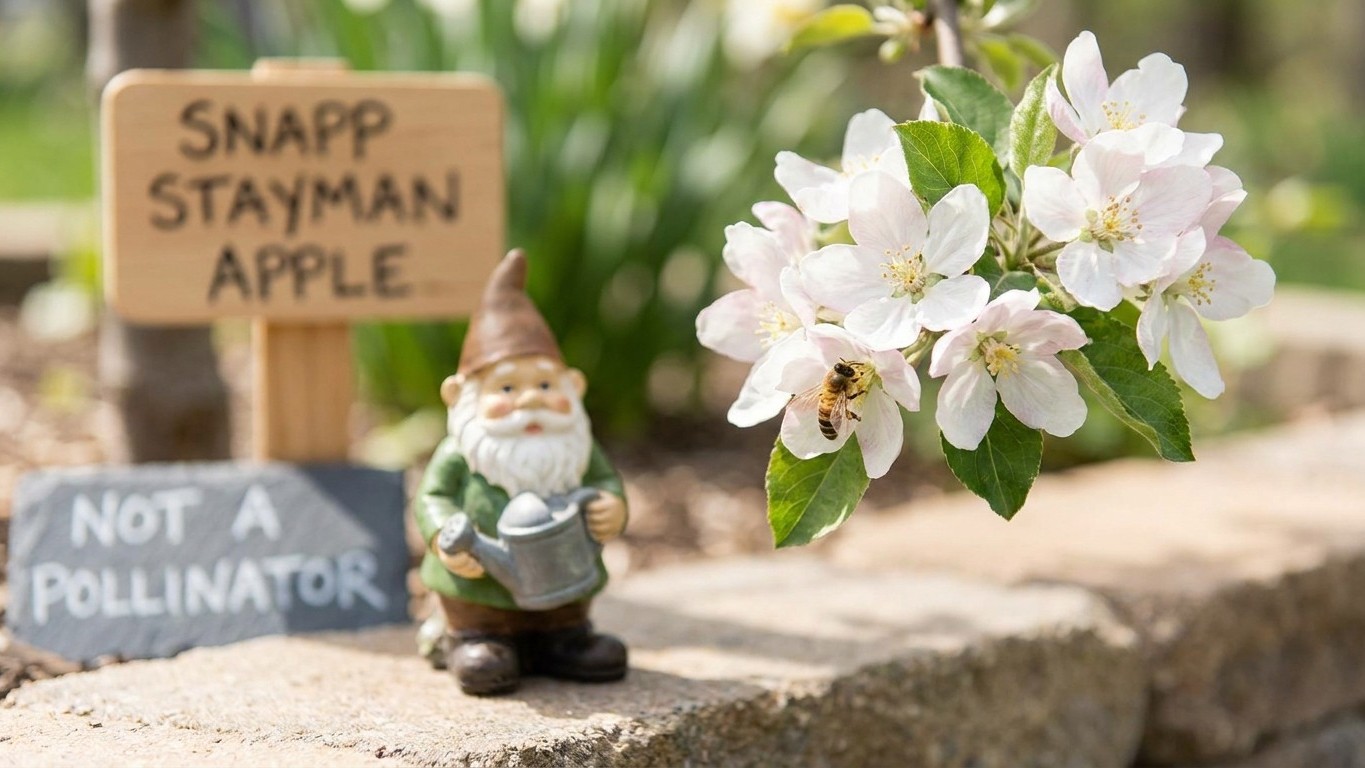

No pollination partner list for Snapp Staymen shows up in the sources checked for this page, including USU Extension’s guide to apple production for the Utah home garden, which gives its bloom timing as Mid and nothing more specific about compatible varieties. That gap does not mean the tree sets fruit alone. It means a grower has to build compatibility from the pieces that are documented: pick a second variety that flowers in the same mid-season window, then check that variety’s own catalog listing for pollen fertility before counting on it.
The short answer
No named companion cultivar for Snapp Staymen is published in the USU Extension guide used for this page, so nothing here should be read as a confirmed pairing. What USU does give is the bloom timing, Mid, and that single fact is the starting point for choosing a partner: any second tree needs to open its flowers in that same relative window, not weeks earlier or later. USU also rates Snapp Staymen for zones 5-8, which matters because a partner variety chosen for pollen has to survive in the same climate the main tree does, or it will not be there to bloom when needed.
How many trees, and why the number changes
The rule that decides tree count is pollen direction, not variety count. If a candidate partner has fertile pollen, two trees are enough, because each one can fertilize the other. If a candidate partner turns out to have sterile pollen, three trees are needed, because a sterile variety can receive pollen and still set its own fruit, but it contributes nothing back. Since no fertility rating for a Snapp Staymen partner is published in the sources used here, a grower should treat the two-tree plan as provisional until the specific cultivar they are considering is confirmed as a pollen donor, not just a same-season bloomer. Harvest for Snapp Staymen lands in late October per USU, which is worth noting only because a partner variety with a wildly different ripening date tells you nothing about whether its bloom lines up, ripening and flowering are separate calendars.
Why these varieties and not others

Bloom group is a relative order, not a date
Cross-pollination only works when two trees have open flowers on the tree at the same time. Growers sort varieties into bloom groups, usually early, mid, and late, to make that overlap predictable without needing an exact calendar date for every climate. Clemson Cooperative Extension frames these groups as a relative order: the actual date a mid-bloom variety opens shifts from a cold spring to a warm one, and shifts again from one region to another, but a mid-bloom variety stays roughly alongside other mid-bloom varieties regardless of where the calendar lands that year. Snapp Staymen sits in the Mid group according to USU, so the search for a partner starts with other mid-bloom apples, not with a fixed date on a calendar.
Same bloom window does not mean compatible pollen
Overlapping flowers only get you the opportunity for pollination, not the guarantee of it. A variety can bloom in perfect sync with Snapp Staymen and still fail to set fruit with it, for two separate reasons. The first is pollen fertility: some cultivars produce pollen that cannot fertilize any other tree, so a same-week bloomer with sterile pollen contributes nothing even standing right next to it. The second is parentage: a variety bred directly from another cannot be fertilized by that parent, the genetics do not work in a circle. Neither of those exclusions is documented for Snapp Staymen in the sources checked here, so this page cannot name a variety to avoid on that basis. It can only tell a grower to ask both questions, fertility and parentage, before planting on the assumption that overlapping bloom is enough. The mechanics of that check are the same across apple varieties generally, covered in more depth in the Apple Pollination guide.
What cannot pollinate it
No documented exclusions for this variety
None of the sources used for this page, including USU Extension’s apple production guide, publish a list of varieties that fail to pollinate Snapp Staymen, whether through sterile pollen or shared parentage. That silence is a gap in the record, not proof that no such exclusions exist. A grower planning an orchard around this variety should not read the absence of a warning as a green light.
The two failure modes worth watching for are general to apples, not specific to a name this page can give you. Sterile pollen works in one direction only: a tree with sterile pollen can still be fertilized by another variety and set a full crop, but it cannot return the favor. A garden planted with two sterile varieties and nothing else will bloom well and set no fruit on either tree, because neither one is contributing usable pollen. The second failure mode is parentage: a variety bred as a seedling of another cannot be pollinated by that same parent tree, no matter how closely their bloom dates line up in a given spring.
Because neither exclusion is written down for Snapp Staymen in the sources checked here, the honest position is that compatibility beyond bloom timing is not published for this variety. A grower with a specific candidate in mind, a particular cultivar already growing nearby, should check that cultivar’s own catalog description for pollen fertility and parentage before relying on it, rather than assuming a mid-season match settles the question. The same caution applies when comparing across varieties: the page on What Pollinates Empire, and What Cannot works through the same two checks for a different cultivar, and the logic transfers even where the specific names do not.
How close the second tree has to be

Pollen moves on bees, not on wind
Apple pollen is carried almost entirely by insects, mostly honeybees and orchard mason bees, working flower to flower. That makes distance a practical question about bee behavior, not a question of how far pollen can drift on air. The rule of thumb growers use is simple: closer is always better, and a second tree in the same garden works far more reliably than one a street away, because bees tend to work a small area intensively before moving on.
A dedicated second Snapp Staymen-compatible tree is not the only source of pollen that counts. A neighbor’s apple tree in bloom at the same mid-season window can do the job, provided a grower has actually confirmed that variety’s bloom timing and pollen fertility rather than assuming it from a fence-line glance. An ornamental crabapple flowering on the same schedule can also serve, since crabapples are frequently used commercially as pollen donors for eating apples. A single grafted branch of a compatible variety, worked onto the Snapp Staymen tree itself, solves the distance problem entirely because the pollen source and the tree needing it share the same root system.
What no partner can fix
None of that matters if bees are not flying during bloom. Cold or wet weather while flowers are open keeps bees in the hive and pollen simply does not move, regardless of how well matched or how close the partner tree is. There is no substitute planting or spacing that compensates for a stretch of poor bloom-week weather. That risk is one more reason to have more than one potential pollen source in range, since a second or third bloom source spread across slightly different microclimates in the same garden improves the odds that at least one overlaps with a window of flying weather.
If there is no room for a second tree
Options that fit a small garden
A full second tree is not the only route to better fruit set, which matters for a garden that genuinely has no space for one. Four approaches cover most small-space situations:
- Multi-grafted tree: several varieties grown on one trunk, so the pollen source and the fruiting variety share one root system and one planting hole.
- Pollinator branch grafted into the existing tree: a single scion of a compatible variety worked onto an existing Snapp Staymen, adding bloom without adding a tree.
- Columnar variety: a narrow-growing apple planted alongside in a fraction of the footprint a standard tree needs.
- Ornamental crabapple: chosen for a bloom period matching the mid-season window, planted purely for pollen rather than fruit.
Each of these solves the space problem, not the confirmation problem. A grafted branch or a multi-grafted tree still needs a variety with fertile pollen and a bloom window matching Snapp Staymen’s mid-season timing, the same checks that apply to a full second tree apply to a single scion. A columnar apple adds flowers but not necessarily compatible ones, so its catalog listing needs the same review. Grafting also carries its own maintenance cost: a pollinator branch has to be pruned deliberately so it does not get shaded out or outcompeted by the host tree’s more vigorous wood, and a multi-grafted tree needs yearly attention to keep each named variety from dominating the others. None of these approaches changes the fire blight picture either. USU rates Snapp Staymen as moderately resistant, and adding a graft or a neighboring crabapple with a weaker disease rating can bring blight pressure into a planting that was otherwise holding up well on its own. A grower comparing options across cultivars might also find it useful to see how the same small-space trade-offs play out for a different variety, as covered in What Pollinates SnowSweet, and What Cannot.
Common questions
Can I just plant two Snapp Staymen trees together?
No. Two trees of the same variety bloom at the same time but carry identical genetics, so neither can fertilize the other. You need a genetically distinct variety blooming in the same mid-season window, not a second copy of the same tree.
Does Snapp Staymen need a special pollinator, or will any apple do?
Any apple variety with fertile pollen and a bloom time that overlaps Snapp Staymen’s mid-season window can potentially work, but overlap alone is not proof. Check the specific candidate’s catalog listing for pollen fertility and parentage before planting on that assumption.
What if my area’s mid-season apples bloom on completely different dates than my neighbor’s?
That is expected. Bloom groups like Mid describe order relative to other varieties, not a fixed calendar date, so the actual date shifts with climate and with the specific spring. What matters is that both trees are in the same relative group, not that they open on the same day of the month.
Will a crabapple actually produce apples if I plant one for pollen?
Most ornamental crabapples set small, often inedible fruit rather than eating apples, and that is fine because the point of planting one is pollen, not a crop from the crabapple itself. Choose one rated to bloom in the same mid-season window as Snapp Staymen.
How do I know if a variety’s pollen is sterile before I buy it?
Check the nursery or catalog description for that specific cultivar, sterile pollen is a published characteristic and reputable nurseries note it directly. If it is not listed anywhere on the catalog page, contact the nursery before assuming it can pollinate anything.