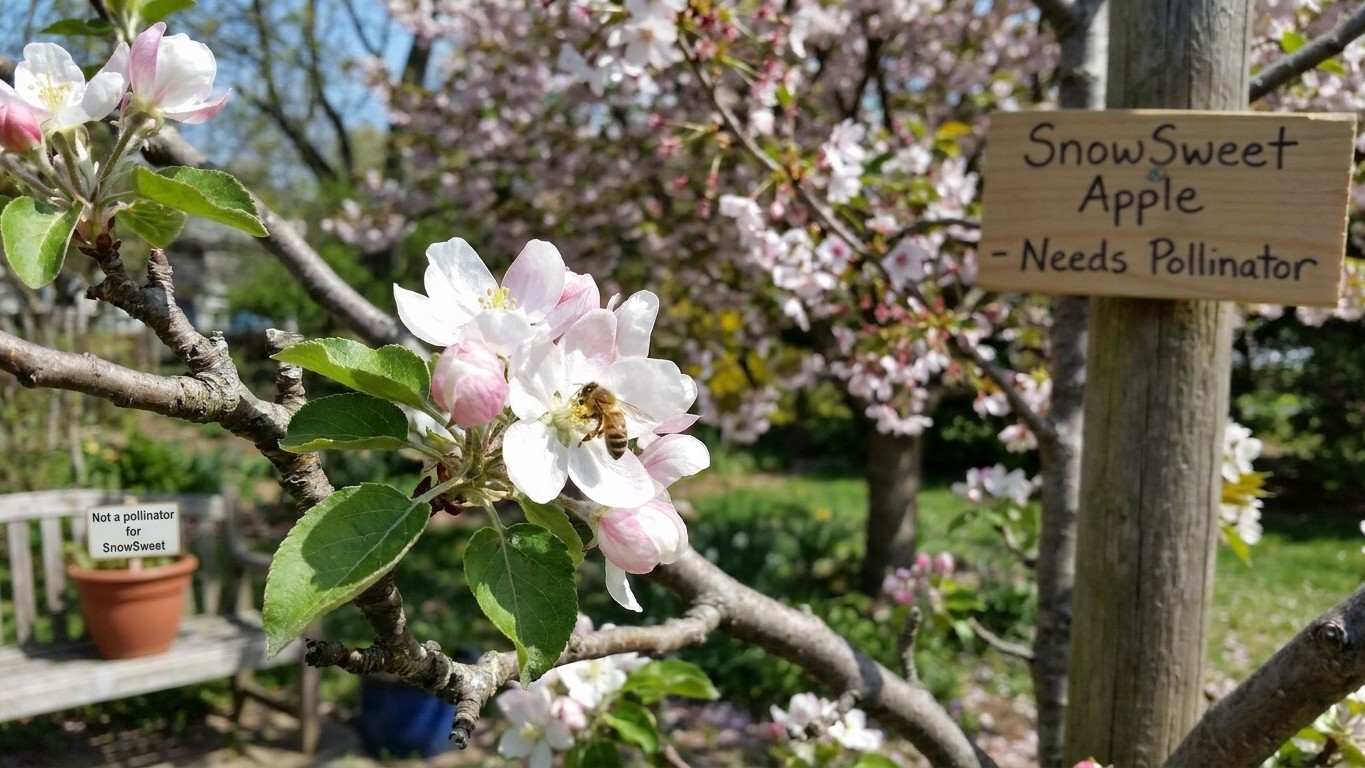

There isn’t a list telling you exactly which apple tree will pollinate your SnowSweet — but you don’t need one. SnowSweet blooms mid-season, so any second apple variety that also blooms mid-season, planted in that same yard, has a real shot at doing the job. What you do need to rule out is sterile pollen and shared parentage, either of which will quietly block fruit set no matter how well the bloom times line up. Start by asking your nursery which mid-season variety they’d pair it with.
The short answer
USU Extension’s guide to apple production for the Utah home garden does not publish a list of pollination partners for SnowSweet. That gap matters more than a name would. What is documented is the bloom timing: USU places SnowSweet in the mid bloom group, which narrows the search even without a name attached to it.
A partner has to open its flowers at roughly the same point in the season. Look for another apple variety carrying a mid-season bloom rating on its own catalog listing or extension sheet, and plant it within the same yard rather than somewhere convenient but distant.
On the tree count: nearly all apple varieties crop better with a compatible partner, and most home orchards need at least two trees to get a reliable set. Some varieties carry sterile pollen, meaning they can receive pollen from a neighboring tree but never return the favor. When a sterile variety is in the mix, the garden needs a third tree, because two sterile trees planted side by side will not pollinate each other even with perfectly matched bloom times. The USU sheet lists the pollen-sterile varieties by name—Jonagold, Mutsu, Stayman, and Winesap—and SnowSweet isn’t among them, so a two-tree layout works fine unless the partner you choose happens to be one of those sterile types, in which case a third tree becomes the safer plan. For the general mechanics behind all of this, see Apple Pollination.
Why these varieties and not others

What bloom group actually means
Bloom group is the mechanism behind every pairing recommendation, not just a label attached to a list of names. Two apple trees need overlapping flower time because pollen moves tree to tree mostly by bees, over a window that on most varieties lasts one to two weeks. Clemson Cooperative Extension describes bloom groups as a relative order, not a fixed calendar: an early bloomer in a cold spring region still opens before a mid bloomer in that same region, even though both dates arrive later than the same two varieties would in a milder climate. The rank holds from year to year and place to place. The calendar date does not.
That’s why USU’s rating for SnowSweet, mid bloom, tells you where it sits against other apple varieties without pinning a specific date to it. In zones 4-6, where USU places SnowSweet’s hardiness range, the exact week bloom opens will shift with the spring any particular year brings, but a mid bloomer will still open after the early varieties and before the late ones in that same yard, that same season.
Matching bloom groups gets you overlap. It does not get you compatibility, and that distinction is worth sitting with before you buy a second tree based on a bloom chart alone. Two trees can flower on exactly the same days and still set no fruit if one of them carries sterile pollen, because sterile pollen fertilizes nothing regardless of timing. Bloom group also says nothing about parentage. Two varieties in the same group can be entirely unrelated, or one can be a seedling raised from the other, and a seedling’s flowers cannot be fertilized by the parent that produced it. A bloom-group match is a necessary condition, not a full guarantee, and neither fertility nor parentage is settled just by knowing which group a variety falls into.
What cannot pollinate it
The two universal blockers
No variety specifically fails to pollinate SnowSweet. What can be stated, because it holds for every apple variety and not only this one, are the two situations that block pollination no matter how well bloom times line up.
The first is a garden built from two sterile-pollen varieties. Sterile pollen can be received but never given, so a tree with sterile pollen depends entirely on its partner to supply usable pollen. Plant two sterile varieties side by side, however well their bloom times match, and the garden sets no fruit, because neither tree can complete the other’s flowers.
The second is parentage. A variety bred from a single parent cannot be fertilized by that same parent, even when both flower in the same week and stand next to each other in the same row. This rule doesn’t get invoked often, because most home gardens mix varieties with no family relationship at all, but it’s worth knowing before buying two trees from the same breeding program on the assumption that a shared release date means a safe pair.
Beyond these two general rules, no source available here documents a variety that is specifically incompatible with SnowSweet. If a nursery or catalog claims otherwise, ask what that claim is based on, because a bloom chart alone doesn’t prove or disprove compatibility either way. For another variety where these same compatibility questions come up just as often, see What Pollinates Stayman, and What Cannot.
How close the second tree has to be

Why proximity beats a matching bloom chart
Pollen moves on bees, not on wind, so distance matters in a way that’s easy to underestimate on paper. A honeybee foraging on a mid-bloom apple tree tends to work that tree and its closest neighbors before moving on, so the second tree belongs in the same garden, not just the same street. A pollinator two properties over does less work than one twenty feet away, even if both are technically within range.
The second tree doesn’t have to be a SnowSweet-compatible cultivar you planted yourself on purpose. A neighbor’s apple tree flowering at the same time counts, provided it’s close enough for bees to move between the two yards during normal foraging. An ornamental crabapple blooming on the same schedule works too. Crabapples are common as street trees and yard ornamentals partly because many varieties flower at times that overlap with orchard apples, and bees don’t distinguish an ornamental bloom from a fruiting one. A grafted branch of a second variety, added onto the SnowSweet tree itself, does the same job without needing a second trunk at all.
None of that helps if the bees simply aren’t flying. Cold, wet, or unusually windy weather during the bloom window keeps bees in the hive regardless of how many compatible trees stand nearby, and no partner variety compensates for a week of bad weather at bloom. That’s a season-to-season risk every apple grower carries, SnowSweet included, and it’s part of why even a well-paired orchard doesn’t set a full crop every year.
If there is no room for a second tree
Weighing the trade-offs of each option
A small garden still has options short of planting a second full-size apple tree, though each comes with a trade-off worth knowing before committing.
- Multi-grafted tree: several varieties grafted onto one trunk, so a single footprint carries its own pollination partner built in. It costs more up front and needs yearly attention to keep weaker grafts from being shaded out by stronger ones.
- Pollinator branch grafted onto the existing tree: a single branch of a compatible mid-bloom variety added onto the SnowSweet tree itself. It’s cheaper than a second tree and takes no extra ground space, but the graft has to take, and grafting fails more often on a first attempt than a nursery-grown tree ever does.
- Columnar variety: a narrow, upright growth habit that fits where a standard tree’s canopy would not. It solves the space problem, not the pollination one. A columnar apple still needs a partner in bloom at the same time, exactly like any other.
- Ornamental crabapple: planted for its flowers rather than its fruit, timed to bloom alongside the apples already in the yard. It takes far less space than a second fruiting tree, but check the specific crabapple variety’s own bloom timing rather than assume every crabapple flowers early or late.
Whichever route fits the space, the underlying requirement doesn’t change: something with overlapping, fertile pollen has to sit within bee range of SnowSweet’s flowers during the weeks it blooms. For a comparison with a variety that has a fuller documented partner list, see What Pollinates Fortune, and What Cannot.
Common questions
Can I plant just one SnowSweet tree and still get apples?
Some fruit may set from wild bees carrying pollen in from a distant apple or crabapple, but a single tree with no compatible bloom partner within bee range usually sets a light and unreliable crop. Plant a second mid-bloom variety in the same yard if you want a consistent harvest rather than an occasional one.
Does a crabapple count as a real pollinator or do I need a full apple tree?
A crabapple counts, and many ornamental varieties bloom on a schedule that overlaps with mid-season apples like SnowSweet. Check the specific crabapple’s bloom timing before relying on it as your only partner, since crabapple bloom groups vary just as much as apple ones do.
Extension variety tables list only four pollen-sterile apple varieties—Jonagold, Mutsu, Stayman, and Winesap—and SnowSweet is not among them. Ask the nursery that sold you the tree, or contact your local extension office, before you rely on SnowSweet alone to pollinate a second variety.
Does SnowSweet’s fire blight resistance have anything to do with pollination?
No, they’re unrelated traits. USU rates SnowSweet as moderately resistant to fire blight, which concerns disease exposure in the tree’s wood and blossoms, not pollen fertility or bloom timing.
My SnowSweet bloomed earlier one year and later the next. Did I plant the wrong partner?
Not necessarily. Bloom dates shift year to year with the weather any given spring brings, while the relative order between bloom groups stays the same, as Clemson Cooperative Extension explains. A partner that overlapped last year should still overlap this year even if the actual calendar dates moved.