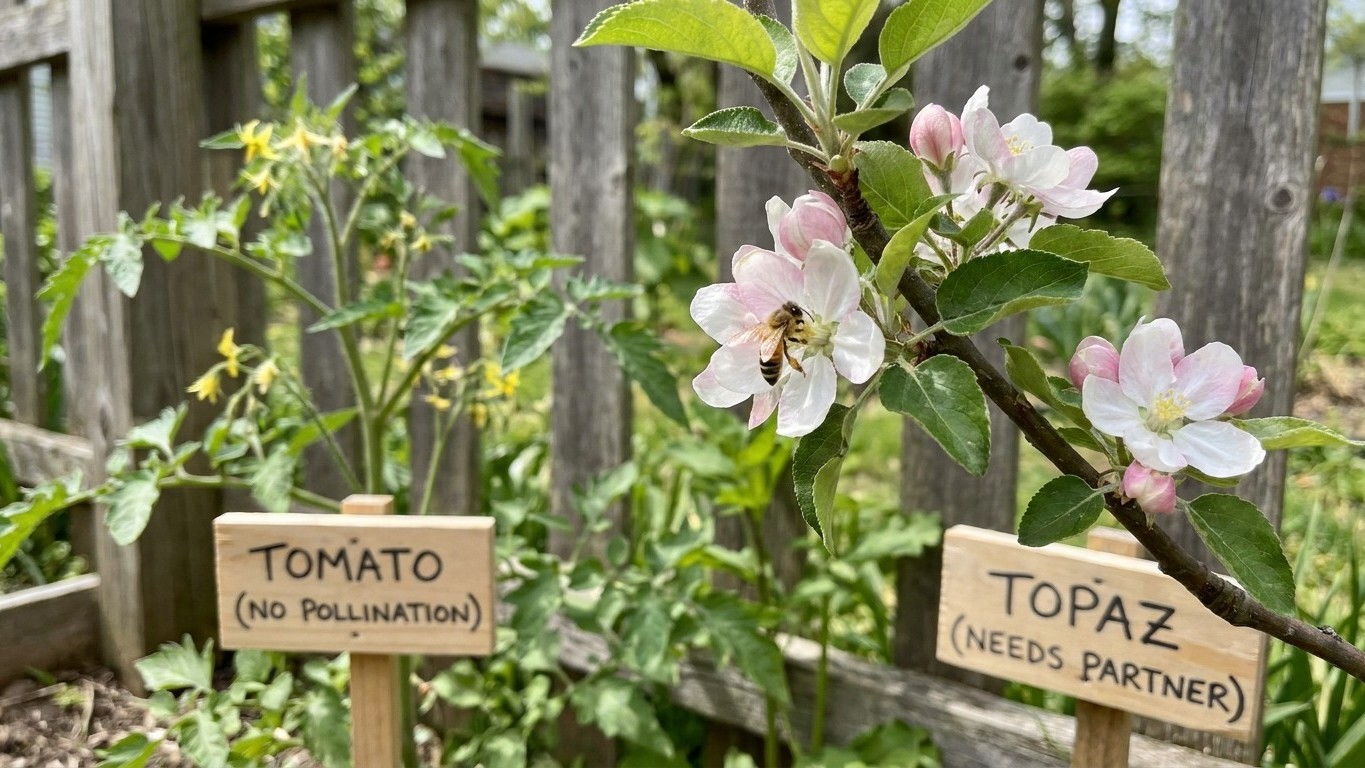

Topaz needs a second apple tree blooming at the same time to set a full crop, because its own pollen cannot fertilize its own flowers. USU Extension’s guide to apple production for the Utah home garden places Topaz in the Mid bloom season, but the publication does not include a list of compatible partner varieties for this cultivar. The action to take is simple: pick a second variety documented as a mid-season bloomer, then confirm the bloom overlap in your own yard before you commit to it as Topaz’s partner.
The short answer
There is no partner list for Topaz in the sources this page relies on, and it would be a disservice to invent one. What USU Extension does confirm is that Topaz is hardy in zones 4 to 8, ready for harvest from late September to mid October, and moderately resistant to fire blight. None of those facts tell you which variety will fertilize its blossoms. Only the bloom season does that, and Topaz’s is listed simply as Mid.
That means the safe approach is to choose a second apple tree known to bloom mid-season where you live, rather than reaching for a specific cultivar name that isn’t backed by a source. Nurseries and extension bloom charts for your region will tell you which varieties fall into that window locally, since the exact calendar dates shift with climate even though the relative order of bloom does not.
How many trees you actually need
The count depends on pollen fertility, and that is a separate trait from bloom timing. A variety with fertile pollen only needs one same-timed partner, for a total of two trees. A variety with sterile pollen, sometimes called a triploid, can accept pollen and produce fruit but cannot pollinate anything else in return. Plant a sterile variety next to just one partner and that partner gets no return pollination, so the safe setup becomes three trees: the sterile variety plus two pollen-fertile partners that can fertilize each other and it.
Pollen fertility for Topaz is not stated in the sources behind this page either. Until you confirm it with a nursery tag or a extension fruit variety list, plan as if a third tree might be needed rather than assuming two will do.
Why these varieties and not others

Pollination compatibility comes down to timing, not taste or color. Two trees have to be shedding pollen and receiving it on open flowers during the same stretch of days, and that shared stretch is what growers call a bloom group. Clemson Cooperative Extension describes bloom groups as a relative order, not a fixed calendar. A variety classed as early in one region blooms early relative to the others around it, even though the actual date moves earlier or later depending on that year’s spring and that region’s climate. Two mid-season varieties in Utah and two mid-season varieties in a warmer state won’t flower on the same date, but within each place they’ll still overlap with each other.
That relative structure is exactly why Topaz’s Mid classification from USU Extension is useful even without a partner list. A grower can go looking for other mid-blooming varieties sold locally and expect real overlap, rather than guessing from a date on a tag.
What bloom-group overlap does not guarantee
Sharing a bloom group only confirms timing. It says nothing about whether the pollen itself is fertile, and it says nothing about parentage. Two varieties can bloom in the same window and still fail to pollinate each other, either because one of them is pollen-sterile or because one was bred from the other. A seedling cannot be fertilized by the parent tree it came from, even if their flowers open on the same day, because the genetics are too close for fertilization to succeed.
None of this is meant to discourage matching by bloom group. It is the correct starting point. It just is not the whole test, and a grower who stops at “they bloom together” before checking pollen fertility and parentage can end up with two trees that never set fruit for each other.
What cannot pollinate it
This is the question worth the most caution, because a wrong guess here costs a whole season of fruit. Our sources for Topaz do not name a sterile-pollen variety sharing its bloom group, and they do not document a parentage exclusion for this cultivar. Rather than fill that gap with a plausible-sounding name, the honest answer is that compatibility beyond bloom timing is not published in the sources behind this page.
That gap does not mean anything goes. Two general rules still apply and are worth checking against any candidate partner before you plant it next to Topaz.
- A variety with sterile pollen can be fertilized by Topaz, but cannot fertilize Topaz back, so it never counts as Topaz’s sole partner.
- A variety bred as a seedling of another cannot pollinate that parent, regardless of how closely their bloom dates line up.
If a nursery or catalog lists a candidate partner as a known sterile triploid, treat it the same way you would treat any sterile variety anywhere: fine as a third tree in an orchard that already has two fertile, overlapping bloomers, but not sufficient on its own next to Topaz. And if a candidate is marketed as a Topaz sport or seedling selection, check its ancestry before assuming it will fertilize the tree it came from.
Growers comparing notes across varieties will find the same caution applies elsewhere. The page on What Pollinates Winesap, and What Cannot walks through a case where a documented sterile partner actually is on record, which shows what that kind of exclusion looks like when a source does confirm it.
How close the second tree has to be

Pollen for apples moves on bees, not on wind, so distance matters far more than it would for a wind-pollinated crop. The general rule among growers is closer is always better: a partner tree in the same garden bed gets visited by the same foraging bees far more reliably than one across a property line or down the street. There’s no published maximum distance in the sources behind this page, so treat “same yard” as the target rather than “same neighborhood.”
What else can do the job
A dedicated partner tree isn’t the only route to a bee visiting both sets of blossoms. A neighbor’s apple tree blooming at the same time can pollinate yours across a fence line, provided bees are actually moving between the two. An ornamental crabapple flowering on the same schedule works as well, since crabapples are excellent pollen sources for apples and many nurseries sell them specifically for that purpose. A single grafted branch of a compatible variety, added onto an existing tree, is another option that skips planting a whole second tree.
What stops it regardless of partner
None of that helps if bees aren’t flying. Cold or wet weather during bloom keeps bees in the hive, and no partner variety, however well matched on timing, can compensate for pollinators simply not working that week. A grower who did everything right on variety selection can still lose the crop to a rainy bloom week, which is a weather risk rather than a pollination-compatibility problem and worth telling apart from the questions this page otherwise answers.
If there is no room for a second tree
A small garden does not have to mean no fruit, but every workaround here trades some effort for the convenience of not planting a second full tree, and it is worth being clear about what each one does and does not solve.
- Multi-grafted tree: several varieties grafted onto one trunk, so the tree pollinates itself internally. It solves the space problem completely but takes more pruning attention to keep each graft’s growth in balance.
- Pollinator branch grafted into the existing tree: a single limb of a compatible variety added onto the Topaz tree itself. Cheaper and faster than a second tree, but that branch needs to actually be blooming at the right time, which still comes back to matching bloom season.
- Columnar variety: a narrow, upright growth habit that fits into a tight bed as a true second tree. It solves the footprint problem but is still a full separate tree that needs its own bloom-timing check against Topaz.
- Ornamental crabapple: planted purely for pollen, not for its own fruit. Cheap and often decorative, but only useful if it flowers at the same time as Topaz, which is the same overlap question as any other partner.
None of these options change the underlying rule. Whatever you choose still has to be checked for bloom-season overlap and, where documented, pollen fertility, the same two things a full second tree would need to satisfy. For a broader look at how these choices play out across varieties, the general primer on Apple Pollination covers the mechanics behind all of them, and the page on What Pollinates Gold Rush, and What Cannot shows how the same small-garden options apply to a different cultivar with its own published constraints.
Common questions
Can I just plant two Topaz trees together?
No. Two trees of the same variety bloom at the same time but cannot fertilize each other, since a variety’s pollen does not fertilize its own flowers regardless of how many trees of it you plant.
Will a crabapple in my neighbor’s yard count as a pollinator?
It can, if it blooms at the same time as Topaz and bees move between the two properties. Distance and weather during bloom both affect how reliably that happens.
How do I find out if Topaz’s pollen is fertile or sterile?
Check the nursery tag or catalog listing where you buy the tree, since that trait is usually noted there. It is not documented in the USU Extension source this page relies on.
Does fire blight resistance affect pollination at all?
No. USU Extension’s rating of Topaz as moderately resistant to fire blight is about disease, not fruit set, and has no bearing on which varieties can pollinate it.
My Topaz tree bloomed but set almost no fruit. What went wrong?
The most common causes are a missing or poorly timed partner, a cold or wet spell during bloom that kept bees away, or a partner too far away for bees to visit both trees. Check bloom overlap and weather during that specific window before assuming the variety itself is the problem.