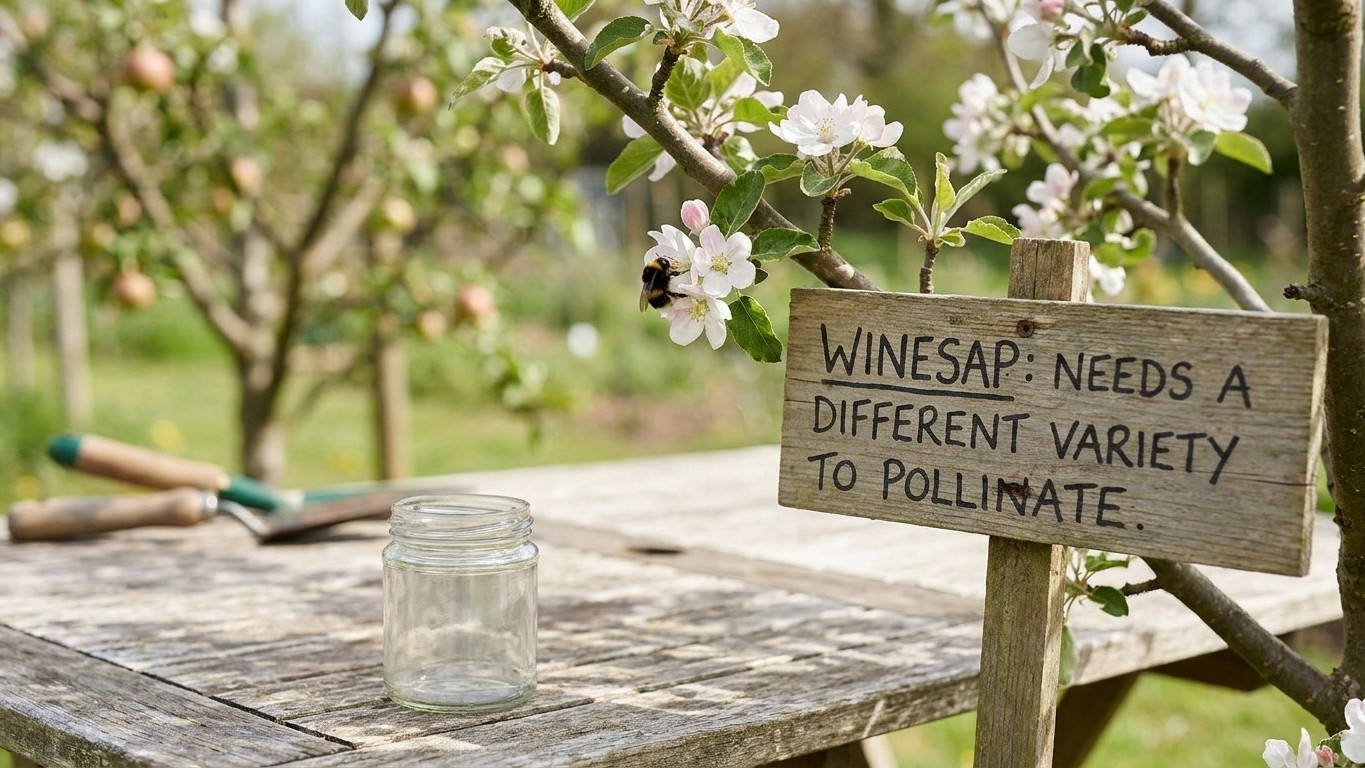

Winesap cannot pollinate itself or any other apple tree. USU Extension lists its pollen as sterile, so it produces none that another tree could use to set fruit. Winesap still needs pollen from a different late-blooming variety to produce its own crop, but USU does not publish which variety that should be for this cultivar. The action that follows: plant two other apple varieties near Winesap, not just one, so a fertile pair can pollinate each other as well as feed pollen back to Winesap.
The short answer
That Winesap in your yard won’t set fruit off its own flowers or off another Winesap, full stop — its pollen is sterile, so it can’t do the job even for itself. What it needs is a different, late-blooming variety flowering at the same time to pollinate it. So don’t just add one neighbor tree: plant two other apple varieties nearby, a fertile pair that can pollinate each other while one of them feeds pollen back to your Winesap.
The sterile pollen changes the arithmetic on tree count. A garden built around a fertile variety usually gets by with two trees, because each can pollinate the other. Winesap cannot return the favor. Plant Winesap next to a single fertile late-blooming variety and that variety pollinates Winesap fine, but the fertile tree itself gets nothing back and may crop poorly if it has no other pollen source nearby. A garden built around Winesap needs three trees total: Winesap itself, a fertile late-blooming variety to pollinate it, and a second fertile variety to pollinate that one in return.
This is different from most apple pairings, where two named varieties simply need to be planted together. For the general mechanics of matching bloom times and choosing a compatible pair, Apple Pollination covers the groundwork. Once you have that groundwork, the Winesap-specific problem is narrower: find two other late-blooming varieties that overlap with each other and with Winesap, and accept that no source names the third leg of that triangle for you. A local nursery or extension office can usually tell you which late-blooming varieties are commonly grown and in bloom together in your area, since that overlap depends on climate even though USU’s late-bloom classification for Winesap itself does not change from place to place.
Why these varieties and not others

What a bloom group actually means
Apple varieties are sorted into bloom groups so growers can match flowering times without needing an exact calendar date, because Clemson Cooperative Extension describes these groups as a relative order, not a fixed date. In a warm spring the whole sequence shifts earlier, in a cold one it shifts later, but a variety that shares a bloom group with another still overlaps with it wherever you garden. A late bloom group in one region might open in the back half of the season locally, while a nearby area with a longer or shorter frost window sees the same group shift by a week or more, without changing which varieties belong to it. Winesap’s late bloom group means it needs a partner that also flowers late, not a variety that finishes blooming before Winesap even opens.
What overlap does not guarantee
Sharing a bloom group is necessary but it is not enough on its own. Two varieties can flower at exactly the same time and still fail to pollinate each other, for two separate reasons. The first is pollen fertility: a variety in the same bloom group as Winesap might itself have sterile or otherwise unreliable pollen, in which case overlapping flowers accomplish nothing. The second is parentage: a variety bred directly from another cannot fertilize its own parent, because the two share too much of the same genetic makeup for cross-pollination to trigger fruit set. Overlapping bloom tells you the flowers are open at the same time. It does not tell you whether the pollen inside those flowers will actually work.
This is why a tested partner list, where one exists, matters more than a bloom chart alone. A bloom chart gets you to the right window. A tested partner list confirms the pollen inside that window actually sets fruit on the other tree. For Winesap, USU’s published record stops at the bloom group and the sterility of its own pollen. It does not extend to naming which fertile, unrelated, same-group variety has been tested against it, which is exactly the gap the next section deals with.
What cannot pollinate it
Saying otherwise here would be a guess, so the honest answer is that compatibility beyond the facts already stated is not documented in USU’s record for this cultivar.
What is documented, and worth restating plainly, is the general rule those hypothetical cases illustrate. If a grower planted Winesap next to a second variety that also happened to have sterile pollen, neither tree would set a useful crop no matter how perfectly their bloom overlapped, because sterile pollen offers nothing to fertilize either flower. The same logic would apply if Winesap were planted next to one of its own parent varieties, though no such parentage is listed in USU’s notes for Winesap specifically. Either failure mode looks identical in the orchard: flowers open together, bees visit both trees, and the crop still fails, because the problem sits in the pollen, not the timing.
- Sterile pollen on both trees: flowers open together, bees visit both, but neither pollen source works.
- Parent and seedling planted together: bloom overlaps, but the seedling’s pollen is too closely related to fertilize its own parent.
- Undocumented pairing: no known conflict, but also no confirmation, since USU’s record does not test every possible combination against Winesap.
This is the part of pollination planning that gets skipped most often, because a grower sees two trees blooming together and assumes the job is done. Some varieties come with a documented, tested partner list that removes the guesswork entirely, such as Yates. Winesap does not have that kind of documented list, which is exactly why the three-tree rule from the first section matters here. It protects you from the sterile-pollen and parentage failure modes even when nobody has published which specific varieties to avoid.
How close the second tree has to be

Pollen moves between apple trees on bees, not on wind, so distance is a practical question about where bees actually fly rather than a fixed number of feet. The closer the two trees, the more reliably a bee visiting one will visit the other on the same trip. A partner tree in the same garden bed works better than one across the yard, and one across the yard works better than one on the far side of a fence line, even if both technically sit within normal bee foraging range.
The partner does not have to be a tree you planted for this purpose. A neighbor’s apple tree in bloom at the same time can do the job, as can an ornamental crabapple flowering in the same window, since crabapples are apples and produce pollen bees carry just as readily. A single grafted branch of a compatible variety, added onto an existing tree, works too, and it solves the space problem without adding a whole extra tree to the yard.
What stops the job even with the right partner
None of this works if the bees are not flying. Cold or wet weather during bloom keeps bees in the hive regardless of how well matched the two varieties are or how close together they stand. A perfectly timed, perfectly placed partner tree still sets no fruit if a cold, rainy stretch lands exactly on the days both trees are in flower. No amount of variety selection fixes a bloom-week weather problem, which is one reason commercial growers sometimes bring in rented hives during bloom rather than relying on wild pollinators alone.
If there is no room for a second tree
A small garden does not have to skip apples entirely, but each workaround trades one problem for another. A multi-grafted tree, carrying several varieties grafted onto one trunk, puts a compatible partner in the same root system as Winesap without needing a second planting hole. It takes longer to establish than a single-variety tree and needs more careful pruning to keep each grafted variety from shading out the others.
Grafting a single pollinator branch onto an existing apple tree solves the space problem even more directly, since it adds flowers rather than a whole tree. It asks more of the gardener though: grafting takes a specific skill, the right scion wood, and a year or two before that branch flowers reliably.
A columnar variety takes up a fraction of the footprint of a standard tree and can be tucked into a bed that has no room for a full-sized second tree. It still needs to be a fertile, late-blooming variety to do Winesap any good, so the space saving does not remove the bloom-matching requirement covered above.
A flowering crabapple bought for pollination rather than fruit is often the cheapest fix, since many are sold specifically for this purpose and take up less space than a second apple tree. It will not give you a second apple harvest, only better fruit set on the Winesap already in the ground.
| Option | Effort | What it does not solve |
|---|---|---|
| Multi-grafted tree | Slow to establish, ongoing pruning | Still needs a fertile, late-blooming variety among the grafts |
| Grafted pollinator branch | Requires grafting skill, 1-2 years to flower | Adds pollen only, no second harvest |
| Columnar variety | Low space cost, normal planting | Bloom timing still has to match Winesap |
| Ornamental crabapple | Cheap, widely available | Produces no apple crop of its own |
Common questions
Can I use a crabapple to pollinate my Winesap?
Yes, as long as the crabapple flowers at the same time Winesap does. Crabapples are apples botanically and their pollen works on standard apple varieties, but bloom timing still has to overlap since a crabapple that finishes flowering early does no good.
Will two Winesap trees pollinate each other?
No. USU Extension lists Winesap’s pollen as sterile, so a second Winesap gives the first nothing to work with. Two Winesap trees planted together, with no third variety, set little to no fruit.
Does USU recommend a specific partner variety for Winesap?
No, USU’s variety record for Winesap does not name one. It documents the bloom timing and the sterile pollen, but the specific partner pairing is left for the grower to work out locally with a nursery or extension office familiar with what else is blooming nearby.
How many years before a new pollinator tree actually helps?
That depends on the tree’s size, rootstock, and how it was trained at the nursery. Ask the nursery selling the tree what bearing age to expect for its specific rootstock and form.
Can I just plant Winesap with Golden Delicious and call it done?
Only if Golden Delicious’s bloom window overlaps with Winesap’s late bloom and Golden Delicious itself has a fertile pollen source nearby, since Winesap cannot supply one back. Check What Pollinates Golden Delicious, and What Cannot for what Golden Delicious itself needs before assuming the pair is complete.