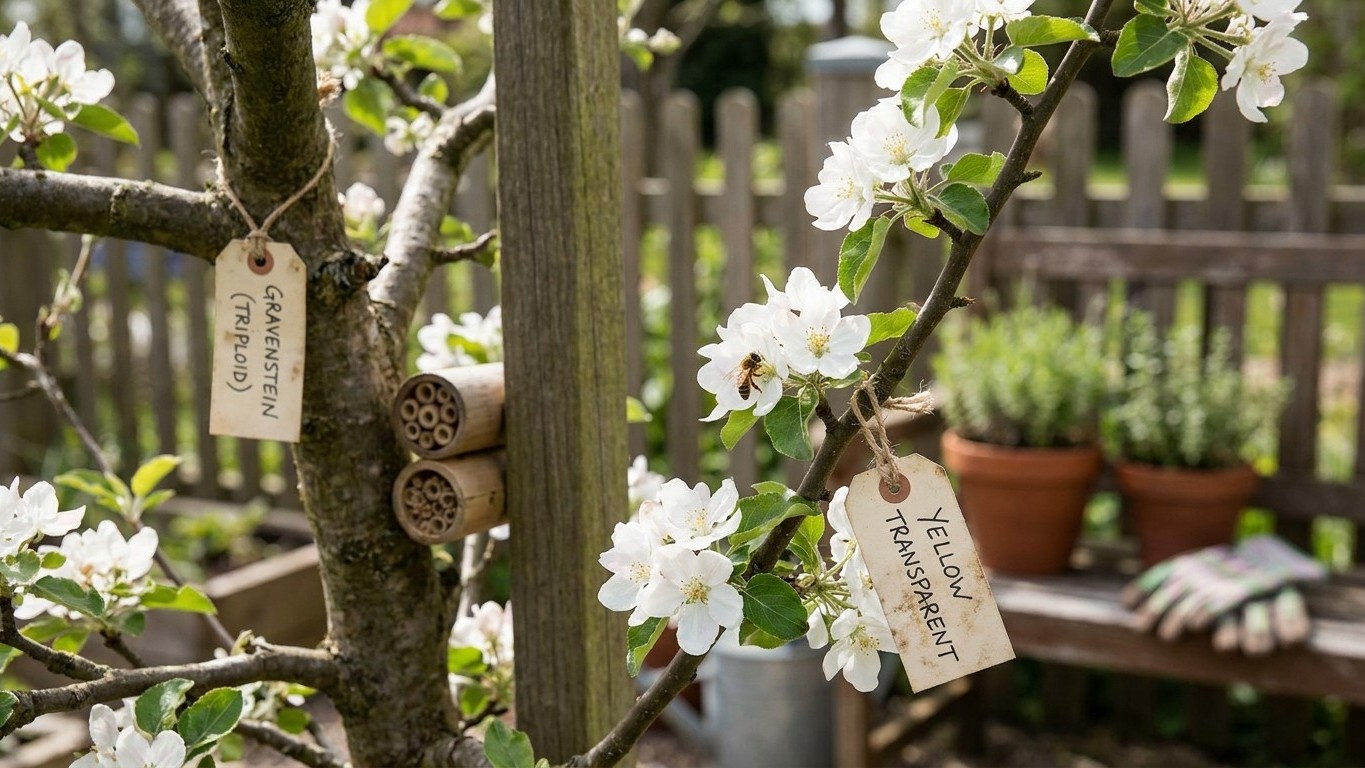

Yellow Transparent blooms early, according to USU Extension’s Apple Production for the Utah Home Garden guide, but that same source does not publish a named pollination partner for this variety. The solid fact you do have is the timing itself: whatever tree you pair it with has to flower in that same early window. Before buying anything, check the bloom season listed for the candidate variety, not just its name on the tag.
The short answer
Yellow Transparent will pollinate, and be pollinated by, any apple that flowers in that same early window it does — that’s the whole rule, since no named partner comes with this variety. The catch is nobody’s handed you the partner’s name, so bloom timing is the one thing you actually get to lean on. Go check the bloom season listed for whatever tree you’re eyeing, not the name on its tag.
What USU’s notes say, and don’t
The guide is specific about zones, bloom season, harvest window and susceptibility to fire blight, but the partner column for Yellow Transparent is blank in the source available here. That is not the same as Yellow Transparent needing no partner at all. Nearly all apple varieties crop better with a compatible partner nearby, and a lone tree with no other apples or crabapples flowering anywhere close will typically set a lighter, spottier crop than the same tree with company.
What to do instead of guessing
Pick any variety that a state extension service lists with an Early bloom rating for your region, and plant it close enough for bees to move pollen both directions. If that partner turns out to have sterile pollen, remember it can still be fertilized by Yellow Transparent, but it cannot return the favor, so a two-tree planting built around a sterile variety will leave one or both trees light on fruit. In that case, add a third tree with fertile pollen so every tree in the group has a fertile source nearby. If you have not worked through the basics yet, start with apple pollination in general, since bloom timing eliminates more candidates than any other single factor.
Why these varieties and not others

Two apple trees cross-pollinate only when their flowers are open on the tree at the same time. That window is what a “bloom group” describes: an ordering of early, mid-season and late bloomers that Clemson Cooperative Extension uses to sort varieties for pairing purposes.
A relative order, not a calendar date
The bloom group is relative, not fixed to a date. An early bloomer in a warm valley might open its flowers weeks ahead of an early bloomer in a colder pocket a few counties over, because temperature drives bloom timing far more than the calendar does. What stays constant from one climate to the next is the sequence: an early-season variety opens before a mid-season one, wherever both are grown, even though the actual dates shift year to year and place to place. That’s the reason Yellow Transparent’s Early rating from USU tells you its position in line without giving you a day to circle on the calendar.
What overlap does not guarantee
Sharing a bloom group is necessary but not sufficient. Two varieties can flower together and still fail as a pair, because overlap says nothing about whether either tree’s pollen is actually capable of fertilizing anything. A variety can bloom right on schedule and still carry pollen that is genetically sterile. Overlap also says nothing about parentage. Two varieties can share a bloom window and still be parent and offspring, in which case they remain unable to pollinate one another, a rule covered fully in the next section. The bloom group narrows the shortlist. It doesn’t finish the job. Anyone working through the same question for a different variety, such as the pairing rules covered for Zestar or Granny Smith, runs into this same two-part check: match the bloom group first, then verify the rest.
What cannot pollinate it
USU’s guide does not name a sterile-pollen variety sharing Yellow Transparent’s bloom group, and it does not document a parent-offspring exclusion for this variety either. Rather than invent a specific pairing the source doesn’t give, it’s worth separating what is documented from what general apple-pollination rules still apply regardless.
No named exclusions in this source
If a future update to USU’s variety notes, or another state extension’s trial data, publishes a sterile-pollen partner or a parentage link involving Yellow Transparent, that would change this section. As things stand, that detail simply is not published here, and stating one anyway would be a guess dressed up as a fact. It’s also worth mentioning fire blight in this context: USU rates Yellow Transparent as susceptible, and because the disease can spread through open blossoms during bloom, the same insects moving pollen between trees can carry infection between them too, which is one more reason to watch bloom-time weather and orchard hygiene together, not just pollination.
General reasons a tree fails to pollinate
A handful of rules apply to every apple variety, Yellow Transparent included, regardless of what the extension notes say about it by name:
- A single Yellow Transparent tree cannot pollinate itself; most apple varieties are self-incompatible.
- A second Yellow Transparent tree does not help either, since it shares the same genetics and counts as the same variety rather than a cross.
- A variety blooming late in the season misses Yellow Transparent’s early window entirely and cannot fertilize it, whatever its pollen quality.
- A seedling grown from Yellow Transparent’s own seed cannot pollinate its parent tree, and the reverse holds too. This is a general apple-breeding rule, not something specific to this variety.
None of that is a partner list. It’s a filter for ruling out obvious mismatches while you wait on better documentation, or while you ask a local extension office directly whether any pairings involving Yellow Transparent have actually been tested in your area.
How close the second tree has to be

Pollen moves on bees and other insects, not on wind, so distance is a practical question about insect traffic rather than a technical radius. The rule that matters is simple: closer is better, and same garden beats same street.
What else can carry the job
A dedicated partner tree in your own yard is the surest arrangement, but it isn’t the only route to fruit. A neighbor’s apple tree blooming at the same time can pollinate yours if bees regularly cross the gap between the two properties, which is far more likely on a quiet residential block than across a busy road or a wide field. An ornamental crabapple flowering in the same early window works too, since crabapples produce plenty of viable pollen and are a common trick for tight yards that can’t spare a second full-size tree. A single grafted branch of a compatible variety, added onto the existing tree, also does the job without needing a whole extra tree taking up ground space.
What stops pollination outright
Weather during bloom matters more than distance ever will. Cold, wet or heavily windy conditions keep bees from flying, and if that stretch lines up with Yellow Transparent’s open bloom, no amount of nearby partner trees fixes it that year. A well-placed partner cannot compensate for a bad-weather bloom week. It can only raise the odds on the days bees are actually out and working.
If there is no room for a second tree
A small yard doesn’t rule out pollination. It just changes which trick you reach for.
Options and their tradeoffs
| Option | Effort | What it doesn’t solve |
|---|---|---|
| Multi-grafted tree (several varieties, one trunk) | Buy once, no extra planting space needed | Still depends on the right bloom-group varieties being grafted on; a wrong combination wastes the slot |
| Pollinator branch grafted onto the existing tree | Moderate; needs grafting skill or a hired hand | Takes a season or two before there’s enough flowering wood to matter |
| Columnar apple variety planted alongside | Low; fits a narrow bed or a large container | Still a second tree to buy, plant and water on its own root system |
| Ornamental crabapple flowering at the same time | Low; many are already sold as landscape plants | Produces no apple crop of its own |
A multi-grafted tree solves the space problem most completely, since it puts several bloom-compatible varieties within reach of the same insects on a single root system. A grafted-in pollinator branch costs less if you already own a mature tree, but it takes real time to grow enough flowering wood to matter. None of these substitutes for checking bloom timing first, and none of them changes the tree’s eventual size on their own. Rootstock is what sets that, not the variety, so a dwarfing rootstock is what actually keeps any of these options manageable in a tight yard.
Common questions
Does Yellow Transparent need a pollinator to make any fruit at all?
Most apple varieties, Yellow Transparent included, set a noticeably lighter crop without a compatible partner nearby. USU’s guide does not describe this variety as fully self-fruitful, so plan on a partner rather than counting on a lone tree to carry a full harvest.
Can I use a crabapple as the only pollinator?
Yes, as long as it blooms in the same early window and bees can move easily between the two trees. A crabapple won’t hand you an apple crop of its own, but its pollen fertilizes Yellow Transparent’s flowers just as well as another eating apple’s would.
What if my Yellow Transparent and its partner bloom a week apart?
A week’s gap can still work if the two bloom periods overlap even briefly, since individual flowers stay open for several days. A gap wide enough that the trees are never in bloom together at the same time rules the pairing out, whatever the bloom-group label suggested on paper.
Does the partner tree need to be on the same rootstock?
No. Rootstock controls the size of the tree, not its bloom timing or pollen compatibility, so a partner on a completely different rootstock works exactly as well as one matched to the same rootstock.
Is a wild apple tree down the road good enough as a pollinator?
It can be, if it blooms early enough and bees travel regularly between the two sites. There’s no way to confirm its bloom group or pollen viability without watching it flower yourself over a season, so treat it as a bonus rather than something to plan a whole harvest around.