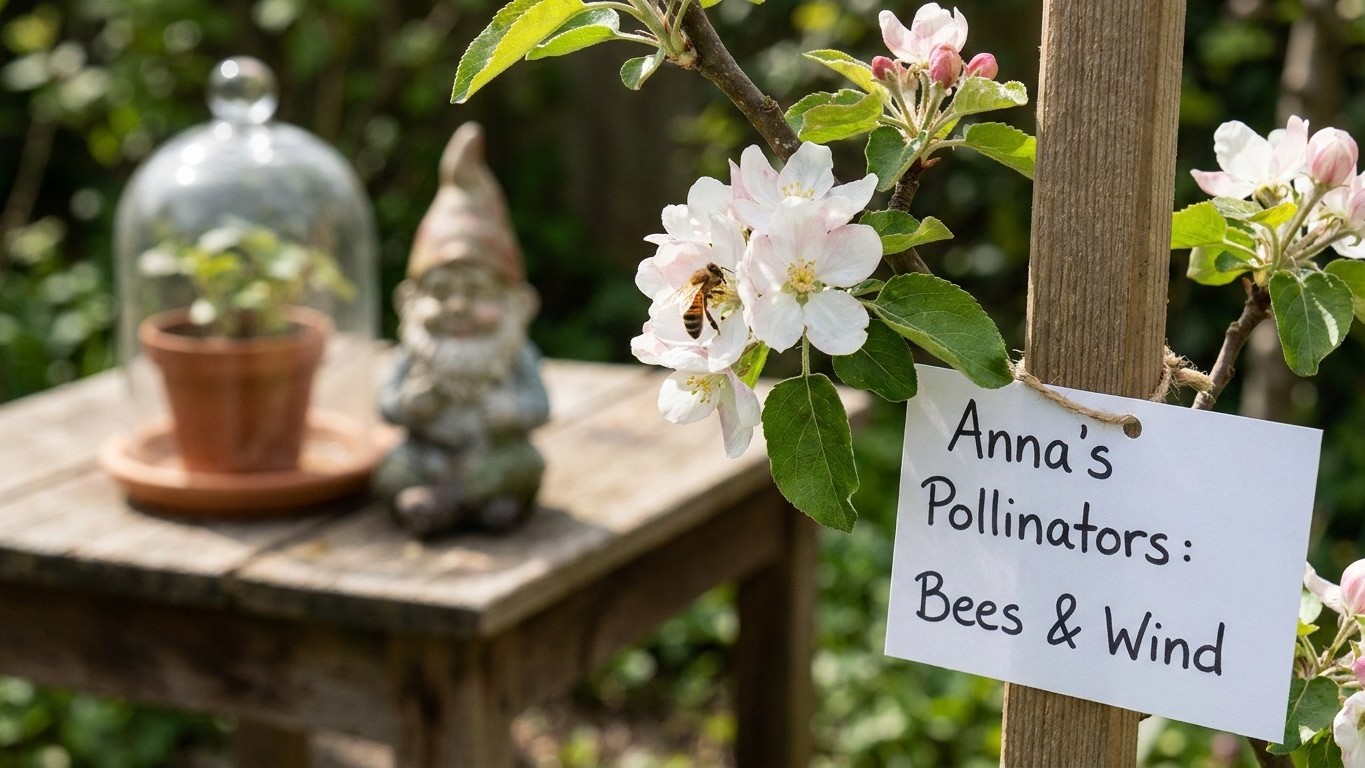

Anna needs a partner tree blooming at the same time, and that partner is Dorsett Golden. Plant it close enough for bees to work both trees during that early bloom window, and Anna will set a full crop instead of a light one. If you’ve only got room for one tree right now, plant Anna anyway — it’ll still bear some fruit off a neighbor’s apples or crabapples — but plan for Dorsett Golden as soon as you can.
The short answer
The variety to plant next to Anna is Dorsett Golden. It’s the only partner named in the extension literature covering this pairing, and it shares Anna’s bloom group A timing, which means the two trees flower in the same window rather than missing each other by weeks.
How many trees you need
Two trees is the target: one Anna, one Dorsett Golden, planted close enough that bees move between them during the bloom window. Nothing in the published record marks Anna’s pollen as sterile, so it can do its share of the work returning pollen to Dorsett Golden the same way Dorsett Golden pollinates it. That two-way exchange is why two trees, not three, is the usual setup for this pair. A third tree only becomes necessary when one partner produces sterile pollen and needs a second pollen source of its own, which is not the case documented here for either Anna or Dorsett Golden.
Nearly all apple varieties crop better with a compatible partner nearby, Anna included, and a single Anna tree standing alone will usually still produce some fruit in a mixed neighborhood with other apples or crabapples in range. It just won’t be the reliable, full crop that a dedicated partner tree gives you. For the mechanics behind why apples need this kind of partner at all, see Apple Pollination.
Why these varieties and not others

Bloom group is a timing label, not a compatibility guarantee on its own. Clemson HGIC 1350 assigns Anna to group A, meaning it’s among the earliest apples to flower in a season, and Dorsett Golden shares that same group. Two trees in the same bloom group open their flowers on overlapping calendar days, which gives bees the chance to carry pollen between them while both are receptive. Miss that overlap and the flowers close before any pollen moves, whatever the label on the nursery tag says.
What bloom group A does not promise
The letter grouping is a relative order, not a fixed date. Clemson’s own guidance is explicit that the sequence of bloom groups holds from one growing region to the next, but the actual calendar date within that sequence moves depending on the climate a tree is grown in. A grower in a colder pocket sees group A bloom later on the calendar than a grower in a warmer one, yet Anna still opens ahead of a variety in group C in either place. Part of what drives that calendar shift is dormancy. UF/IFAS document MG368 puts Anna’s chill requirement at 250 to 300 hours for north and north-central Florida, and the pace at which those hours accumulate each winter is one of the things that nudges bloom earlier or later within the group.
Sharing a bloom group also says nothing about pollen quality or ancestry. Two varieties can flower in the same week and still fail to set fruit together if one of them carries sterile pollen, or if one is a direct parent or seedling of the other. Bloom timing gets the flowers open at the same time. It doesn’t decide whether the pollen that lands is any good, or whether the tree it lands on is genetically willing to accept it.
What cannot pollinate it
No sterile-pollen partner and no parent-seedling exclusion is known for Anna. That’s a real gap worth naming rather than guessing past. What the wider apple world does show clearly is the general shape of the problem: a triploid variety, one bred with an extra set of chromosomes, produces pollen too irregular to fertilize anything. Jonagold is a well-known example of a triploid apple, and a grower who wants to know exactly what does and doesn’t pollinate it can check What Pollinates Jonagold, and What Cannot for that variety’s own requirements. A triploid can still accept pollen and fruit well, but it can never repay the favor, so it never counts as the second tree in a two-tree planting.
What’s not published
The same caution applies to parentage. A variety bred from Anna, or a variety Anna itself descends from, would not be able to complete pollination with it even if the bloom dates matched perfectly, because a seedling and its own parent share too much genetic material to fertilize each other reliably. If a nursery tag or catalog claims a specific exclusion for Anna beyond Dorsett Golden’s compatibility, treat that claim as unverified until a state extension service backs it, and check with a local extension office or the source itself before ruling a variety out. A grower comparing notes on a different low-chill favorite can see the same kind of caution applied on What Pollinates Mollie’s Delicious, and What Cannot.
How close the second tree has to be

Pollen moves on bees, not wind, on apples, so distance is really a question of how far a forager is willing to fly between flowers. The closer the two trees stand, the more reliably bees carry pollen between them in one visit. Planting Dorsett Golden in the same yard as Anna beats planting it across the street, and planting it across the street still beats not having it within flight range at all.
What else can do the job
Dorsett Golden isn’t the only thing capable of carrying pollen to Anna’s flowers in practice, even though it’s the only variety named in the extension literature. Anything blooming at the same time and visited by the same bees can contribute:
- A neighbor’s apple tree, if it’s in bloom on overlapping days
- An ornamental crabapple flowering in the same window
- A pollinator branch grafted onto an existing tree nearby
None of that is a substitute for confirming the pairing works. It’s a reason not to panic if a compatible variety happens to be two doors down instead of in your own bed.
What stops it
Cold, wet, or windy weather during the bloom window keeps bees from flying at all, and no pollen partner compensates for a week of bees staying home. This is the most common reason a well-paired planting still sets a light crop some years: the trees were fine, the timing was fine, but the pollinators simply weren’t working that week.
If there is no room for a second tree
A small garden doesn’t have to give up on Anna, but every workaround here trades effort for space rather than eliminating the need for a partner entirely.
| Option | What it gives you | What it doesn’t solve |
|---|---|---|
| Multi-grafted tree | Several varieties, including a partner, on one trunk | Still needs bees moving between the grafted branches |
| Pollinator branch graft | Adds a partner’s flowers directly onto Anna’s own canopy | Takes a season or two to establish and bloom well |
| Columnar variety | Fits a partner into a narrow footprint | Still a separate tree needing its own root space |
| Ornamental crabapple | Compact, decorative, blooms alongside many apples | Only works if its bloom window actually overlaps Anna’s |
Whichever route you take, the goal is the same one a second full-size tree would achieve: flowers open on Anna and on a partner at the same time, close enough for bees to move between them.
Common questions
Can Anna pollinate itself?
Plant a compatible partner rather than relying on one tree alone.
Does Anna need a specific rootstock to pair well with Dorsett Golden?
Rootstock controls the size of the mature tree, not whether its flowers overlap with another variety’s. Choose rootstock based on the space you have and check with the nursery supplying your trees, since that choice is separate from the pollination question.
Will a crabapple actually pollinate Anna, or is that just a myth?
A flowering crabapple can carry pollen to Anna if its bloom overlaps in timing and bees are working both trees. It isn’t guaranteed the way a named compatible variety is, so treat it as a backup rather than a first plan.
I planted Dorsett Golden last year and still got almost no apples, what went wrong?
Young trees often bloom late or lightly in their first couple of seasons, so the pairing may simply not have matured into overlapping bloom yet. Weather during the bloom window matters too. Cold, wet spells keep bees from flying regardless of how well the two varieties are paired.
Can I use Anna to pollinate a different low-chill apple, or does it only take pollen?
Confirm the specific pairing on that other variety’s own pollination guidance before relying on it.