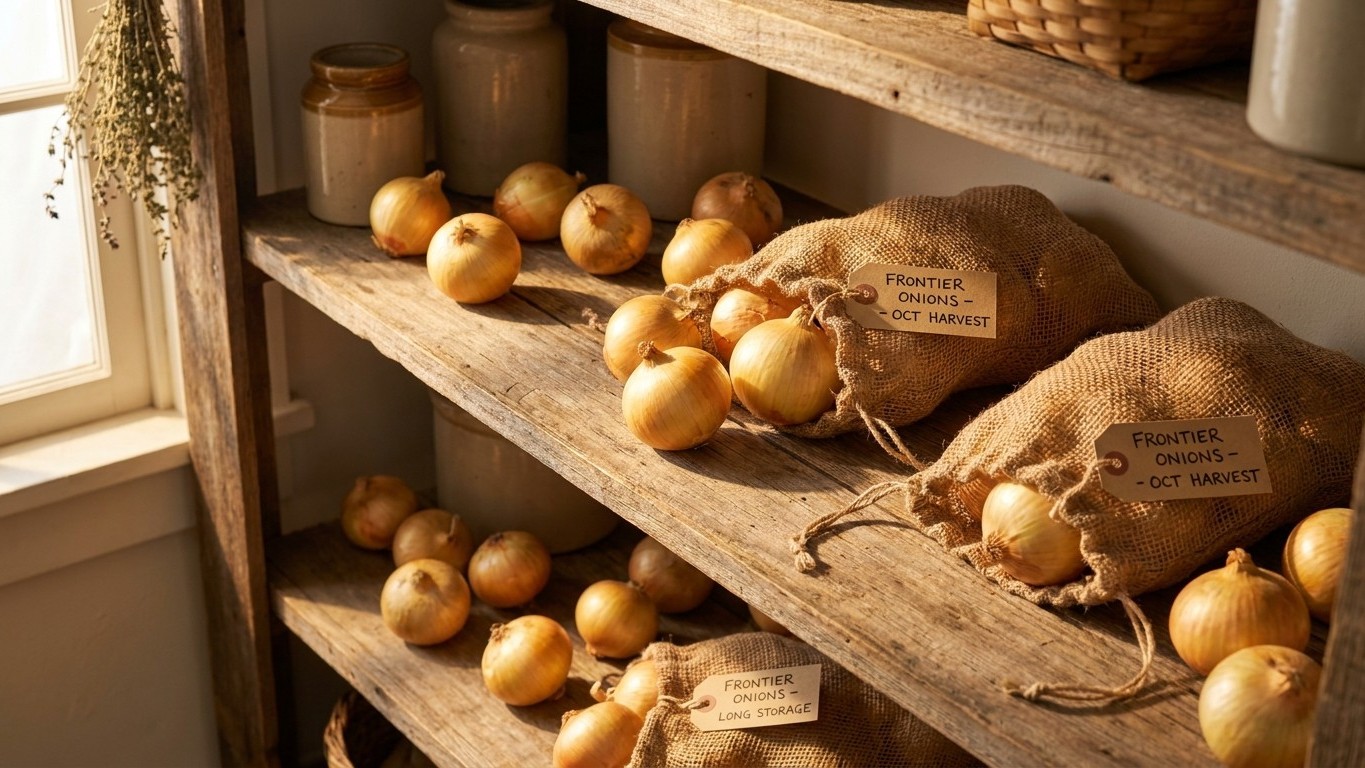

Frontier is a long-day yellow onion built for storage, not for salad bowls. It bulbs reliably between 40 and 50 degrees north latitude, matures around 100 days from transplant, and holds in the pantry for six months or more. That combination, sharp flavor and long keeping, makes it a workhorse variety for northern growers who want onions in March, not just in August. Whether it works for you depends on one thing first: where you garden.
Will Frontier bulb where you are

Frontier belongs to the long-day group, and that single fact decides everything else on this page. Long-day onions need 14 to 16 hours of summer daylight to trigger bulb formation, which is exactly the kind of daylight you get between roughly 40 and 50 degrees north latitude, a band running from about the Nebraska-Kansas line up through the northern tier of states and into southern Canada.
Here is the part that trips up a lot of gardeners: bulbing is triggered by day length, not by heat. It feels backwards, because we associate onions with sun and warmth. But the mechanism is photoperiod, plain and simple. The farther north you go, the longer the summer days stretch, and the more reliably a long-day variety like Frontier gets the daylight signal it needs to stop making leaves and start making a bulb.
Plant Frontier south of that 40-degree line and something predictable happens: the days never get long enough. The plant keeps pushing out green tops all season, because it’s still waiting for a signal that never arrives strongly enough. You don’t get a small onion. You get no bulb at all, just a thick-necked plant that, if you try to store it, rots from the neck down within weeks.
If you’re gardening near 40 degrees north, in states like Kansas, Missouri, or Virginia, you’re in the blurred zone. Frontier may bulb decently in a warm year with a long enough season, or it may disappoint. That’s not a guarantee either way, and no seed catalog can promise otherwise. Gardeners in that zone are usually better served checking with a local Cooperative Extension office, since day-length response can shift slightly by microclimate and elevation.
What Frontier is like
Frontier is a catalog-standard storage onion: yellow skin, round to slightly flattened shape, medium-large bulbs, ready about 100 days after transplant. None of that is opinion, it’s the baseline data every grower should know before planting.
- Color: Yellow
- Days to maturity from transplant: 100
- Day-length group: Long-day
- Keeping time: 6+ months
The flavor is sharp, and that’s not a flaw, it’s the point. Onion pungency comes from sulfur compounds, the same volatile chemicals that make your eyes water when you slice one. Those compounds aren’t just about bite. They’re also what protects the bulb’s cell structure during months in storage, slowing down the rot and sprouting that end mild onions’ shelf life early.
This is a trade-off, not a coincidence, and it’s worth understanding rather than memorizing as a rule. A sweet onion, the kind you’d eat raw on a burger without flinching, has low sulfur content. That’s exactly why it doesn’t keep. Frontier sits at the other end of that spectrum: sharp raw, but built to last. Don’t expect it to mellow into something mild by Thanksgiving. It won’t, and that’s by design. If you want an onion that’s pleasant eaten raw in July and gone by September anyway, look at a sweet short-day type instead. Frontier is for the cook who wants onions in the pantry through winter and into spring, sharp every time it’s sliced.
When to plant it
Planting time for onions isn’t fixed to a date on the calendar, it follows the day-length group, and that surprises a lot of first-time growers who expect one answer nationwide. Short-day onions, grown mostly in the mild-winter South, go into the ground in fall and get harvested the following late spring. Long-day onions, Frontier among them, follow the opposite calendar.
Since Frontier is long-day, it goes in the ground in late winter to early spring, as soon as soil can be worked, typically four to six weeks before your last expected frost. That gives the plant a full spring and early summer to build leaf mass before the long days of June trigger bulbing.
Here’s the test that matters more than any planting date: the plant needs to be reasonably sized before day length flips the switch to bulb formation. Onion physiology is unforgiving on this point. Whatever size the tops are when bulbing triggers, that’s roughly the size of onion you get. A stunted, weedy, or late-started transplant that’s still small when the solstice daylight hits will make a small bulb, no matter how much you baby it afterward. The bulb doesn’t catch up later in the season; the window for growth closes the moment bulbing begins.
That’s why timing your planting early enough, and giving transplants or sets time to establish real root and leaf growth before late spring, matters more than hitting an exact calendar day. If your local frost dates run late, starting onion transplants indoors six to eight weeks ahead, then setting them out as soon as soil is workable, closes that gap.
Growing it well
Onions are shallow-rooted, and that single trait explains most of what goes wrong in the onion patch. Their root system rarely goes more than a few inches deep, which means they compete poorly against weeds for both water and nutrients. A bed that’s even moderately weedy doesn’t just look messy, it directly steals the moisture and space Frontier needs to bulk up its bulbs. The result shows up at harvest as undersized onions, not as wilted plants, because the damage happens underground, week after week, long before it’s visible above.
Consistent moisture matters for the same reason. Because the roots can’t reach deep reserves, a dry stretch during bulb development doesn’t get compensated for later. Skimping on water during the weeks leading into bulbing typically shows up as smaller, sometimes misshapen bulbs at harvest, not as obvious drought stress on the leaves.
Bolting is the other issue worth watching for. A plant that sends up a flower stalk has shifted its energy from bulb storage to seed production, and a bolted onion will not keep in storage no matter how well it’s cured. The bulb around that flower stalk develops a woody core and breaks down fast. The fix isn’t complicated: if you spot a flower stalk forming, pull that onion and use it right away rather than adding it to your storage batch. Bolters are for tonight’s dinner, not for the pantry shelf.
Harvesting and keeping it
Frontier tells you when it’s ready without needing a calendar. The tops fall over on their own, flopping down at the neck as the plant shifts from active growth to dormancy. That’s the signal to watch for, not a target date counted from planting. Pulling onions early, while the tops are still upright and green, gives you smaller bulbs and onions that won’t cure or store properly.
Curing is the step most home gardeners skip, and it’s usually the reason their stored onions rot within weeks instead of lasting months. The process is simple but non-negotiable: the necks need to dry down until they’re papery and tight before the bulbs go into storage. A soft, green, or spongy neck is an open door for bacteria and mold once onions are stacked in a bin or braided for the pantry.
The sequence, start to finish, looks like this:
- Watch for the tops to fall over naturally in the field, that’s the harvest signal.
- Pull the bulbs and let them cure in a warm, dry, well-ventilated spot out of direct sun, typically on a screen or spread on a porch, for one to three weeks.
- Check the necks: they should feel dry and papery, not soft or green, before you move on.
- Trim the dried tops and roots, brushing off loose soil without washing the bulbs.
- Store cured bulbs in a cool, dry, dark space with airflow, mesh bags or slatted crates work better than sealed containers.
Frontier’s payoff for that patience is six-plus months of storage life, according to catalog data for the variety. In practical terms, that’s the difference between an onion supply that runs out by the holidays and one that carries a household through winter and into the first weeks of spring planting. An onion that only keeps three months gets eaten within its own season. One that keeps six months becomes a pantry staple, sharp every time you reach for it, but still solid long after the garden itself has gone quiet for the year.