
Bloom timing against a frost window that runs into late April is what decides a Missouri apple crop, not the winter cold before it. Kansas City’s coldest nights average 19.6F, and nearly every cultivar sold at a nursery shrugs that off without damage. What it can’t shrug off is opening flowers into a freeze that still has a 30-70% chance of showing up as late as April 20. A tree forty feet up a slope avoids that more often than one sitting in the low corner of a yard.
The short answer for Missouri
For the Kansas City area, NOAA’s NCEI 1991-2020 climate normals put the last spring freeze at 32F between April 6 and April 20, and the first fall freeze in the same 30-70% probability band between October 18 and October 29. Counting between the far ends of those two ranges gives a frost-free window of roughly 180 to 205 days, and that range, not a single picked date, is what a planting plan should work from.
Winter cold rarely kills an apple tree here. NOAA’s 1991-2020 normals put the average low in the coldest month at 19.6F at the Kansas City reference station, and most apple cultivars sold through a nursery catalog are rated hardy well below that, often to -20F or colder. The tree comes through winter fine. What decides the crop is whether bloom, which lands inside or close to that April frost window, gets caught by a late freeze.
The real answer depends on three things: which variety is planted and when it blooms relative to the local frost window, whether the winter delivered enough chill hours to bring that variety into flower evenly, and where on the property the tree sits. A tree in a low spot that collects cold air blooms into frost more often than one on a slope forty feet up the same hillside. Bloom timing against the local frost window matters more than the date on a nursery tag or a seed catalog. Anyone choosing between cultivars for a new planting should weigh that before anything else, a comparison covered in The Best Apple Varieties for Missouri.
Every figure above comes from the Kansas City reference station, and a location north, south, or at a different elevation runs on a shifted version of the same calendar, covered in the next section.
Working through it

| Stage | Visual cue | Task |
|---|---|---|
| Dormancy | Bare wood, buds tight and dark | Prune, apply dormant oil |
| Green tip | Green leaf tissue shows at the bud tip | First scab spray on susceptible cultivars |
| Pink | Unopened flower cluster shows color | Last pre-bloom spray window |
| Bloom | Petals open | Watch for frost, protect if a freeze is forecast |
| Petal fall | Petals drop, tiny fruitlet visible | Fertilize, begin insect sprays |
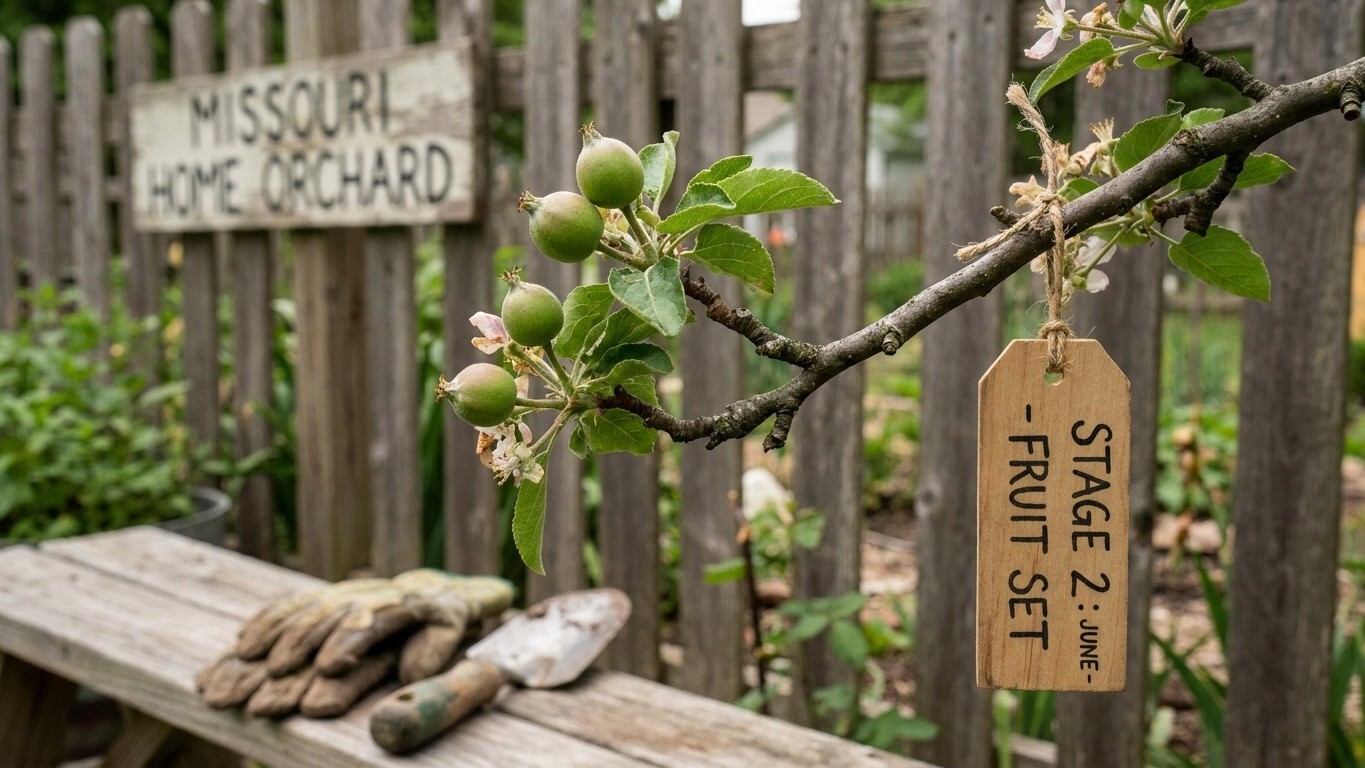
| Fruit set | Fruitlets sizing up in clusters | Thin clusters, continue disease cover |
| Harvest | Fruit reaches mature color and size for the cultivar | Pick before the first fall freeze |
Dormancy through pink
Dormancy runs from leaf drop in fall through late winter, and it is the only stretch where a tree can be pruned hard without triggering new growth that a freeze could kill. Dormant oil for scale and mite eggs goes on before buds swell, on a day above freezing with no rain expected for the following day.
Green tip is the first visible stage: bud scales part and a sliver of green leaf tissue shows at the tip. This is driven by accumulated warmth in the wood, not a fixed date, so the calendar is only a rough guide. Once green tip shows, scab-prone cultivars need their first fungicide cover, since the fungus infects through exactly this new tissue.
Pink stage follows as the flower cluster expands and the unopened petals show color before the bloom opens. This is the last point to apply anything that isn’t safe for pollinators, because bloom is only days away.
Bloom through harvest
Bloom is the stage that decides the year, because it sits inside or close to the Kansas City area’s last-freeze window of April 6 to April 20, per NOAA’s NCEI 1991-2020 normals. An open blossom is far more frost-tender than a green tip or a ripening fruit, and a freeze that would do no damage two weeks earlier can wipe out the crop if it lands during bloom. Watch the bud stage on the actual tree, not a date on a calendar, once temperatures start climbing into the frost window.
Petal fall marks the point to feed with nitrogen and begin the insect sprays that protect the newly set fruitlet, since codling moth and plum curculio target fruit at exactly this size.
Fruit set is thinning time. Removing the smaller fruit from each cluster now improves the size and color of what’s left and reduces limb breakage later, and disease cover sprays continue through this stage on a schedule rather than a single application.
Harvest timing comes off the variety’s days-to-maturity from bloom, printed on the nursery tag or catalog listing, and it needs to finish comfortably ahead of the Kansas City area’s first fall freeze of October 18 to October 29, per NOAA’s NCEI 1991-2020 normals. A summer cultivar like ‘Lodi’ matures in roughly 70 to 80 days from bloom and is off the tree in high summer, well clear of that window. A late keeper like ‘Enterprise’ or ‘GoldRush’, both bred with scab resistance for long storage, needs closer to 160 to 180 days from bloom and is the variety most likely to still be hanging when that fall window opens, a timing tradeoff worth checking against The Best Apple Varieties for Missouri before planting.
What changes across Missouri
Every figure above comes from the Kansas City area, and it moves as you go anywhere else in the state. The NOAA NCEI normals used here are measured at Kansas City’s airport station, which sits well north of the city itself and runs colder in early spring than downtown. The downtown Kansas City station typically records its last frost about five days earlier than the airport figures above, so a tree in the urban core carries slightly less frost risk into bloom than one near the airport.
Southern Missouri, including the Ozark hills and the Bootheel down toward the Arkansas and Tennessee borders, runs milder again on top of that. A longer frost-free stretch there means bloom is less likely to land inside a damaging freeze, though it can also mean a long-chill cultivar bred for a colder winter doesn’t get the cold hours it needs to flower evenly. Northern Missouri trends colder than the Kansas City reference figures, with a later last frost and an earlier first freeze in most years, which tightens the whole calendar from both ends at once.
Site matters as much as latitude. Cold air is heavier than warm air and drains downhill at night, so an orchard in a low field or the bottom of a valley collects that cold air and blooms into frost more often than a tree forty or fifty feet higher on a slope with open air movement below it. A river bottom near the Missouri or Mississippi can trap fog and cold air on a still spring night even when a hillside a mile away stays clear. None of the NOAA figures above account for that microclimate, because a reference station can only describe the ground it sits on, not the low corner of a particular orchard.
The mistakes this climate punishes
An early-blooming cultivar planted without checking the local frost window is the most common failure. A variety chosen for its early bloom, or grown from a seedling with unknown bloom timing, can open flowers well before the Kansas City area’s last-frost window of April 6 to April 20 closes, and a freeze that lands on open bloom can take an entire year’s crop in a single night. Bloom timing has to be checked against the local frost window before a cultivar goes in the ground, not after the first bad spring.
A long-chill cultivar bred for a much colder climate is the opposite mistake, and it shows up differently. Missouri’s winters, with the Kansas City area’s coldest-month average low sitting at 19.6F per NOAA’s 1991-2020 normals, are cold enough for hardiness but rarely brutal, and a variety that needs a long, deep winter to break dormancy evenly can flower late, thin, or over an extended and uneven stretch in a mild year. The symptom is a scattered, weak bloom rather than a clean one, and it shows up as a lighter-than-expected crop even when no frost ever touched the orchard.
Feeding a tree late in the season carries a specific cost here. Nitrogen applied in mid to late summer pushes soft new shoot growth right when the tree should be hardening off for winter, and that soft growth is the first thing killed when the first fall freeze arrives between October 18 and October 29 at the Kansas City reference station. The damage shows up as blackened shoot tips the following spring and, in a bad year, dieback that costs a season of framework growth on a young tree.
Pruning too early, in late winter before the coldest nights have passed, is a smaller version of the same problem. A hard cut opens the tree to cold air and can push the wound tissue to break growth earlier than it should, right into a stretch that still has weeks of frost risk ahead of it. The safer window sits late in dormancy, close to green tip, once the worst of the cold is behind the tree rather than in front of it.
Checking this against your county
Every date and figure in this piece comes from the Kansas City reference station, and the actual numbers for a specific county, especially one at a different elevation or further north or south, can run several days to two weeks off in either direction. The University of Missouri Extension keeps county-level guidance and can confirm local frost risk, chill accumulation, and cultivar performance for a specific address rather than a statewide average.
Before locking in a bloom-sensitive cultivar or a spray calendar built on the dates above, a call to the county extension office is worth the ten minutes, especially for a first orchard where a wrong guess costs a full season rather than an afternoon. Find the local office through Missouri Extension, and mention the steps already covered in Growing Apples in Missouri so the conversation starts from where the planting already stands.
Common questions
How do I know what stage my apple tree is in right now?
Look at the buds themselves rather than the date. Tight, dark buds mean dormancy, a sliver of green at the tip means green tip, and color showing through the unopened cluster means pink is close. There’s no substitute for walking out and checking, since the same week can put one cultivar at pink and another still fully dormant.
Will one late frost during bloom kill the whole crop?
Not always. A freeze right at the coldest point of bloom can kill open flowers outright, but flowers at slightly different stages within the same cluster or the same tree often survive at different rates, and a partial bloom on a tree can still set a partial crop. The severity and duration of the cold, not just the fact that a freeze happened, decides how much survives.
Do I need two different apple trees to get fruit?
Most apple cultivars need pollen from a different variety blooming at the same time, since a single tree of one variety alone usually sets little or no fruit. A crabapple with overlapping bloom timing works as a pollinizer if there isn’t room for two full-size trees, but it has to actually be in flower at the same time as the main tree.
Why did my tree bloom two weeks earlier this year than last year?
A warm stretch in late winter or early spring pushes bloom forward, and a cool, slow spring holds it back, so the same tree in the same spot can shift its bloom date by two weeks or more from one year to the next. That’s exactly why this calendar is built around frost dates and growth stages rather than a fixed month, and why an early warm spell is worth watching closely rather than treated as good news on its own.